Here is the follow-up to my first Unicorn blog
This morning around 6 am while checking my e-mail I noticed that the unicorn mantis was ignoring some fluttering fat moths and instead anchored itself head down in a very neat symmetrical pose. Next time I looked up, the back skin head split open and the new, very large, bloated body was pushing itself out. Everything was still hanging only by the tarsi of the hind-legs, and even those were just an empty shell when the emerging Mantis freed its legs.
Three green triangular wing-buds were now clearly visible on the thorax. From its size and proportions I had thought that I collected the nymph during the last instar but now I began to wonder whether this wing-budded version would be followed by another molt?
Afraid that our swamp-cooled interior might be too cool for an exotherm creature that chose the morning after our record breaking 107 degree of June 2, 2012, I took the container with me for our usual breakfast on the patio.
Halfway through breakfast I noticed that the wing bud had sprouted into a long, sweeping veil of lime-green wings that were nearly fully inflated.
Insect wings are soft and vulnerable at this point, so I removed the mantis from the confining container to let her dry her wings with only the pressure in the wing veins and gravity as the forming forces.
After the wings were fully extended, two dark blotches appeared very slowly on each front wing which had been just lime-green in their earliest teneral state. The hind-wings turned dark. Drying, hardening and reaching the mature coloration took all of the afternoon and the following night.
The next morning the mantis was constantly hanging belly up from branches. When I sprayed the terrarium with water, she immediately left her perch to lick up all water droplets she could find. A couple of hours later she was finally ready to eat as well. She grabbed several moths that I offered. In the picture she is holding a freshly hatched Tent Caterpillar Moth
Sunday, June 3, 2012
Wednesday, May 30, 2012
Evening Walk with Cody, Snakes, Lizards and Hawks
On the evening of Memorial Day my dog Cody and I took a walk into the State Trust Land to the north of our property. A little rattler by the side of the road enjoyed the evening sun - the day had been surprisingly cool.
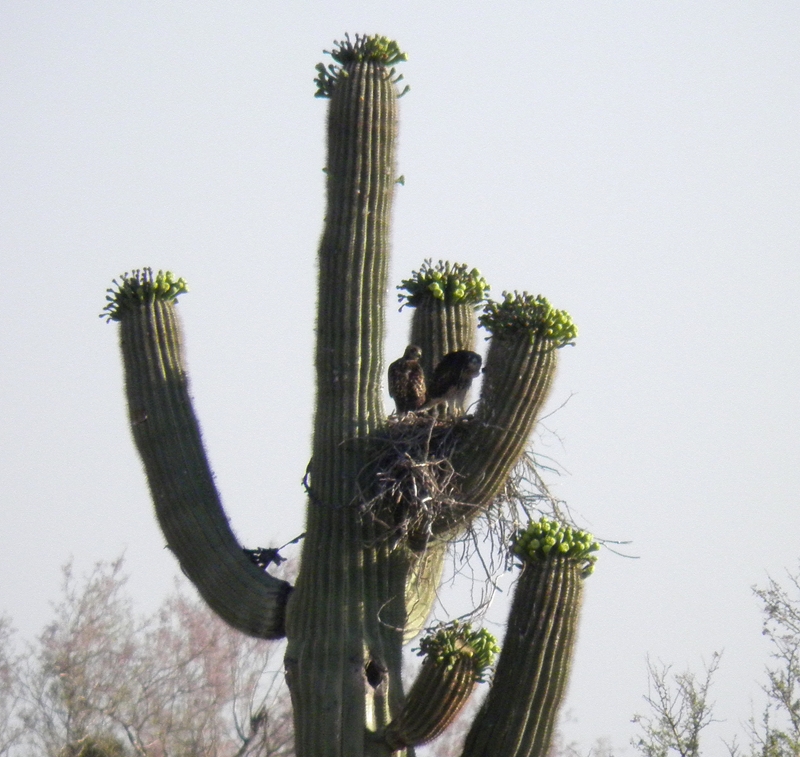
Cody and I were really out there to check on the Red-Tails one last time. After one chick was on the ground on the 18th, and back with his sibling on the 20th, Randy and I found only one chick in the nest and the mother calling from a close by saguaro on the 25th. After that it got so windy and dusty that nobody wanted to be out there for a couple of days. By now, we expected that they were all fledged. Sure enough - in the picture you see the saguaro with the empty nest.
But when I swung my binoculars left, to a mistletoe clump in the Ironwood Tree - there they were: two very grown up Red-tail chicks, still meeting a sunset curfew! I had noticed before that I was more likely to find the older chick in the nest at night than in the morning.
I found a feather and stuck it in my hat as a good bye. It's from a big raptor, maybe the male red-tail, the female's secondaries seemed much darker than this.
.
By popular request: Hawk-watching Cody. He looked very different when he pointed at the rattler, but I don't have the nerve to take a photo before calling him off.
Sunday, May 27, 2012
Unicorns Do Exist
Hi, I'm a Unicorn Mantis from Molino Basin, Catalina Mts, close to Tucson, Arizona. I am having a small identity crisis. I'm still a nymph, even though I'm more than 5 cm long, or would be, if I ever stretched my body, which I don't because the curl of my abdomen is part of my shape-dissolving camouflage.
Here I am before I was discovered for stardom. My agent has good eyes, don't you think? Where do those grapevine twigs end and my endless legs begin? And when the wind shakes the vines I even add my own confusing little sway, almost sure to throw a predator or camera out of focus.
So here I posed in the open for some beauty shots. I do know my angles! And always turn both my eyes to the camera - after all, I'm one of the few insects with binocular vision and a head that rotates on its neck just like yours. This unique ability also sets me apart from my youngest siblings as a sign of my maturity.
Far from being a pious 'Praying Mantis' like my Mediterranean cousin, I love Latin dancing and could conduct any symphony orchestra without a baton with my innate rhythm and great arms.
Let me not conceal my weapons, though: these are raptorial and deadly when unfolded. I don't even have to pursue my prey. The wariest moths and grasshoppers will walk right into my embrace.
Just observe what it takes to make me disappear again! Just some dry branches, and a little motionless patience!
Now lets add a natural background that isn't just white: wouldn't you walk into the trap?
But back to my identity crisis: Am I an Arizonan (Pseudovates arizonae) or a Mexican Unicorn (Phyllovates chlorophaea)? Supposedly we are easier to separate as adults and the ranges of the species do not overlap, with the Mexican staying in Texas and the Arizonan living in Arizona. But I need to ask the scientists who divided us not just into two species but into two distinct genera: was that politically motivated???
![]() |
| Pseudovates arizonae ootheca hatching. 22 July, 2014. Rio Rico, Santa Cruz Co. AZ, photo and copy right Tony Palmer |
Nothing could soothe those identity problems better than this reminder of my roots. Weren't we adorable?
See more pictures and the rest of the story here
Labels:
Pseudovates arizonae,
Unicorn Mantis
Sunday, May 20, 2012
Scary interlude
Two days ago before breakfast we went to visit the Red-tail nest. Something was different: the female wasn't as usual high up in the sky, but in a saguaro close to the nest. Sporadically she screamed at me - that was not so unusual.
But then, there was only one lonely chick in the nest. It seemed to be the smaller of the two. Doesn't he look unhappy? Like he was left behind?
Sure enough, the other chick had left the nest. He was sitting not far away out in the open - looked very much like he had sailed off the nest, but couldn't really fly yet.
| May 18th, 2012 |
Feisty and healthy looking, he threw himself on his back to show me his needle sharp talons when I approached. I have worked at raptor rehabilitation stations here and in Germany. We received many little guys like that. Even if they start eating, which they usually do, they often arrive with broken pinion feathers and don't learn to fly properly because those are not replaced before the next molt - in a year I believe. I checked him out and put him under a shady tree right next to the nest saguaro. His mother was right there, if the sun didn't kill him, he had a chance.
But for two days, I wondered whether I shouldn't have brought him to a rehabilitation center. I do believe that a lot of chicks that well-meaning people pick up would survive just fine where they were found. I also knew that he was vigorous enough to fend off a coyote - they have easier prey right now and will not risk any injury. He was used to the sun because there wasn't much shade at the nest either. If he stayed under the tree he might also escape the great horned owls who seem to be hunting closer to our little mountain lately anyway. And yet...
This evening I finally made up my mind to find out what happened. I really dreaded going out there. Around sunset the adults are often nowhere to be seen, so at least I wouldn't upset them. From a great distance, I could see a chick standing tall in the nest. But - there seemed to be another dark shape with him. It could have been the ugly black plastic bag sticking up? Or the mother? I walked in a wide circle to get better light. Finally it was quite clear: the older chick had made his way back up into the nest, he (or she) had even reclaimed her favorite spot on the west side of the roost. She couldn't have climbed up, she must have flown, short wings or not. Maybe she managed to climb up the tree and then fluttered back from an elevated spot..
| May 20th, 2012 |
Tuesday, May 15, 2012
Incubation Sonoran Desert Style
Yesterday I watched a male Curve-billed Thrasher bringing food to his nest in a Cholla Cactus. I was surprised to find the female actually on the nest, even though the chicks were clearly big enough to make a lot of noise. Her feathers were all fluffed up, the wings spread out, and she was panting strongly.
But she kept her chicks tightly covered by her body. At least until they heard me and worked their way out from under her wings to start begging with wide open yellow bordered beaks.
Like mammals, but unlike most other animals, most adult birds are homeotherm (with a few exceptions like hummingbirds and swifts undergoing temporary states of torpor) which means that they regulate their body temperature (42C or 105F in birds). To achieve this, they have to maintain a constant equilibrium between metabolic heat production and heat loss to the environment. Behavior is an important element of their thermoregulation, like seeking sunshine or shade. But birds and mammals have a great, if costly advantage over ectotherm animals like reptiles: they can regulate their body temperature independently of the environment through autonomous mechanisms. If the heat loss is greater than the resting heat production, muscle shivering is used to increase heat production. The insulation of the body is adjusted through changes in feather or hair position (piloerection) and altered blood flow to the skin and extremities.
With high environmental temperatures or during high physical activity birds and mammals need to get rid of excess metabolic heat. They do that they employ evaporative cooling. Birds have no sweat glands, so their main cooling mechanism is the gular flutter (vibrating the thin, highly vascularized skin of the neck in the breathing airstream) and panting. Avian thermoregulation is very efficient and allows birds to inhabit a wide range of habitats from the arctic ice to the Sonoran Desert heat.
Developing eggs and young chicks (of the non-precocious species) need to be kept at the same core temperature of 42C for optimal development, but their regulatory systems are non-existent or underdeveloped. So the incubating parent has to provide the temperature regulation for eggs and young chicks. "Broody" birds develop special brood patches for this transfer of heat from their body to the eggs. In these areas of the bird's chest (abdomen and legs in Penguins) the feathers fall out to minimize the insulation between bird and eggs and an extensive vascular network develops in the skin because it is the blood that moves the bird's inner metabolic heat to the periphery and thus to the eggs. This is incubation as we people from temperate climates understand it.
At high-noon in May and June in Tucson you could literally fry an egg on the sidewalk (if there was one). At 3 pm I measured the temperature in a cholla next to the nest: just about 100F. A few degrees below the temperature of the fully sun exposed surroundings, but still too high for chicks with no insulation and an immature thermoregulartory system My thrasher demonstrated that under heat stress, the incubating bird actually provides cooling to the nestlings by using her own evaporative cooling system and keeping close contact with the chicks. During the hottest part of the day she was so reluctant to leave them that I could have touched her.
Cavity breeders like woodpeckers and our kestrels have chosen a quite controlled environment for their off-spring. Especially when the cavity is in a saguaro, which is really just a massive column of water, nest temperatures stay much higher than the cool desert night and up to 25C under the outside temps when the afternoon sun heats the desert to triple digits (E.J. Braun, 1987). The Gila Woodpecker female above also has chicks, but since the temperatures climbed over the 100 mark, she regularly waits out the hottest part of the afternoon outside the nest in the shade.
I went back to the trashers around 5:30 pm when the sun was lower and temperatures in the mid nineties felt quite pleasant to us Arizonans of over ten years. Sure enough, the chicks were sleeping in the depth of the scruffy nest bowl.
In a nearby tree the mother was preening her disheveled feathers and then took off for a drink from some saguaro flowers. She also regularly frequents the birdbath/quail block station in front of my studio window just around sunset. For at least the next three days, while temperatures were raising, the bird kept the exact same schedule. During this time the chicks grew in size and feathering at an amazing speed.
Galliform birds like quail use a different incubation trategy: Their precocious chicks can follow their parents within the hour after hatching. They are feathered, can move to optimally shaded micro-environments, drink water, and do most of their thermoregulation by themselves.
But even in this harsh desert environment all kinds of niches are used and the success of doves and thrashers who breed in the most obviously exposed nesting sites seems surprisingly high.
.
References: Metabolism and Water Balance of the Gila Woodpecker and Gilded Flicker in the Sonoran Desert. EJ Braun, University of Arizona Press, 1969

Sunday, May 13, 2012
The last chick to fledge
On May 9th wildlife biologist and photographer Bruce Taubert set up a blind in our backyard. At this time only one kestrel chick remained in the nest. Although it was constantly chirping and begging, only the male kestrel came to feed it a couple of times between 8 am and 12 pm. He was always in and out so quickly that it was hard to get a good shot, even with Bruce's great set-up. This was a day with very strange weather. Around noon the sky went from gray to black, there was dry lightning, and the wind grew into a steady gale of 50 mi per hour. Dust and sand were flying until the visibility was close to zero. I was glad that Bruce had given up his vigil around noon when there was nearly no activity around the nest.
The next day began with a clear Arizona sunrise. I was very happy to hear sounds from the nest where the last chick was demanding his breakfast. The feedings seemed to increase somewhat in frequency, maybe because there were more lizards out due to the better weather. We never saw the female again.
For three more days, the male kept supplying the single chick in the nest. This morning, on the 13th, I found the little guy sitting about 15 meters from the nest, sitting nice and upright in a bush, even though his eyes fell shut at times. Half an hour later he had disappeared. All day, there were ravens and the Cooper's hawk around...
But at dusk, when the Night Hawks came through on their daily migration to the river, I heard a begging call. Sure enough, the chick was back, close to the nest in the dead Palo Verde, asking the falcon like passers-by for hand-outs.
His dad was right there with some prey, and he stayed close by after the feeding, so I'm very hopeful for the little guy.
Tuesday, May 8, 2012
A Rescue
This afternoon the male kestrel was hanging around, not moving much, just intently staring. From the nest hole came begging sounds, but much weaker than before. I could see only one chick, and after a while I noticed that it was watching something on the ground in front of the saguaro.
There he was - one of the bigger chicks but still unable to fly and very tired. These chicks were nicely protected from predators while staying inside the saguaro arm that juts far out from the main trunk, but as soon as they leave the nest they are quite out in the open with nothing to climb up on and no way back.
We had no intention to interfere with nature, we only chased the ravens off a couple of times....and got very attached to these little falcons in this hard environment. This guy was definite coyote bait where he was sitting. They come by very night to taunt our dogs.
So I caught him with my shirt and stuffed him into the photo bag. Randy got the ladder and held it steady so I could teeter on it's top steps reaching up to the saguaro arm. I dropped the chick unceremoniously on his brother's head and covered the hole with my hand until they settled down. No photos of that adventure - we both had out hands too full.
We were being watched closely. The male never left his perch. But it didn't take long and two heads appeared at the nest entrance and two chirping voices demanded food. Father obliged - he got at least two more lizards in the waning light and just tossed them in - the chicks can do the rest by themselves now.
I have the feeling that this was one of the last times we have seen this family at the nest.
Subscribe to:
Posts (Atom)