Sunday, April 10, 2011

Orioles and April Rain

Costa's Hummingbird
Yesterday we got some much needed rain. Not just a short April shower, but long lasting 'female' rain as native Arizonans call the gentle, productive winter drizzle. Thunderous summer monsoon showers are called male rain.

Early during our breakfast all birds bravely kept feeding.


Female Oriole
But they began to look wet and disheveled, smeared with clumpy, sticky pollen. They didn't seem to enjoy the weather very much. When it is cold - yesterday we were in the high forties - most birds, like mammals, keep their body temperature up by shivering, and that costs energy. Only a few, among them hummers and swifts, can let their core temperature drop and go into torpor like lizards, but his happens usually only at night at even lower temps.


Bullock's Oriole
After breakfast on the patio we went inside to 'do our taxes'. It's that time of the year. So the roofed patio was left to the birds. Hummers were already hiding under the eves - no great photo op there. But:
An old cholla skeleton used to support a Mandevilla that didn't make it through the February freeze. It soon looked like a traditional Easter Tree, all decorated with Orioles instead of Easter Eggs.


 To my surprise Hooded and Bullock's Oriole males peacefully shared the cover. Usually they are very territorial and the Hooded succeeds in chasing the Bullock's out.  


 Obviously, he didn't feel up to it in that weather and concentrated on staying warm. Or does misery really like company?


Even though I'm aware of northern species of the genus, Orioles always strike me as visitors from a lusher, tropical world with sweet fruit and perennial sunshine. Our birds seem to agree with me.


I have no idea to which species of Oriole the female belonged. She didn't show any interest in either male.


Our Cactus Wrens always populate the patio,  sharing it with us and 5 big dogs. They even go through the pages of our newspaper on the table. But this guy looks wet and miserable, too.

Update: today it's sunny, but chilly with frost on the roof, and the Orioles are happily mobbing each other with angry keck-keck-krrreck calls.

Friday, April 8, 2011

True Bugs on Cactus

True bugs suck!

There are times in Arizona's Sonoran Desert when cacti and agaves are about the only juicy things for a bug to suck on. Cactus specialists among the hemipterans can be found during all seasons, even reproducing in the middle of winter.

The species of the coreid (leaf-footed bug) genus Narnia specialize on different cacti. Some of them can be found on Prickly Pear, another that seems to be undescribed so far, prefers Saguaros.


Several species, like for example Narnia wilsoni spend their lives under the formidable protection of the thorns of the Fish-hook Barrel Cactus. The freshly hatched first instar nymphs above are enjoying the juicy film that covers the fresh seeds after a squirrel broke into the fruit. 

 
Of course, no protection is absolute: This older nymph, still red (teneral) and soft after its last molt before reaching adulthood, fell victim to a jumping spider. You can see the exuvia (shed skin) at the top left and a string of new eggs on the thorn on the right. So I guess this rare species will survive here in our backyard.

Adult Narnia wilsoni

N. wilsoni adults are quite attractive. Most others in the genus Narnia are drab and hard to tell apart. And who knows whether the species is really so rare. Hidden deeply between the ribs of the barrel cactus these guys are very hard to spot.

Two more coreid species Chelinidea vittiger and C. hunteri also frequent our succulents. Their contrasting wing vein pattern and subtile coloring remind me of my grandmother's Art Deco jewlery.


The nymphs with their thick antennae seem more in the style of children's plastic toys. Parental guarding is common in these bugs.


A couple of days ago I found the odd looking Merocoris sp., also a Coreid, on an Engleman's Prickly Pear in our back yard. It can't be an obligatory cactus feeder, because it also occurs in the Sonoita Grasslands where there is hardly any cactus. But it was definitely sucking from the succulent little leaf remenant on the Opuntia bud.


Despite their plump shape and suggestively big hind thighs, these coreids are no jumpers, but they can fly.
Merocoris sp.


Some Stinkbugs or Pentatomids also have cactus as a preferred host plant, like these Chlorochroa opuntiae. The  little congregtion below was photographed in September 2010 in the Saguaro Monument West in the Tucson Mountains. The individual below was feeding on a Cane Cholla in our backyard (bajada of the same mountains) on March 29, 2011.


Chlorochroa opuntiae


Zelus renardii, Leafhopper, Assassin Bug

Growing cacti release sugary juices from extra-floral nectaries and just growing  pads and flower buds.  A predatory bug, a reduviid in the genus Zelus, is stalking  insects that can't resist the sweet attraction.  


Small Milkweed Bugs Lygaeus kalmii
These Small Milkweed Bugs  in the Seed Bug family will most likely not lay their eggs on the agave leaf that they chose as a mating place, but the closest relative to milkweed in our backyard are some Oleanders that survived the 'renatification' of our property.

Thursday, April 7, 2011

Sabino Canyon in April

"Sabino Canyon is fun!"
Yesterday, Ned Harris invited me to join his 'Friends of Sabino Canyon' for one of their weekly spring walks. The morning was beautiful, cloudy, but not windy... just perfect. Notably missing were flowers. No spring annuals and nearly no brittle bush bloom this year. But lots of small critters and birds were out.

 Round-tailed Squirrel

Sonoran Whiptail Lizard

Young Desert Spiny Lizard
Clark's Spiny Lizard

Female Side-blotched lizard
We also saw Greater Earless, Zebratail, Side-blotched, and Ornate Tree Lizards. The canyon has a lot of diversity because it covers very different habitats and elevations. Some of the lizard species are confined to certain areas. Knowing what to expect where can be a great help to identify them.

Black-chinned Hummingbird at Ocotillo flowers
This is from the visitor center in the open desert area. TheBlack Chins shared the ocotillo with Ana's. In the riparian part of the canyon we encountered also Costa's and mostly Broadbills.


Pyrrhuloxia and Northern Cardinal were waiting for hand-outs at the tram station kiosk.


Pyrrhuloxia female

Cactus Wren


The Roadrunner was making barking noises that confuse even the experienced birders. We also heard the song of many territorial males of Lucy's Warbler. 

All Black-throated Sparrows were paired and nesting. Turkey Vutures were circling, also Redtailed Hawks, and Cooper's were calling among their nesting trees. Of course, lots of  Phainopeplas planting mistletoe.


But I went to look for insects. Surprisingly few Grasshoppers, so I photographed our most common one, the Pallid-winged banded Grasshopper.


Metallic green Sweat Bees enjoying Ocotillo pollen. They were joined by huge Carpenter Bees, their mimics the Mexican Cactus Fly and even a couple of Tarantula Hawks.


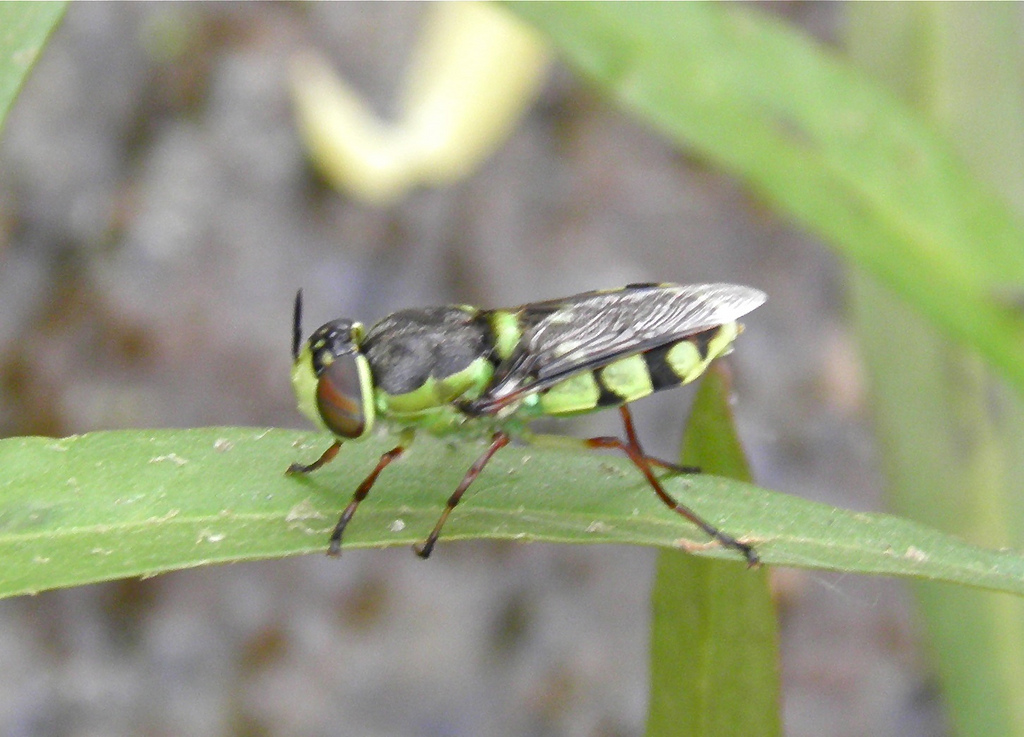
Along the creek, and especially in the area of the dam, we always find the best insects. This time, Fred Heath discovered the big, colorful Soldier Fly, and I found a very modest looking Tipulid, that Carl Olson declared 'very cool!'

Soldier Fly

Limoniid Cranefly

Haplorhynchites planifrons
This beetle is a  primitive weevil that returns every year to blooming Brittle Bush in Sabino Canyon. This year, there was only one - there was just one blooming Brittle Bush.  


Three different insect orders on one little Fleebane disc: To beeflies, a little wasp and the mating Metallic Wood-boring Beetles (Buprestids) Acmaeodera sphaeralceae.


Tuesday, March 29, 2011

A tiny Parasitoid Wasp on Campus


There are only small patches of planted,  native vegetation on the University of Arizona campus. I don't know whether that is because of a great old arboretum that used to take up most of the campus area - many of the old trees have made room for building expansions by now, and the last freeze killed a number of others - or if there is an attempt to match the old fashioned red brick buildings with fresh green lawns and ivy....

But if you offer just a few yellow flowers (Desert Marigolds) and budding prickly pears with extrafloral nectaries, the bees and wasps will come.


On the fat Santa Rita Opuntia pads, washed lavishly in silver, turquois  and hot pink, a little speck of yellow and black stands out. It's only about 4 mm long, and in the glare of the mid-day sun I have to take a macro photo to get a better look.


The tiny abdomen, huge hind femurs and sickel-shaped tibiae tell me that it is a male chalcid wasp of the genus Conura. Against hope it is identified quickly on Bug Guide by Ross Hill as C. side (Walker 1843).


Most Chalcid wasps are parasitoids of other insects. They lay their eggs into eggs or larvae of Butterflies, Beetles, Flies, True Bugs, Spiders, and even some Nematodes (Worms). Their larvae develop in the living host, but the host usually dies when the chalcid larvae break through the skin to pupate externally. Chalcid wasp distribution covers the holoarctic as well as the tropics. The genus Conura is most widespread in the tropics.
 Chalcidoidea are ecologically important, morphologically and biologically extremely divers, and phyllogenetically very challenging. With 60, 000 to 100,000 species and a worldwide geographic range they will keep researchers busy for a long time. To learn more go to the Chalcid site on line which offers lots of information.

Monday, March 28, 2011

Carpet Beetle Anthrenus sophonisba

Anthrenus sophonisba

While photographing dozens of  interesting bee species on the Brittle bushes around our patio, I found a beetle that I hadn't seen before on a cholla branch. You can see it smaller than the areoles of the cactus, less than 4 mm long. Its compact round shape, tiny clubbed antennae and the dense, attractively patterned scale covering identified it as a member of the Genus Anthrenus in the family Dermestidae. Typical is also the ability to withdraw all appendices into a tight pill shape. These beetles are also called Skin or Carpet beetles. They could be named Collection bugs as well. While the adults can be found on flowers feeding on pollen, the larvae feed on all kinds of organic material like wool, stored food, hides, and insects in collections.

Dorsal and ventral view of the beetle playing dead

 Checking the family page for Dermestidae on BugGuide.net and Andreas Herrmann's excellent online resource for dermestid species I quickly got to the species A. sophonisba.  Surprisingly, the attached author name Beal 1998 indicates that the species was only described 13 years ago. I have no access to distribution data other than Bugguide and some mentioning of the species when I google it. All point to western locations, mostly in California. It's amazing how many insect species are still being discovered and/or described every year in the Western United States.


Those pretty scales are fragile. By the time I'm done with my photos the beetle sadly shows some  wear. But I did get one good shot for my digital collection of Arizona beetles that will hopefully one day mature into a field guide.

  I wonder whether I should digitally straighten that right middle leg or leave it like this - after all, my beetles are alive when I take my photos.
However, this one is going into the freezer now. Being too small to be pinned, it will be glued to a point of archival paper. An insect pin will keep this point and the labels with the collection data together to make this carpet beetle a useful part of a research collection, unlike his feared, destructive brethren.


Thursday, March 24, 2011

Curve-billed Trashers Rule!

Cuve-billed Trashers have many talents. They whistle at you like a street kid. They have a beautifully varied song that I like at least as much as that of the Mockingbird. They build a nest in the middle of a jumping cholla protected by thousands of barbed thorns, but are said to clip off the thorns that could hurt the nestlings. They are great parents that never tire of their very noisy, demanding fledgelings.   
But they are as fierce and aggressive as their yellow eyes and their sharp profiles promise.


A couple of years ago I watched this fight among a Trasher and a Gilded Flicker. Flickers are our largest woodpeckers here in the desert, and they easily drive the smaller Gila Woodpeckers from feeders and nesting sites. Luckily for the Gilas, there aren't very many pairs of Flickers. But in the case of Trasher against Flicker, the Trasher won.

But you have to watch what happens if a Trasher wants to impress his girl (and I don't think I' m anthropomorphizing very much here - shared aggression is a form of pair-bonding that can be observed in many species). Curiously, he never attacked the smaller Round-tailed Ground Squirrel, but he took on the giant Rock Squirrel every time the big guy tried to stuff his cheeks. When I filmed this, the squirrel was already a little desensitized to the attacks and seems to mimic a skunk, so the Trasher walks off, finds a new strategy and.....Just watch it.


The original video shows how the female thrasher joined the triumphant male after his victory of the quail block. Unluckily, the flickr version cuts off just before she arrives.  


Anyway, here they are, sole owners of the quail block of contention.

Monday, March 21, 2011

Coyote Crossing


 One my way home from the University I often leave the busy freeway (I10) to travel west on Silverbell, a road that winds its way between the Santa Cruz River on the north side and the Tucson Mountains on the south side. It's less romantic than it sounds, because the river smell bad from the release of treated waste water and the banks are pockmarked by gravel mining and cruising off-road vehicles.   But there is wildlife: Hawks are nesting precariously on power poles,  ducks and herons fly overhead, and today I first slowed down for a roadrunner, then for a coyote trying to cross the road. 


In fact, because there were many cars behind me, I first blocked her progress by pulling up next to her. She wasn't too happy - it shows in her expression. I never turned off the engine and kept the windows closed.  She relaxed and waited around until I got my camera out of its bag and focused, and all the other cars had passed. Then she took up her original direction again, crossing the road, leaping elegantly over a substantial fence on the other side, and off towards the Tucson Mountains. Good luck!

Our Coyotes here in the desert are small, only about 35 pounds. The packs usually consist of a pair and a couple of last years pups. The desert just doesn't feed larger groups. From coyote scat one can tell what they eat: everything. There is bunny fur, bones of little rodents, though most will be dissolved by strong stomach acids. Pieces of mesquite or other fabaceae beans that are in season. Bird seeds, berries, lots of pinacate beetle shells. They do grab cats and small dogs if they can. 

Our dogs are at fifty to sixty pounds much larger than coyotes. We used to have an invisible electric fence to keep our dogs  in about one acre of our back yard, the rest was left to a group of  resident coyotes, usually three of them.  During full moon nights, the male appeared outside the dog run to challenge Cody, our male dog, who just loved to play along. For hours I'd listen to: Yep-yep-yep-wheoouuuuh! Wow, Wow, Wowowowow!!!! Yep-yep-yep-wheoouuuuh, Wow, Wow, Wowowowow!!!! endlessly repeated. The females, a husky and a wolf-dog, and on the other side probably the coyote bitch, stood back admiringly. Sleeping? impossible. The contestants had found the best acoustics closest to the house. So I got up, with a flash light (for the snakes) and joined Cody. Mr. Coyote was only 15 feet away, clearly visible in the moonlight, but safely on the other side of the invisible fence that controlled the dog. He ignored my requests to leave and sing elsewhere. He scoffed at me clapping my hands. So I crossed the line of the invisible fence. He put back his ears, kept staring. Unbelieving. Made grunting noises. Another step. His tail went down. Tucked between his legs. Unhurriedly, he backed of. Melted into the surroundings. Was gone. For now. I was my dogs' hero! For now - forever. They are dogs! 

Cody, Montana, and Laika
When my dogs meet coyotes on walks (outside the dogs' direct territory) I often see them pointedly looking the other way when they have to pass each other. A strange dog would cause a happy chase or a fight, but the coyotes seem to enjoy a truce.