Showing posts with label Assassin Bug. Show all posts

Wednesday, May 25, 2016

Kissing Bug or not?

It's time for the Kissing Bug post again: Yes, we have them in the Southwest US.
In the Soutwestern US, they are neither new nor uncommon
They may carry the microbe that causes Chagas desease (Trypanosoma cruzi) in fact, studies showed that  
about 40 % of the Kissing Bugs around Tucson are infected 
 with Trypanosoma cruzi. .But so far they are not known to transmit it to humans here in AZ. Behavioral differences from tropical species may play a role. 
Some possible cases in Texas were reported (there are different species of Kissing Bugs there, the same genus, Triatoma, plus some others.)
Female Triatoma rubida in Tucson, AZ
 Adult Kissing Bugs fly to lights at this time of the year, from the end of May to the beginning of July. They are NIGHT-ACTIVE. But I have found them sitting under our kitchen light in the morning, still there from their nightly visit. They are very flat and can get through narrow openings under doors.
Nymph of T. rubida, stilll flightless
I've found nymphs (flightless) indoors since January. The dogs may bring them in? We have packrat middens too close to the house and should get rid of those.  That's were most Kissing Bugs grow up.


Side view of the elongate head of a Kissing Bug (conenose) At rest, the sucking mouth parts are folded back. They stretch forward when in use. Photo by Eric Eaton (detail)
Taxonomically, Kissing bugs belong to the order Hemiptera
so they are True Bugs, not Beetles. One characteristic of that group are the piercing, sucking mouth parts.

Several other True Bugs are often mistaken for Kissing Bugs
Let's separate the Kissing Bugs, also called Conenoses, from similar True Bugs that are often mixed up with the real thing.
Eastern Boxelder Bugs Photo by Seth Ausubel
Some hints: if you find bugs on flowers, or anywhere in the sunshine, bugs in big aggregations, on leaves or fruit: Those are NOT Kissing Bugs. Several related species of these
Rhopalidae (Scentless Plant Bugs) and similar Lygaeidae (Seed Bugs) are very common in Arizona. They feed on leaves and milky, fresh seeds piercing them with their probosces and sucking the juice.

 Here are the Small and the Large Milkweed Bug. They are plant suckers and not interested in animal blood at all. Both are smaller than our common Kissing Bugs in AZ.

Some of our Leaf-footed Bugsdon't have actual 'leaves' on their legs
A number of Leaf-footed Bugs (Coreidae) is as large or larger than Kissing Bugs and shape and coloring may be similar. If you see flanges (leaves) along the hind legs, the separation is easy, but not all Coreids actually have those.  The large ones feed on fruit and cactus pads, often in aggregations, usually during the day 


Some Assassin Bugs found in Arizona may resemble Kissing Bugs


 Remember that  
Kissing Bugs are Assassin Bugs, but not all Assassin Bugs are Kissing Bugs
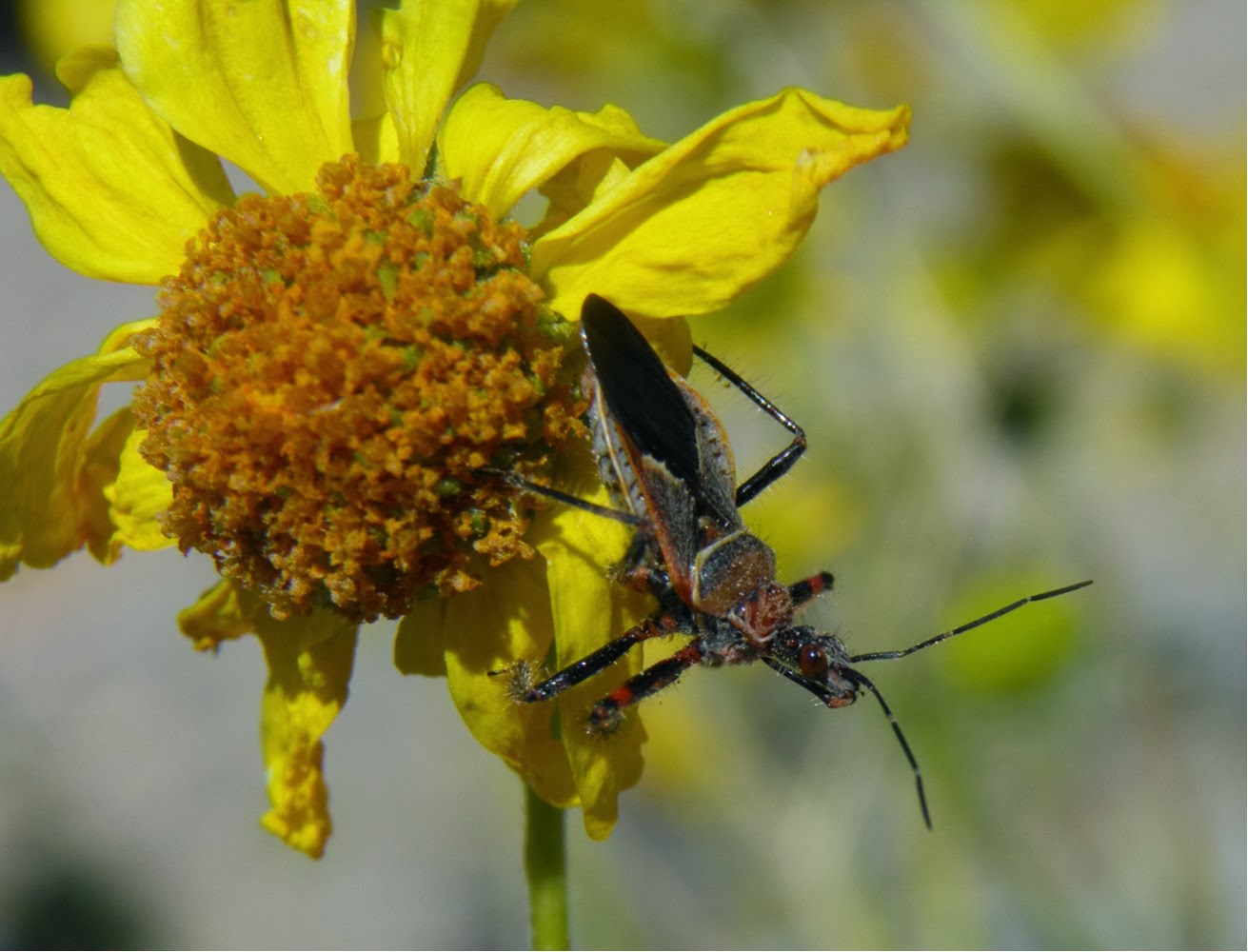
Most Assassin Bugs are predators of other arthropods. Many Assassins look similar to Kissing Bugs. They can be of similar size and also share a similar color scheme of red on black. If you look closely, their heads are not cone shaped like those of the Kissing Bugs.  Hint: if a predatory Assassin Bug bites you it hurts very much. 
If a kissing Bug bites you, it's completely painless and usually goes unnoticed.
Itching welts and inflammations may appear later. The strength of the reaction is dependent  on the immune reaction of the victim. Over time, after repeated exposure,  hypersensitivity can be developed and a person becomes allergic. These allergic reactions can be severe.  

Photo by Tony Palmer
 Here is Triatoma rubida, our most common Kissing Bug, feeding on a Mediterranean Gecko. The reptile made no effort to avoid the painless bite.  The bug injects an anesthetic and an anticoagulant.
 
1 Macrocephalus dorannae; 2 Lophoscutus sp.; 3 Phymata sp.; 4 Pseudozelurus arizonicus; 5 Narvesus carolinensis; 6 Oncocephalus geniculatus; 7 Reduvius sonoraensis; 8 Rhiginia cinctiventris; 9 Triatoma protracta; 10 Triatoma recurva; 11 Triatoma indictiva, 12 Triatoma rubida, 12a Triatoma rubida nymph

We have 3 or 4 species of Kissing Bugs here, all in the genus Triatoma,  In Tucson proper you'll see most likely Triatoma rubida, In Madera Canyon T. protracta is quite common, T recurva I have found at Clear Creek in Yavapai Co. All are night active and come to lights. 

My blog should help you to better identify the bugs you find. To learn more about Chagas disease and the status of vector infection in AZ, I suggest the paper 'Infection of Kissing Bugs with Trypanosoma cruzi, Tucson, Arizona, USA'  by Carolina Reisenman  et al. 

Monday, March 10, 2014

Apiomerus cazieri - a valid name at last


 Today I went out to photograph some small bee assassins. I find this species every in Saguaro National Park West when the Brittle Bush blooms. When I came home I looked up what had happened to the species name of this insect since I had first seen it in 2008. It was a somewhat convoluted story:
 In April 2007 J. Dockens posted her observation of a small Apiomerus from the Boyce Thompson Arboretum in Superior, Arizona, on BugGuide, and Eric Eaton identified it as Apiomeris cazieri.
A year later our most active Assassin Bug expert D.R. Swanson commented 'This has actually been bugging me (no pun intended) for awhile. There is no mention of Apiomerus cazieri in Henry and Froeschner's catalog (1988). I also have the revision of the genus by Costa Lima (1951) in front of me and there is no mention of A. cazieri there either. In fact, I cannot find a single literature record for this species. Now that doesn't mean there isn't one, of course, but it does have me curious and albeit it, a bit skeptical.'


So how did this discrepancy come up and who was right at the time?
Eric Eaton, then living in Tucson, had access to the University of Arizona Insect Collection, and there in the reduviid drawers were several Arizona specimens of a small bee assassin clearly labeled Apiomerus cazieri. But Carl Olson, the collection manager, told me the strange of those labels:  
The specimens had been part of the type series of  Leopold Szerlip's description of a new species for his doctoral dissertation. A Berkeley grad student at the time, Szerlip completed a biosystematic analysis of the Apiomerus of North and Central America in 1980 as the topic of his doctoral dissertation. Unfortunately other than qualifying him for his PhD, nothing more was done with the information; a paper was never published. As a result, the 19 new species erected within it were invalid.


 But at the same time, no other scientist felt comfortable to do any work on the group because of this existing manuscript. At BugGuide and at the U of A specimens kept coming up that were carefully designated as  Apiomerus crassipes species group (crassipes species group) with 'A. cazieri' added  in quotation marks. We all knew that 'A. cazieri' was a 'good' species, easily recognizable by its small size and the early spring appearance of the adults, but we also knew that the name was invalid.


While we were still scratching our heads Ted C. MacRae got the ball rolling in 2009. He wrote:
'Dimitri Forero, a Postdoctoral Researcher in Christiane Weirauch's lab at University of California-Riverside, has just responded to my discussion about this situation on my website and informs me that it will be rectified soon. A Masters student in their lab is revising the species concepts of Szerlip and adding a phylogenetic analysis, while Dimitri is dealing with the rest of the fauna in Central and South America. Best of all, Szerlip will be a coauthor of the Masters student's work validating his names. I think this is a fantastic outcome - not only will Szerlip's names be published, but he will get the credit he deserves and benefit from a modern phylogenetic analysis. Soon, we will be able to say Apiomerus "floridensis" (and Apiomerus cazieri) without the quotation marks!'
Then, finally in 2011 Ted C. MacRae posted: Resolution!
'Apiomerus floridanus and several other species have now been formally described in the following hot-off-the-press publication:
Berniker, L., S. Szerlip, S. Forero & C. Weirauch. 2011. Revision of the crassipes and pictipes species groups of Apiomerus Hahn (Hemiptera: Reduviidae: Harpactorinae). Zootaxa 2949:1–113.'
 

 Anyone who is wondering how the validity of a species name is controlled and tested should turn to the code of the International Commission on Zoological Nomenclature (ICZN) and consult this scheme;  names from Szerlip's unpublished thesis would have been disqualified in the second line.


With this blog, I would like to make one point very strongly: When research is done at a public university it not only takes the work of the one researcher. It usually also takes resources from tax dollars, lab space, a position that others would love to have.... But beyond that, keeping the research community in limbo needlessly by not publishing is unethical in my opinion. I understand that there are lots of reasons for delays, and I do not know what exactly caused it in this particular case, but still....

But what really surprised me most in this case was that this little Apiomerus that is so distinctly different from others in the crassipes group had been overlooked for so long and was not described before 1980. Of course, I have the advantage of living right in the middle of its habitat, so I see some of them every year when the Brittle Bush blooms in Saguaro National Park West. The reason for the late discovery may have been that early spring is not one of the most interesting times for all those collectors who usually arrive for the monsoon bugs. So keep your eyes open, Arizona still has more to offer!

Friday, April 8, 2011

True Bugs on Cactus

True bugs suck!

There are times in Arizona's Sonoran Desert when cacti and agaves are about the only juicy things for a bug to suck on. Cactus specialists among the hemipterans can be found during all seasons, even reproducing in the middle of winter.

The species of the coreid (leaf-footed bug) genus Narnia specialize on different cacti. Some of them can be found on Prickly Pear, another that seems to be undescribed so far, prefers Saguaros.


Several species, like for example Narnia wilsoni spend their lives under the formidable protection of the thorns of the Fish-hook Barrel Cactus. The freshly hatched first instar nymphs above are enjoying the juicy film that covers the fresh seeds after a squirrel broke into the fruit. 

 
Of course, no protection is absolute: This older nymph, still red (teneral) and soft after its last molt before reaching adulthood, fell victim to a jumping spider. You can see the exuvia (shed skin) at the top left and a string of new eggs on the thorn on the right. So I guess this rare species will survive here in our backyard.

Adult Narnia wilsoni

N. wilsoni adults are quite attractive. Most others in the genus Narnia are drab and hard to tell apart. And who knows whether the species is really so rare. Hidden deeply between the ribs of the barrel cactus these guys are very hard to spot.

Two more coreid species Chelinidea vittiger and C. hunteri also frequent our succulents. Their contrasting wing vein pattern and subtile coloring remind me of my grandmother's Art Deco jewlery.


The nymphs with their thick antennae seem more in the style of children's plastic toys. Parental guarding is common in these bugs.


A couple of days ago I found the odd looking Merocoris sp., also a Coreid, on an Engleman's Prickly Pear in our back yard. It can't be an obligatory cactus feeder, because it also occurs in the Sonoita Grasslands where there is hardly any cactus. But it was definitely sucking from the succulent little leaf remenant on the Opuntia bud.


Despite their plump shape and suggestively big hind thighs, these coreids are no jumpers, but they can fly.
Merocoris sp.


Some Stinkbugs or Pentatomids also have cactus as a preferred host plant, like these Chlorochroa opuntiae. The  little congregtion below was photographed in September 2010 in the Saguaro Monument West in the Tucson Mountains. The individual below was feeding on a Cane Cholla in our backyard (bajada of the same mountains) on March 29, 2011.


Chlorochroa opuntiae


Zelus renardii, Leafhopper, Assassin Bug

Growing cacti release sugary juices from extra-floral nectaries and just growing  pads and flower buds.  A predatory bug, a reduviid in the genus Zelus, is stalking  insects that can't resist the sweet attraction.  


Small Milkweed Bugs Lygaeus kalmii
These Small Milkweed Bugs  in the Seed Bug family will most likely not lay their eggs on the agave leaf that they chose as a mating place, but the closest relative to milkweed in our backyard are some Oleanders that survived the 'renatification' of our property.