Wednesday, July 8, 2015

Madera Canyon up close

The view from Proctor Road
The Santa Rita Mountains already received a nice amount of monsoon precipitation. Mark Heitlinger, the manager of the research station in Florida Canyon sent me this encouraging graph.

temperatures and precipitation during June at the SRER in Florida Canyon
When I crossed Madera Creek at  Proctor Road I found only a little trickle of very murky water and no roadside flowers yet. The Mesquite Trees were blooming again and the tall candles of blooming Sotol stood out from the brush. From earlier years, I remember trips with Eric Eaton when it was difficult to make him move on from the overabundance of Hymenoptera and Diptera that usually buzz around these nectar sources. But yesterday, there wasn't much diversity.

The sound of summer and heat - Cicada song
The insects that I did find where all old acquaintances that I had photographed before. So - since I did not need any more documentary shots - this time I went for close-ups, portraits and details.

Mozena sp., Leaf-footed Bug on Mesquite
 All photography is done with my point-and-shoot Olympus SP-800UZ, an ideally light camera for hikes in hot, muggy weather and under threatening storm clouds. The SLR stayed safely tucked away in the car.
 
A Flower Scarab, Euphoria leucographa
There was some activity on the few Desert Broom bushes that have not fallen victim to the strange maniac who goes around year after year and brakes off the most mature and attractive bushes. Why would anybody do this?

Chlorion sp. and Cotinis sp.
 The sweet sap oozing from the bark of some Desert Broom bushes attracts the strangest table fellows and often causes short displays of aggression and dominance. This Chlorion had just chased off a big, clumsy Tarantula Hawk, then shared peacefully with the scarab, only to finally get chased off herself by a horde of marauding ants.

Acanthocephala thomasi, Giant Agave Bug
 Giant Agave Bugs seem to be able to pierce the intact bark to reach the sugar water flow in the phloem of the bush. Often, they actually seem to start the sap flow for everyone else. All extremities of the huge dark bug end in bright orange segments that seem ideal for signaling and posturing.

Polistes dorsalis and E. leucographa
Not all wasps are just snacking on sweets. A Polistes comanche is masticating Marine Blue caterpillar into a package that's easy to carry to a colony full of hungry larvae nearby.


 For years this area close to the ticket booth for Madera Canyon used to be dominated by several colonies of Polistes major, but it seems that they have been replaced by Polistes comanchus this year.


Finding this Leptinotarsa haldemani chomping on the leaves of a bush instead of the usual herbaceous Nightshades surprised me until I realized that it is Lycium pallidum – Wolf Berry, or Pale Desert-thorn - in the family Solanaceae. Still to me it's a new host for this beetle.


Brightly aposematic Leaf Beetles, Lema trabeata, are using a Datura Plant to provide for their offspring. A reliable source of juicy leaves and protective alkaloids if the monsoon holds its promise.


Zygogramma piceicollis pairs are hiding in Asteraceae that are shooting up now and will soon produce yellow flowers and later those annoying black, elongate seeds that seem to be waiting for entomologists swinging insect nets as their chosen form of distribution. I hope the beetles and their larvae are very hungry!
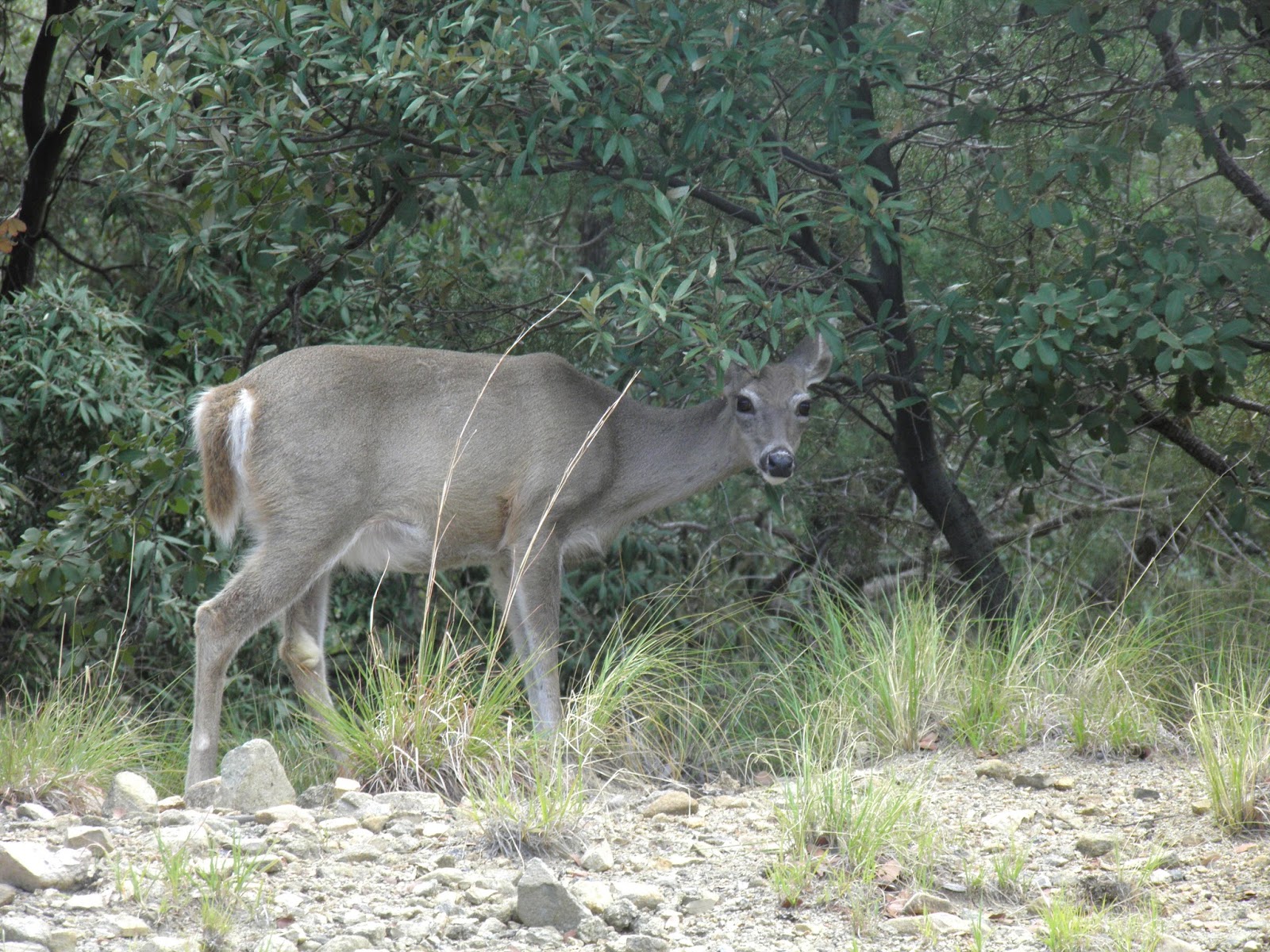
White Tail Deer grazing under Silver Leaf Oaks
 After several couple of hours in the low grassland at over 90 degrees Fahrenheit and, as it feels, over 90 percent humidity (it actually rained a couple of times), 80 Degrees at the upper Mt Baldy trail head are refreshing and cool. Ceanothus greggii is still blooming, but many of the plants have been destroyed by mud slides last year.


A hunter is hanging out among the small flowers: a small ambush bug in the genus Phymata. Waiting motionless for prey to walk into the reach of it's short, strong raptorial arms, it is ready to take on prey several times its size. Brachial power is not its only weapon: its bite will quickly paralyze its prey. 


The usual mass orgy of Rose Chafers is still ongoing and beetles are flying around their wings catching the afternoon sun and their long legs trailing.
 

Soon several species of red Net-winged Beetles (genus Lycus) will join them and buzz around the oaks in great numbers, but this time I only see a couple of individuals.


Weevils in the genus Pandeleteius nibble on the tips of oak leaves. They look like spiders from afar, but close up they always remind me of Popeye  after a good meal of spinach.


Weevils in the genus Curculio are extremely difficult to identify to the species, but I feel some justification in calling this one an Acorn Curculio. I usually see them at the black lighting sheet and never realized how well their subtle pattern matches that of a young acorn.


A persistent irritation under my shirt drove me into the privacy of the trail head restroom. The culprit: a rather large tick that obviously had not found a spot that it liked. Luckily. We don't seem to be in an area with a lot of Lyme disease here, but a tick bite is never pleasant. Trying to identify the tick, I end up with the eastern genus  Amblyomma. Now I wished I had collected the specimen as a voucher because that would be a considerable range extension for that genus.   

Thursday, July 2, 2015

Toads and Dogs


Here in Arizona we are anxiously waiting for the beginning of the monsoon. We already have high humidity, dust storms, dramatic clouds and black skies at times. But no real measurable rain yet, at least not on the west side of the Tucson Mountains. Of course, the wildlife around us is waiting more eagerly than we humans with our access to CAP water and ground water delivered from every faucet. Amphibians like toads, frogs, and spadefoots are hidden under ground during the dry season and emerge when water might be available. They need to keep their bodies moist because their skin is quite permeable - they breath through it and can absorb, but also loose, water. Even more than the adults the eggs and larvae of amphibians (tadpoles) depend on water. Some of our desert species are masters in utilizing very temporary puddles that only lat for a few days for their offspring. Those species, like red-spotted toads and spadefoots have produced quite a lot of offspring last year. But the big Colorado River Toads, or better now Sonoran Desert Toads (after their western most populations are disappearing) need more than just a puddle, they need at least a small pond to mate, lay their strings of eggs and for their tadpoles to reach maturity. Nevertheless, we have at least half a dozen of those prehistoric looking giants between our and our neighbors property. The probably have not bred in decades. But the individuals survive and eat  bugs nightly under all our porch lights and my black light.
These toads have a terrible reputation with dog owners and concerned parents because they produce potent psychedelic and toxic secretions from glands in their skin.
Wikipedia: 'Just behind the large golden eye with horizontal pupil is a bulging kidney-shaped parotoid gland. Below this is a large circular pale green area which is the tympanum or ear drum. By the corner of the mouth there is a white wart and there are white glands on the legs. All these glands produce toxic secretions. Dogs that have attacked toads have been paralyzed or even killed.'
The cocktail of chemicals produced by these glands contains among other toxins 5-MeO-DMT (5-methoxy-N,N-dimethyltryptamine) is a powerful psychedelic tryptamine. This had brought them to the attention of seekers of highs among humans - and dogs.


My best dog ever, Cody, discovered the toads when he was young. The first encounter was scary - his heart raced out of control and his breathing became labored. (no foaming from the mouth). But after that first time which ended at the vet's office  (Cody was already fine again when we got there), he seemed to like the effect and know how to dose it. So once a year early in the toad season, he would show up with his hair standing on end, very happily swaggering and humping everything in his reach (something he did not usually do). A dead toad would be somewhere in his wake. He eventually outgrew this behavior and paid no attention at all to the surviving toads that were always drawn to bird baths and dog tub. Our 5 other dogs always completely ignored the toads. So the danger from the toads to smaller dogs or unlucky individuals is certainly real, but nobody should overreact and try to eradicate the toads. Remember, they were here fist, they are surviving in a very difficult environment, they may be the only ones that actually eat the big Palo Verde Root Borers.  Different from rattlesnakes, Sonoran Desert Toads will never make any aggressive advances towards the dogs. They only want to be left alone. ... The skin secretion is also an irritant to mucous membranes, and most dogs will realize that and back off after the first contact.  Any reasonably smart dog can learn to stay away from the toads with some training and supervision.  You can never be sure that you eradicated every single toad from your yard. But you should be able to control your pets.
The smaller species like Woodhouse's Toad, Great Plains Toad, and Red-spotted Toad are not, or only mildly toxic and pose no threat. Still, I see a lot of hysteria in public forums that targets even those harmless guys.

Tuesday, June 23, 2015

Toad Concert


Red-spotted Toad, Anaxyrus punctatus
 Last night we were watching a movie when in the background, there were suddenly very loud trilling noises. If that was a cricket, it was on steroids. Now if the movie had been some Amazon nature flick .... but it happened to be a Norwegian Mafia movie, set in snowy Lillehammer. The noise soon reached a volume that droned out the dialogue (kind of hard to follow anyway as my Norwegian is getting rusty), so we investigated. The sounds came in through the open kitchen door. Outside on the patio the dogs had spilled a lot of water from their tub. In that puddle, half a dozen Red-spotted Toads were courting, making great use of the acoustics of our patio, especially a narrow space between the tub and a big wooden box. Mecki was lying close by watching in obvious amazement.

Red-spotted Toad, calling
Anurans (frogs and toads) produce mating calls using the huge swelling of their throats to amplify the sound produced by air blown from their lungs over simple vocal cords. Such sounds are unique to individual species and are used during courtship (a prelude to mating). Spectrograms of the calls can be used to identify frogs or toads species. In most species the peak noise level measured 50 cm in front of a calling male exceeds 100 dB, but of course body size is an important factor.
 Male toads eager to mate tend to grab anything vaguely reminiscent of a female. When other males of the congregation happen to be approached by mistake they utter a different, shorter squeak, demanding to be released. I think that's what's going on in my video. I'm pretty sure that last night, there were no females around at all, and in the morning there were no strings of eggs to be rescued from the concrete patio floor. The monsoon rains have not started yet and I don't expect the females to show up before that happens. Maybe they need the drumming of heavy raindrops to wake them in their underground resting chambers.


Red-spotted Toads occur all over Arizona, but they are highly adapted to procreate in arid areas where puddles may last only for a very short time. They and the desert Spade Foot-species have some of the shortest tadpole phases among anurans so their offspring is ready to leave the water and stand (or crawl) on its own tiny legs within a few days.

Great Plains Toad,  Anaxyrus cognatus, who can make a much bigger resonance bubble
Most of our other toad species need some more lasting water source like this goldfish pond in a friend's backyard at Cochise Stronghold or the remnants of Sabino creek where Ned Harris photographed the big Sonoran Desert Toads.

Sonoran Desert Toads, Incilius alvarius, mating in Sabino Creek (Photo Ned Harris)
We have Sonoran Desert Toads in our desert habitat too (in Picture Rocks). There is no open water for miles. Still, the same individual mature toads emerge year after year to harvest bugs at porch lights and my black light. They are huge, old individuals that can probably remember better times when our part of the desert still received enough water to at least occasionally allow them to breed. But for the last 10 years at least, these Sonoran Desert Toads have been celibate and childless.


Let's wish them better luck in the future.

Monday, June 22, 2015

Sunrise walks in June

June finally lives up to its reputation and it's very hot, with noon temperatures reaching triple digits. Our new dog Mecki needs a lot of exercise, so we begin our walk just before sunrise and try to stay in the mountain shadow as long as possible.


Lesser Nighthawks fly up from the ground where their young may be hiding. The male makes interesting purring sounds while sailing low over our heads, then lands, stretches along a branch, and becomes invisible. A peaceful time of the day, one should think, but it's never quite without drama.


Mecki is not as desert savvy as the dogs that grew up here. This morning he could not resist launching himself at something that had found safety in a Chain-fruit Cholla. He came back with legs, flanks, ears, and nose decorated with broken-off cholla pieces. (No, they did not 'jump' him). With Randy's comb I pulled off the bigger stuff, and Mecki was very stoic about it. The remaining thorns will soften quickly where they are imbedded in the tissue and will be easily pulled out later. 'Jumping' Chollas use zoochory for the distribution of their vegetative offspring, meaning they recruit animals to carry broken-off pieces to new planting grounds. Thus Cholla needles hurt noticeably  less than those of Prickly Pears that are exclusively defensive (and seem to contain painful chemicals to boost their effect).


Mecki securely leashed, we then walked along a dry wash that is lined with Ironwoods, Acacias and Palo Verdes. All are still much greener than usually in June. Soft heavy wings were suddenly beating right above me: A Great Horne Owl had been hiding to sleep through the day. Now he landed about twenty meters away from the shelter of the wash, and close to a Saguaro Cactus where a Gila Woodpecker had just raised his brood. The woodpecker probably felt still territorial. He not just mobbed the sleepy owl, he flew right at it with his formidable beak. Of course, he's no match for the GHO who just stayed put.


Saguaro fruit are ripening and bursting open to expose seeds imbedded in sweet pulp that everybody loves. I even spotted a quail up there, but only the house finches let me take their photo while they snacked.


Snack break for the pack, too, and still no coffee for us. The old guard Bilbo, Frodo and Laika, sticks together. Mecki is still not to be trusted around Frodo so I keep them apart. Although Randy thinks they'd be just fine.

I'm afraid of another fight and want to slowly and patiently habituate them. Luckily, Frodo does not return the aggression, so it's enough to control Mecki (at my feet, with training collar). A nice old Ironwood makes a great barrier.


Sunday, June 21, 2015

Midsummer Night Magic


For midsummer night Randy and I joined the traditional party at Mark Dimmit's beautiful gardens in North West Tucson. An Oasis overflowing with native as well as exotic xerophytes outside and a jungle of orchids and bromeliaceae in greenhouses, or rather shade tents, the place fascinates and surprises every year. The potluck tables were equally rich and exotic. We could only try to sample everything. Just about everyone who loves  herbs, herps, bugs and birds, and braves Tucson in the mid of summer, was there. Weaving through the crowd under those huge mesquite trees, we exchanged greetings and news, and easily joined conversations with friends and strangers.

Tucson's latitude is 32° N. So at around 8:45 pm it is already fully dark even on the 20th of June. That's so different from midsummer nights in Norway and even Germany at higher latitudes!
The nice thing about Tucson is that it  it get's really dark when the sun goes down, because artificial light pollution is kept at a minimum for the sake of several powerful observatories on the surrounding mountain tops (Kitt Peak, Mt Graham).

Around 8:15 the space station caused ahhs and ohhs when it crossed over, still radiantly illuminated by the sun that had just set for us.

Soon after the crescent moon and close to it Venus and Jupiter dominated a deep blue, velvety sky, off-set by  the black filigree of the trees' canopy. Admiring that scene, I overheard with one ear Maggie Fusari's remark about  Lewis Carroll's (and Walt Disney's) Chesire Cat, whose body  disappears from time to  time, the last thing visible being its iconic grin. I had read Alice in Wonderland when I was 6 or 7. At that age, it's magic must have completely escaped my budding analytical mind and I did not like the story at all.
But now I suddenly discovered the Chesire Cat above me in the tree, or at least I clearly saw its grin! ...Midsummer Night Magic!

Sunday, June 14, 2015

A snake in the morning ...

Diamondback Rattler peacefully resting in a desert wash.
5:56 am.This morning's rattler encounter was hair-raising and heart-stopping. For us humans that is, not the other participants, the rattler not having any hair, and my wolf-dog Laika being completely heartless, I'm certain of that now.


Frodo is our snake spotter. He found the camouflaged rattler
So here goes: Frodo, on Randy's leash, pointed at a rattler resting in the shade a couple of feet in front of them. Randy called me to take a photo. Laika had run ahead and now decided to rejoin the party, loping down the wash right towards the snake. Randy jumped to the side to divert her. I tried to make her stop (a trained command, but hey, this was party time, right?) and the wash is the most comfortable place to run along in. Time slowed down for me like in a movie. In slow motion, I saw her left front leg touch the snake, then her hind legs actually pushing it out of place.


Happy Laika then hoped for her treat. Indignant snake reorganized its coils. My heart got back into its, albeit accelerated, rhythm.
But wait, then comes Bilbo! Hot on Laika's tracks, but lighter, younger, more elegantly only just skimming the snake.

Resting after the excitement. Bilbo now on the leash, behind him Laika, Frodo. Mecki and I are not in any photo because we are operating the camera


Does the rattler look grumpy now? This picture was taken after the assault ... can you tell?

P.S. On this balmy morning the rattler was probably warm enough to be active. But it was resting after a presumably active night. With day temps close to 100 degree Fahrenheit, the snake will spend the rest of the coming day in a cool rodent burrow and go hunting again in the evening (if he's already hungry again) But for now, this shady spot in the sandy wash must have been so pleasant that it would have taken more than some 70 pound dogs barreling over it to make it  rattle, strike or leave. 


Saturday, June 13, 2015

Queen of the Night, Peniocereus greggii, 2015


Last night the night-blooming Cereus  bloomed in our area. While Tohono Chul Park and the Cactus Society's park on River Road got all the press, we went looking for wild specimens here in the creosote flats of Picture Rocks. We took off around sun rise, shortly after 5 am. The flowers were still crisp when we started but began to wilt before we go home around 7 am.


We found more than 20 blooming plants and several that took the year off. Most plants do that from time to time - the whole over-ground part of the plant, which is pretty thin to begin with, shrivels up and looks dead. Luckily, a fresh trunk eventually springs from the under-ground tuber and in a couple of years will be ready to bloom.


Most plants had 1 to three flowers, about knee to wast high and hidden within creosote bushes. Their sweet cloying fragrance betrays them and optically they stand out as pale handsized signals even at dawn and even from a distance.


Randy, being a head taller than I, had a definite advantage spotting them after he had the search image down.


A few plants towered  above their creosote  companions with a whole array of flowers on an antler-like branched system of trunks. Here in the desert, the wild plants seem to max out at around a dozen flowers. Irrigated specimens in parks, under optimal conditions can have more than 20 flowers.


I prefer the magic of finding them in the wild, without any strangers around.  It's just us and our dogs who mostly don't understand what the fuss is about. And there is the memory of my faithful dog Cody who accompanied me for the last time last year to see the wild Queens.


Here are a few notes from Facebook correspondent Larry Ayers:  a great drawing by Paulus Roetter, an artist who accompanied George Englemann when Englemann was exploring the US/Mexico boundary. This might be the first visual record of the species we now know as Peniocereus greggii var. greggii, La Reina de la Noche.


Another plate from Englemann's report which shows cross-sections of P. greggii stems, the tuberous roots, and other details

 Also, several people from Cochise Stronghold and the Bisbee area have found blooming Queens since mid-May (2016) while the ones here NW of Tucson showed only very small buds. Larry says: Yours (NW Tucson) are var. transmontanus, which I think of as the Sonoran sub-species, whereas the plants down here (Cochise Co.) near the border are var. greggii. The greggii var. greggii plants seem to be consistently earlier to bloom.
Asked if he is aware of any morphological differences between the two subspecies he answered: I think so. Some friends of mine in the Bisbee area have plants which they bought from Tucson nurseries. Transmontanus seems to have larger flowers and stems with more ribs, and the stems are slender compared to var. greggii. 


One more photo of out NW Tucson variety in the state trust land behind our house