Sunday, July 7, 2013

Sunday Seven

Today's Sunday Seven are all photographed on the garage wall where I keep my black light when it's not raining or to windy. Over time you will probably come to recognize that slump block background. I think it looks better than my dirty white collecting sheet and also doesn't flap in the wind as much. 

Euscirrhopterus cosyra (Staghorn Cholla Moth)
Staghorn Cholla Moths are back. Soon we will find groups of their caterpillars feeding on cholla branches.  I'm  amazed how closely these Owlet Moths resemble the Mesquite Stinger Moths in the Flannel Moth family.

Ligurotettix coquilletti, Desert Clicker Grasshopper
Day and night our creosote bushes seem to emit little clicking noises. A small grasshopper with a lot of attitude is producing them by rubbing his hind tibia against its abdomen. The sounds seem to be territorial markers as the males do not appear to be randomly distributed over the desert but to keep strict distances from each others calling perches.

 Cylindera lemniscata, White-striped Tiger Beetle
Diminutive Tiger Beetles are running along the wall catching his small prey close to the black light. They seem to come out only during the warmest time of the summer, maybe they need the heat to keep up their high activity level and speed.

Hogna carolinensis, Carolina Wolf Spider
Speaking of speed, the records at my wall are certainly held by spiders and relatives. Running Crab spiders, the depicted huge Wolf Spiders and a number of Windscorpions (Solifugae) are taking advantage of my nightly bug parties under UV light.

Anomala arida
Defenseless soft Anomala scarabs and moths are the favorite prey of the predators. 

Epicauta tenella, Blister Beetle

 Blister beetles are better left alone. Their hemolymph (circulatory fluid)  contains toxic cantharidine and the beetles react by 'reflex bleeding' to attacks and inadvertent squeezing. I very carefully keep them out of my shirt collar and so far never developed any blisters.

Dermestes marmoratus
Here is another one that I carefully stay away from. I believe that I can actually smell his dietary preferences from a distance of several meters, probably because I have seen whole aggregations of these guys feeding on cow carcasses. Forensic labs use larvae of this species to quickly and thoroughly clean skeletons.

Female Eretes sticticus, Predatory Diving Beetle
We are living in a very dry part of the Sonoran Desert. But even so, Some water beetles show up regularly at my lights, and curiously, this was the case even before our neighbor installed their cattle tanks. So there's either water around that I don't know about or these guys can fly very far.

Ooops, ....and then there were eight... I don't think you would have noticed :)

Thursday, July 4, 2013

Assassin Bugs of Arizona

As a preparation for the BugGuide gathering 2013 in Arizona, I pulled BugGuide's data for Assassin Bugs in Arizona. I found that my own photos are the basis for many of the existing species pages. I also found that I had taken white background photos of all but one of the AZ species that are represented on BugGuide. The one missing was  Pseudozelurus arizonicus photographed by D.R. Swanny from a museum (UMMC) specimen. D.R. Swanny also did most of the identifications and I gave him many of my specimens, so I'm sure that he doesn't mind that I included his photo in the tableaux below.

1 Stenolemoides arizonensis; 2 Emesaya sp.; 3 Zelus tetracanthus ; 4 Zelus renardii; 5  Castolus ferox; 6  Apiomerus cazieri; 7 Apiomerus flaviventris; 8 Apiomerus sissipes; 9 Apiomerus longispinis, 10 Fitchia aptera; 11 Heza similis; 12 Pselliopus marmorosus ; 13 Pselliopus zebra; 14 Rasahus thoracicus; 15 Melanolestes picipes; 16 Rhynocoris ventralis; 17 Homalocoris erythrogaster; 18 Sinea rileyi; 19 Sinea diadema


1 Macrocephalus dorannae; 2 Lophoscutus sp.; 3 Phymata sp.; 4 Pseudozelurus arizonicus; 5 Narvesus carolinensis; 6 Oncocephalus geniculatus; 7 Reduvius sonoraensis; 8 Rhiginia cinctiventris; 9 Triatoma protracta; 10 Triatoma recurva; 11 Triatoma indictiva, 12 Triatoma rubida, 12a Triatoma rubida nymph


There is a lot of work in these tableaux. Since I composed similar collages of other Arizona insect families, I have learned several things: to always store my work as png files so I can go back and move the elements around. To keep the species names in the legend instead as part of the image file - it's easier to correct mistakes and to follow changes in taxonomy that are inevitable. Last, but not least, to post only a small watermarked version on the internet. My ladybug plate showed all intentions to go viral after it was posted on pintrest, turned up in an African language blog, and on several gardening web sites, but by then it had lost all connections to my name and copyright.

Prints of these and other insect plates are available. Please contact me at mbrummermann@comcast.net

Sunday, June 30, 2013

Sunday Seven

All insects staring in this blog entry are less than 5 mm long. A reasonably good macro lens reveals amazing textural detail and colorful patterns even in these smaller bugs. I am using a 50 mm 1:2 Macro Zuiko Digital on an E-500 Olympus SLR body. This is an inexpensive hand-held set-up and far superior solutions are available. All the images are taken at night at my black lights which are hanging on out slump block garage wall and on the wall of our neighbors wooden weekend cottage. I support the built-in flash of the camera with a strong LED flashlight to help the camera focus and to brighten up the cast shadow.
 I try to orient the camera so that the flash hits the insect from front to back.  Depending on its position this can be difficult. A secondary flash would be ideal, but I am trying to keep things simple.

Cymatodera aegra-complex
 So here are 7 species that are common at the light right now: Adults of this genus Cymatodera in the family of the Checkered Beetles (Cleridae) are predaceous, some feeding on the larvae of gall wasps, others hunting fruit tree lepidoptera and wood-boring beetles. Identification to species is very difficult.But Cymatodera aegra is one of the smallest around here

Anoplocurius canotiae
This little Cerambycid is a family member of the largest of beetles. Tropical species can be as long as my lower arm, but even the Palo Verde Rootborer (Derobrachus hovorei) that is emerging right now in Arizona can be up to 4 inches long. This little guy is about as long as a Derobrachus foot.

Adelina sp.
The 3.5mm long  Adelina sp. is a darkling beetle and as such related to the big, black Pinacate or stink beetles that cruise the desert floor at dusk and stop to stand on their heads when they are disturbed.

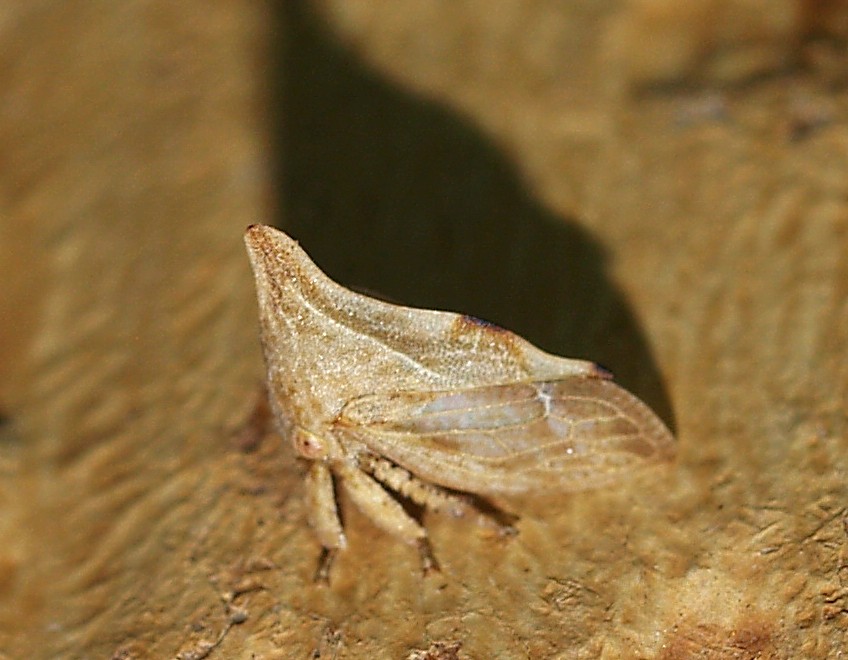
Enchenopa permutata - Female
In this species of Membracidae (Treehoppers), the female wears the horn, the male just has a rounded forehead. Maybe she needs the thorn mimicry more than he while she deposits her eggs on something thorny (?) Just about all plants here qualify...

Lomamyia sp.
Eggs of this little Beaded Lacewing  are stalked, and can be found on wood surfaces near termite nests. The larvae live with and prey on termites, using an immobilizing gas (containing an allomone) discharged from their anus.


The little Rove Beetle was running around, always ready to take wing again. At rest his membranous fore wings can be folded tidily and stored under the short elytra. This little predator is a member of the Staphylinidae, the largest family in the animal kingdom with 55,440 recognized species worldwide.

Aristotelia corallina

This little one is a Gelechiidae (Twirler Moths). The larval habits in this group vary widely: it includes leaf miners, leaf folders and tiers, gall makers, and fruit & seed feeders. The species A. corallina constructs larval webs near the tips of the host plant, the Sweet Acacia. 


Thursday, June 27, 2013

June Nights


This year around Midsummer the largest, most beautiful moon graced our clear desert sky. Randy and I hiked up Sabino Canyon, the mountains on both sides of the road actually benefitting us with the impression of several spectacular moon rises during one evening.


By 10 pm the moon had cleared the mountains and, hanging close to the zenith, was bright enough to read the small symbols on my camera's dial.

Queen of the Night (Peniocereus greggii)

Last night more magic happened. Our first, and this year only, Queen of the Night (Peniocereus greggii) flower opened. Delicate and fragrant it survived into the early morning hours, so I could capture the first rays of sunshine just reaching it. As beautiful as this seems, there is a scary reason for this longevity: right now pollinators are virtually absent. It has been nearly a month that I saw the last Manduca or Whitelined Sphings, and even local feral bees that often do early morning duty have completely disappeared.

So unpollinated and still hopeful, the Virgin Queen lasts into the late morning hours, until the merciless heat of another 108 degree day will brake her spirit and she will die unfulfilled.

There is still hope, though. While in other years all Peniocereus plants in the area seemed synchronized to bloom during the same single night, this year there are still buds that are only about an inch long and will not open before this incredible heat spell ends, the rains begin, and the insects eager to break their estivation pause will awake ... and life will go on. Or so we hope


Saturday, June 22, 2013

Saturday Five

Following in Dragonfly Woman's footsteps, and missing her alliteration by a day this week, here I am presenting five midsummer-nightly co-inhabitants of our backyard. This is just before the monsoon begins (we hope).


These little scarabs, Acoma sp. come to my porch light every year, but only the males. I have yet to find one of the flightless females. As with many other desert spp., the numbers are dwindling.


Temnochscheila sp. are predators of wood-boring beetles and usually associated with conifers. We had an old pine tree which I thought was the source of these beetles, but some years ago it died and was completely removed while the beetles are still going strong. Of course, the idea that our one pine tree, far removed from its normal habitat, would support this secondary guest (a predator of the tree's pests) was a little naive to begin with. This species seems to be a true desert inhabitant and quite independent of conifers.


This little wingless wasp had me wonder whether it was a mutillid or bradynobaenid but in fact its family Chyphotidae is not related to any of those. They just share the features that there females are wingless and their winged stin-gless males come into our house to buzz around the reading lights. This species impressed me because it is suspected to be a brood parasite of Solifugae, sun scorpions


 Kissing Bugs, the blood-sucking cone-noses  Triatoma rubida, are the only bugs that I always kill when I find them in our house. This year at least, they go into the freezer to be shipped off to a collector in Spain. Kissing bugs probably grow up in Packrat nests, but I have found nymphs in our dogs' beds, too. The adults are good fliers who are attracted to lights. Luckily their activity ends with the onset of the monsoon. Arizona has at least three species of Kissing Bugs but T. rubida is the only one I have collected around our house.


Midsummer night brought a tiny new moth, very delicate and pretty: Hileithia magualis, in the family Crambidae. I don't know its host plant. Its distribution is mostly southeastern with very few records west of Texas. (New Mexico and Arizona) A true Southern Belle.


Wednesday, June 19, 2013

Lions on (in?) my Mind

Above Turkey Flats on Mt Graham
 Last week a friend urgently needed some life insects from the Pinaleno Mountains. I know that at above 7000 feet elevation my old truck has even less power than usual, so I asked Fred Skillman whether he didn't need to collect Cerambycids up there, and of course he did, and so he drove us up in his stronger vehicle. We camped at in the mixed conifer region above Turkey Creek. Tall pines, beautiful blue spruce and fresh green fir trees form a dense canopy and keep the undergrowth sparse. Where fire or windbreak had toppled the giant trees, white blooming, fragrant Ceanothus greggii was  blooming and  Manzanita bushes and Cliffrose were already setting fruit.

Ceanothus greggii,   Manzanita,and Cliffrose
At one point the dirt road crossed a deep gully that may have been hiding a permanent trickle of water in it's depth. There were Alders, Cherries, Sambucus, and Emory Oaks sprouting from the steep slopes. Here I found my first Giant Ladybugs! The are really much bigger than all of their North American and European cousins, close to the size of a copper penny.

Anatis lecontei, Giant Lady Beetle

At dusk we set up our sheets Mercury Vapor and Ultra Violet lights to attract night-flying insects. While Fred, hoping for bycids, stayed in the campground close to a windbreak with a lot of dead trees, I chose the little riparian area about a third of a mile down the road.

The most numerous visitors on both sheets were  Dichelonyx sp. This genus in the family Scarabaeidae that is not very well represented in Arizona. In fact the only other Arizona entry on BugGuide is my own record from Oak Canyon, Sedona. But the species on Mt Graham is bigger and I hope Bill Warner will id it for me.


Here is a sample of the many species of moths that I photographed. Maury Heiman did most of the identifications. To see all my Mt Graham moths, please click here.
To see all my beetles from this trip, please click this link. 

Vaejovis electrum Hughes 2011
During the hours that our sheets were up, I walked several miles along the road and several times to the campground and back, searching with my flashlight for night active critters that don't fly to lights. I found Darkling Beetles and Ground Beetles, Camel Crickets and little dark scorpions with small chelicerae. When Warren Savary identified them as  Vaejovis electrum, Hughes 2011  I realized that I had actually been on Mt. Graham with Garret Hughes when he found the first specimens of this species that he described in 2011.

Nomius pygmaeus (Stink Beetle) (2)
Fred picked up a tiny ground beetle that turned out to be the most odoriferous thing I have smelled in my life. Its odor reminded me of the Common Stinkhorn, Phallus impudicus (Mushroom), but it was much, much stronger. It filled the vial the beetle was in, the space around the black lighting sheet, the campground, now my studio... I can smell it everywhere. Did I mention that the beetle is barely 5 mm long?


In the morning I was up early to watch for some moth and beetle species that fly during the cooler day light hours. Along the road I found Silverspotted Skippers already positioned to attack everything from slow flying blue Pleasing Fungus Beetles to darting big Aeshnidae. Several kinds of Lycids and their mimics where also on the wing or nectaring on Ceoanothus flowers.


The road and the roadside vegetation were dusty. Luckily there was no traffic as we had had the place completely to ourselves since the early evening. When I reached deeply carved riparian area my eye caught tracks of a big animal that had climbed up onto the road. Repeatedly, it seemed. I found clear marks: rounded, four-toed with no claw marks where it hadn't been climbing, the pad with three lobes in back. Bigger than my fist, bigger than my wolf-dog's tracks (of course, Laika does have very dainty feet). This was a big cat,  no bobcat but a mountain lion.
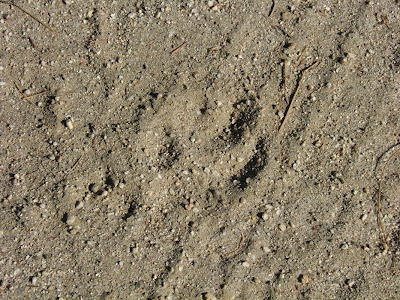

I saw that the puma's tracks overlapped mine from the night before. So he had strolled along the road after I left my sheet around 10:30 PM? Then I found a spot where my foot prints covered those of the cat. I also saw paw prints close to my sheet. Then a row of them, leading towards the campground. And again, my own footprints crossing the paw prints, and in some places the paw prints were on top. At a very soft, dusty spot there were clearly much smaller tracks next to the big ones. At least one cub! It seems that I had had a lot of company last night. I hadn't heard a thing.


But by now I was listening to any pebble that fell off the cliffs along the road and any rustling in the bushes. Believe me, there were shadows moving under the overhanging branches of a big blue spruce and on the cliff above fawn colored rocks moved and turned into crouching lions staring down at me.


 But then all I found were some lizards and more skippers bashing each other noisily with their wings. Mysterious little clicks and crackles were identified as the 'song' of Platypedia putnami, the small cicada associated in many places with Ponderosa Pines. I resumed chasing bugs with my net and beating branches over my beating sheet.

Mother Puma was probably relaxing somewhere with her cubs, laughing at those human antics ...

Wednesday, June 12, 2013

Yard Snakes in June

Our rattlesnake count for 2013 is finally going up. After several months without any visitors we first had the little one that the quail family pointed out. Then two nights ago, Randy, barefoot in sandals, stepped on a Diamondback that was concealed among some garden hoses on the brick terrace in front of the house. My husband is now turning on his flash light, not just carrying it. The rattler hid in a thicket of barrio petunias and could not be convinced to come out.


This morning a big rattler struck at Frodo on the steps of the back patio. It happened so fast, I heard a hiss but at first no rattle. Frodo has finally learned to fear rattlers (after 7 or 8 bites) and he backed off unharmed, only to let Cody take over the snake-barking duty. That rattler (photo) we carried out to the old lime stone quarry. When we crossed our fence to the state land the horses heard the rattle from the transport bin which has great accoustics. They threw up their heads and spooked with Cody in deliriously happy persuit.

When released from the bin, the snake recoiled and rattled. Trying to encourage him to move on, I threw some dry horse manure and sticks, not hitting him but very close. He didn't react at all to the flying objects, just kept his head turned toward me ready to strike. Maybe the  heat-sensing "pits" on his face read my thermal radiation and told him where the living threat was, or he could smell me. Looking at the photo I think his eyes look filmed over, so he may have been temporarily blind because he's close to shedding his skin. I'm wondering: what information do the heat sensors provide when the environmental temperature raises above the core temperature of an endotherm bird or mammal? Of course the rattlers are mainly night active in summer.


On the way home I was speculating how to test my theory (the one about the ignored inanimate clods of horse manure) on a non-viper, when Randy said "Like this one? Camera??"
A four to five foot Gophersnake was beginning his day with a dip in our bird bath. He was lying quietly, and as I watched him breathing while all of his body remained submersed, I found another physiological problem to ponder: He seemed to pump the air rythmically from his gular and neck region into his elongated lung (click to see video).  The entire rest of the body was lying completely motionless. I had never noticed this 'air gulping' in snakes before, just in amphibians. When the snakes left the water, its breathing movement became invisible.
Answer:  the lungs of a snake are usually ventilated almost exclusively by its axial musculature. That is the same musculature that is used for locomotion. What I saw in my 'water snake' was buccal pumping which is indeed a form of swallowing air  (into the lungs, not the digestive tract). It is used in situations where axial breathing is not feasable.

Gophersnake swallowing a rabbit. This is after the strangle hold is released
Another question: how do these constrictors breathe while they are squeezing the life out of a squirrel or bunny? How do they manage not to suffocate themselves? Buccal pumping doesn't seem possible then either, because the mouth is open. Maybe snakes, being heterotherm, just need so much less oxigen than their warmblooded prey that they can afford not to breath during this act. But what if the prey is a lizard?