Showing posts with label Sonoran Desert. Show all posts

Saturday, March 31, 2018

Will the Harris Hawks of Sandario Rd in Picture Rocks become homeless?

Watching a pair of Harris hawks at a tree that has hosted their family for years, maybe decades, made me wonder about the symbiosis between an endemic hawk and an imported tree.
Aleppo Pines were brought  to Arizona desert cities from Lebanon and Syria as landscaping trees. Most were planted 30 to 50 years ago. Although they were not really adapted to our typical rain pattern of monsoon showers in summer and soft. but productive rains in winter, they thrived for decades and outgrew in many cases their allotted space. Low slung ranch houses under towering, monstrous pine trees were a strange, but typical look for Tucson neighborhoods when I arrived here in the early nineteen nineties.

But nowadays, those trees are becoming rare. We lost a few on our own property: they became pale, nearly straw colored, produced a couple of panic crops of cones, and died. It made us sad and left us feeling guilty - thinking that we did not care for them properly.
Then there was a diagnosis: Aleppo Pine Blight.
 There was a lot of guessing as to the cause of this disease. Bark Beetles and 'nearly invisible' mites were blamed. I stripped the bark of our tree corpses: no tell-tale sign of bark beetle infestation at all. Anyway, those bugs like mountain air, not desert heat ... but still, bugs usually get the blame.

Bark beetle infestations leave typical tracks under the bark of trees killed by the beetles. They were not present in dying Aleppo pines.
By far not all plant diseases are caused by organisms (bugs). Disease may occur because moisture is not available to tissues; consequently, they malfunction or die as a result. Insect infestation may sometimes be exasperating the problems but they are usually secondary to climactic stresses. No insect infestation was found in most dead pine trees in Tucson. 
Excessive evapotranspiration occurs when soils are dry and sustained winds  blow at extremely low relative humidity. The high water loss from needles cannot be replaced by adequate water uptake from the soil. Climate change has increased these stresses over the last decade, so now even old, established trees are succumbing all over Tucson. Another factor: irrigation over decades might have leached nutrients from the desert soil and caused an increase in salts, while an ever increasing layer of caliche that further inhibits healthy root growth and water uptake. Temperature extremes are also increasing lately - maybe exceeding tolerance thresholds of the Mediterranean Pines.
But even if the huge pines were aesthetically uncool and also, while healthy, a burden on our limited water resources, they had a positive side: Harris Hawks loved them as nesting trees. 
Harris Hawks are superbly adapted to the Sonoran Desert in many ways. I am pretty certain that it was the pressure of this hard environment that made them evolve into the only social species of hawks: the resident, territorial pair allows several younger hawks to live close by. The hawks hunt as a group, share the kill, and the young 'satellites' help the main couple to raise its young. So an obvious advantage for the resident couple. From the viewpoint of the younger hawks, this altruism is a little hard to understand because genetic tests showed that the hawks are not usually related. So no kinship selection here. But, the entire group can take down larger prey than a single hawk could slay. This may be advantageous as so many small prey animals are night active here. Considering that about 50% of fledgling hawks usually die from starvation within their first year, communal living may give more time for the young guys to become strong adults.  Furthermore,  the younger birds are probably in an excellent position to take over territory if something happens to the owners.   
Free Flight Hawk Group of the Arizona Desert Museum
 Harris Hawks,  because they hunt cooperatively, can afford to be smaller than our other successfully free roosting desert birds of prey, Red-tails, Caracaras, and Great Horned Owls. (Kestrels breed in cavities, Gray, Black and Zonetail stay in riparian or mountain forests, Cooper's adapted well to human neighborhoods with trees).

Who knows who built this nest? GHO do not do it themselves
 But Harris Hawks share their habitat directly with their great arch enemy: the Great Horned Owl.  The owls hunt and slay birds up to the size of Harris Hawks, they rob hawk nestlings and they love to take over established nest sites like the classical Harris Hawk nest in the sturdy bowl of sheltering Saguaro arms. 
A different site, also now owned by the GH owls. Both Picture Rocks, west of the Tucson Mountains
 So Harris Hawks around Tucson may have really benefited from the prevalence of huge, dense Aleppo Pines - I knew at least half a dozen nests that successfully produced fledglings year after year.  I also know of successful owl attacks on some of these nests, but at least in one case, the hawks were back a year later. Maybe the dense pine branches give enough of an advantage to the smaller, maneuverable hawk over the large owl. 
Dead Pines along Sandario Road, still hosting an active nest
 Since we lived in Picture Rocks I saw Harris Hawks around, but although I found Red-tail, Screech and GH Owl, Cooper's, and Kestrel nests, I never found a Harris Hawk nest around here. But I always saw them flying, carrying branches or food,  into two huge pine trees at Sandario Rd. There had to be a nest! But it remained completely shrouded by those dark tree crowns. 
Sadly, this spring the needles are falling, the trees are nearly bare. There is a nest though, and the hawks have not quite given up on it. 
 Today I saw the female sitting on the rim of the nest. - freely silhouetted against the sky. Then she flew down, landed on a power line post, the male joined her and they mated. So the hawks are optimistic, life will go on, even in a dead tree. 

Tuesday, January 16, 2018

Javelinas in our Backyard


Our backyard gets visitors periodically, even though it's fenced as a dog run. They (the Javelinas) systematically uproot dozens of mamillaria cacti and eat the roots. So we pick up the buds and put them into sand-filled pots to reroot, then plant them for the next invasion. To get at least something out of it, I made the whole party pose for a painting.

 Even though they look deceivingly similar to wild boars Javelinas or Peccaries are only distant relatives of pigs. Taxonomically they are members of the same suborder, Suina, but are in their own family, Tayassuidae (New World pigs). They sport two pairs of big canines as opposed to just one in Oldworld Pigs.
But like pigs, they live in family groups, and root for their food with very similar snouts. As ours live in the desert, I never saw them enjoy mud baths, but our Arizonan, New Mexican and Texan Javelinas  live at the northern most tip of their distribution area which reaches all the way south to Argentinia. So they must use  many different types of habitats.
They are territorial and use skunk-smelling secretions of their  scent glands (below each eye and  on their backs) for marking and communication. If hunted for food, these glands have to be carefully and immediately removed or the meat is spoiled. I have eaten jerky and fresh, grilled tenderloin as guset of Mexican gold miners and it was very good.
Javelinas are rather nearsighted and also quite fearless, which results in frequent close encounters between them and human and caninen Arizona residents. Often the Javelinas just go quietly about their business. While house-sitting in the Tucson foothills at First Avenue, I once found myself surrounded by a herd  between garage and patio. They were so peaceful that I reached out to touch the big patriarch when he walked close to me. He screamed with indignation and bristled. Other people have been less lucky,  and those big canines leave bad wounds. My 40 pound Healer-type dog Bilbo got into a fight with a single Javelina last year, and he came away from it with a big, gaping chest wound. But at other times my dogs have cornered the entire resident herd including young ones and nothing happened. With Javies, you just never know.  So don't ever feed them, not even inadvertently by  keeping garbage or compost in accessible containers. The more the 'desert pigs' get habituated to humans and their houses, the more confrontations happen, and those usually end with killing or removal of the javelina herd, and our desert is all the poorer for it.

Sunday, October 22, 2017

We need Connections, not Walls!


Ocelot and Mexican Amberwing, watercolor October2017
 I live in Tucson, Arizona. 30.7 miles, or 50 kilometers, or 44 min by car from the US/Mexico border. In my dual role as artist and biologist I spend much of my time in the field. Tucson is surrounded by the Sonoran Desert. As deserts go, the lower Sonoran is beautiful and rich in geological formations and fauna and flora. But also hot and dry most of the year. The long drive to the Colorado Plateau and Grand Canyon in northern Arizona  would take me through the endlessly sprawling metropolis of Phoenix. So I turn south instead. The borderland to Mexico, studded with sky islands and the first hints of the Sierra Madre Occidental has become my favorite hunting ground.  I regularly join  excursions to study the biodiversity south of the border wit groups of US and Mexican naturalists and biologists. More often, and on my own, I spend time just north of the border. Long dirt roads connect the Canelo Hills and the San Rafael Grasslands, Parker Lake and Copper Canyon, Sycamore Canyon and Arivaca. Many side roads take me directly to the border fence. There are often heavy truck barriers, but they are low enough to step over. In other places, tall metal beams, set too close to each other to squeeze through, form a more impressive interruption of the landscape, but it still seems penetrable for small wildlife and cougars have been shown to jump it. In Lochiel, an old, nearly abandoned border town south of Patagonia, AZ, I used to pet Mexican horses grazing on the other side of an old chain link fence with big holes.  It's a quiet area, somehow suspended in time, and full of natural beauty.
It's not all paradise. In many areas along the fence, there is a wide gash in the vegetation, where border patrol erased every living thing to create a corridor for easy surveillance. There are strange contraptions that the agents can pull behind their trucks to sweep the ground so new tracks of border crossers show up clearly.   There is thrash that crossing people abandoned and sometimes clearly the packing material from drug transports. There are water stations that good Samaritans established because the harsh desert claimed so many lives. Very occasionally I meet people who approach me for help - who ask for water or need a charge for their phones. Or even a connection to the next agents of 'la migra'. The white, green-barred  SUVs of the border patrol agents are usually not far away, always cruising, waiting, watching ... but also often the last resort for people in need. The agents keep up the immigration restriction that US law dictates, but  so far, the situation is very different from what we experienced in the Europe of my childhood along the Iron Curtain and most of all the Wall and Death Stripe of Berlin. I can only hope that it stays that way.  

Thursday, September 17, 2015

The patience of snakes


 It's snake weather again. Each year, our rattlers show several bursts of activity. One is beginning now at the end of the monsoon season after a few good soaking rains. Diamond Backs even have a second mating season in fall. So every evening Frodo, our snake barker, announces his sightings on and around the patio.


Yesterday I heard a loud buzz when the dogs were running up to get their dinner. A big Diamond Back was curled up in their path, looking somewhat annoyed, but sat quietly while the dogs were being fed 10 feet away and then let into the house. He then moved on, too. Go, get those packrats!


This morning we walked into the state land right next to our place, happy that for once we heard no 'puff puff puff' noise from the guns of dove hunters. But we aren't able to pay enough attention to two things at once. On the way back I nearly stepped on a curled-up Sidewinder with Randy's tracks firmly imprinted on both sides and Bilbo's nearly touching the snake's body. That had been very close.


Temperatures in that sunny spot were approaching the nineties by then. Nevertheless, the snake was tightly curled up, snuggled in and keeping a low profile as only Sidewinders do. I thought that he'd soon be too warm, so he'd probably be close to moving on. I had not seen the 'side-winding' motion and was determined to make him demonstrate it. Camera in one hand and a thin, dry creosote branch in the other, I tried. Gently. No reaction.


A little more forceful. He acknowledged me with a flick of his tongue. I pushed the stick under him. He turned out to be much easier to flip than a pancake. I unraveled his coil, admired the small, perfect rattle, he just gave me a look.


I felt more and more guilty about disturbing his peace. I moved him back to his favorite spot, tucked him back in and rearranged his coils. Not quite right, he sighed and perfected it himself.


I apologized for disturbing him so rudely. I still haven't seen a Sidewinder side-wind. He dozed off for another hour or so.
This blog has links to 2 videos on flickr. Please click on the orange highlights in the text to see them. And trust me, while clumsy, I was gentle.


Friday, July 11, 2014

The Night of the Desert Queen Peniocereus greggii


Last night the flowers on our backyard Queen of the Night (Peniocereus greggii) finally opened. The flowers were small but perfect. They seemed to glow in the light of the full moon and their sweet fragrance floated on the humid, warm air of this monsoon night.


 A single small moth was visiting. Even at my black light, this still is a moth-poor time. Last year I noticed that many queen flowers wilted away without producing fruit. The reason could have been a lack of pollinators. But last night I found a longhorn beetle obviously doused in pollen. I'm sure he came to the sweet smell and found the nectar and will also distribute the pollen.


I went back in the very early morning hours to find more blooming plants. The first thing I noticed was that our backyard flowers had already closed up, usually a sign that they are pollinated.


I walked across about half a square mile of state trust land. Many of the plants that were blooming last year were resting this season. The wild native Queen cacti whose branches are thin and not very succulent rely mainly on  big underground tubers for survival during droughts. After a year with many flowers and fruit, the above-ground stems often shrivel and dry up. New sprouts emerge from the ground but rarely bloom for the first two years.


But I found about a dozen new plants that I had not known before. Many were small and had only a single flower, but some were as tall as I, with big, antler-shaped stems and up to a dozen flowers.
Of course the pollinators may be drawn to the flowers by the sweet fragrance, but I, being a visual creature, scan the area for the pale white spots that barely clear the branches of the creosote bushes. The color seems perfect to reflect the uv part of the lunar spectrum. So the big mobile sphinx moths can probably also do a long distance visual scan, even at night.


This morning however, I found even the wilting flowers inundated by honey bees that were obviously still getting their fill. Every plant was surrounded by dozens of honey bees. This is very different from last year, when I found little Agapostemon sweatbees but no Apis melifera at all.
I think I know the explanation: the winter of 2012/13 brought several nights of deep freeze. Well provisioned honey bee hives in Europe are able to keep the temperatures high enough during cold spells to allow the majority of bees to survive. Africanized honey bees usually sustain much greater losses. Small feral hives (many Africanized bees tend to split hive and swarm more frequently than Italian honey bees) are even less cold resistant. So while Africanized bees can usually survive Arizona winters as feral colonies, the winter of 2012/13 had pretty much wiped out the local population. But now, after the very warm winter of 2013/14, they are back in force.
The Queen of the Night is by timing and color the very opposite of a bee flower, but those feral honey bees have great scouts and are fast learners - I think they found all the wilting flowers today and carried off all the drags.    


I did not ask any dogs to join me on my NBC quest, but after a while I noticed that Cody had quietly joined me. We walked all over together, until he finally got tired of my meandering from plant to plant. He might have felt too weak to go on and returned home as quietly as he had come out. This was our last walk together and the photo above is the last one I took of our most beloved dog. A week later, Cody died.

Thursday, March 20, 2014

Mining Bees under the bedroom window

Updated repost from 2014
 Our house is built on sand. It sits on a little mesa (elevation) consisting of soil that was excavated to put in the basement. Over the years I found out that we share this site with many sand loving, digging insects, tarantulas and scorpions. And please don't think that that is a problem. Some of these guys may even keep out others that we would like less.

The little dark parasitic bee, waiting close to the nest entrance
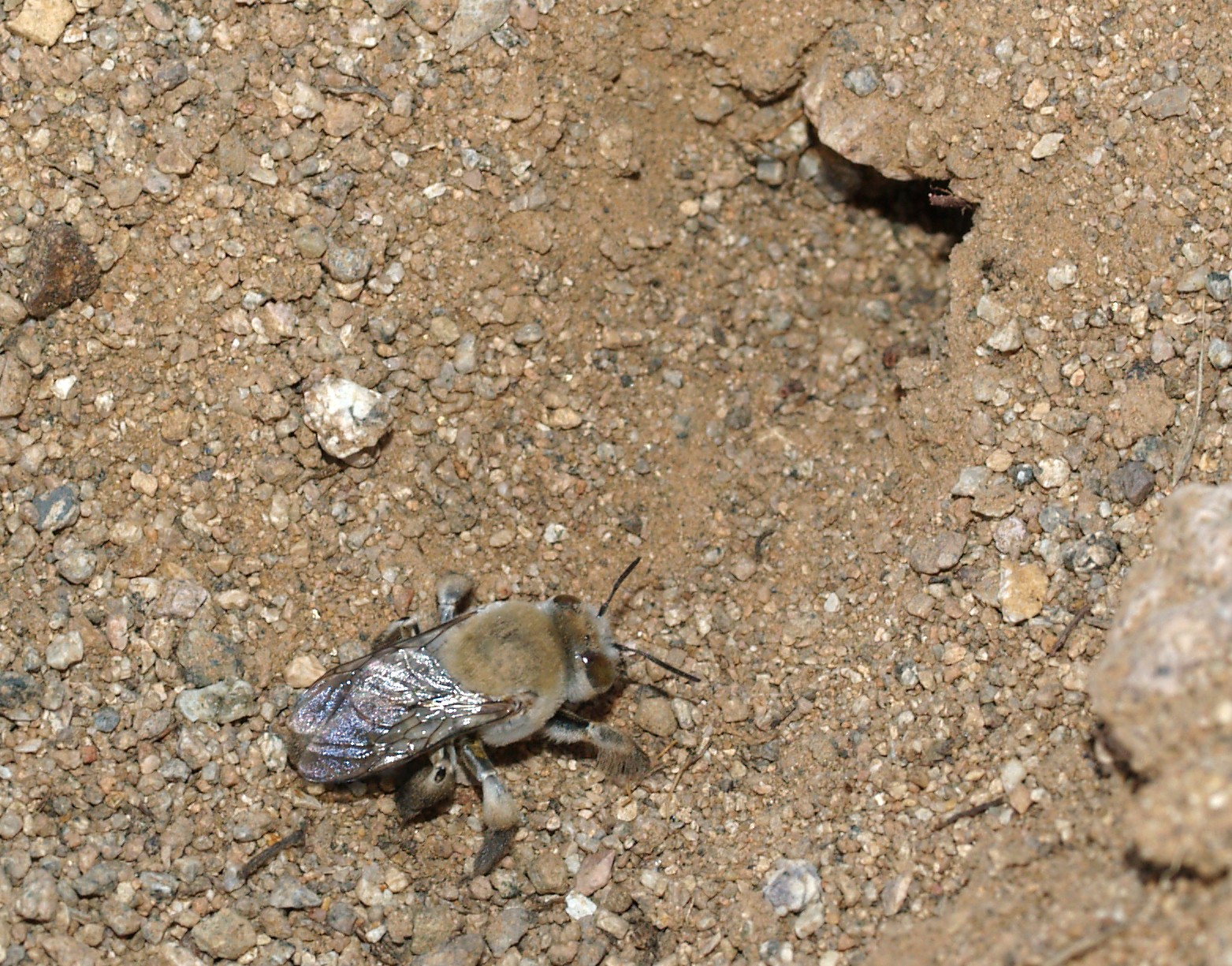
 Yesterday I was reading at the bedroom window when I noticed a dark little bee zigzagging and descending repeatedly out of sight under the window. Time to investigate.
When I got outside, she was resting on a flat rock. In the soil around it were several small, round holes about 5 mm in diameter. Another bee buzzed closer, circled, landed next to one of the holes and slipped inside.

A mining bee exiting the nest entrance
 This bee was larger, plumper, and lighter than the little observer. It stayed in the hole for a long time. While I was watching, two more bees arrived and crawled in. for over 10 min no bees left as far as I could see. Then the smaller bee flew up, circled shortly and also crawled into the hole. Several other bees of the bigger kind entered 5 other holes, all in an area of less than a square meter.  Eventually bees also exited the hole that I was watching, but too fast to get any good pictures. Peak activity seemed to be around 10 to 11 am.
Today I came better prepared. For example, I found a way to sit instead of crouching over the hole for what turned out to be long waiting times. So I got some video of the larger bees that clearly shows that several bees are using the same entrance and are under ground simultaneously. Incidentally, the little bee was inside during that time as well. This time I trapped her and three exiting larger bees to get a closer look. I had an idea by now that I was dealing with mining bees and a clepto-parasite, but I found that I didn't have these guys in my photo collection yet.

Ancylandrena sp. Doug Yanega det.
 Indoors, I put each bee into a white ceramic bowl and covered it with a clear plastic container. It took a while for them to calm down. If they had been beetles, they would have experienced a short cool-down in the fridge by now, but bees just don't look right when they are cold. So instead, I got the chance to take a few quick photos, some OK, some blurred and some out of focus, of each bee before she took off for the window. No harm done, they were easily coaxed back into the container.

Hexepeolus rhodogyne, Doug Yanega det.
In the close-ups, the parasitic bee looked somewhat beat-up. Maybe her life as an uninvited guest was not quite as easy as it seems. But her visits in the nest, concurrent with those of several 'owners' did not seem to create any disturbance.

Several of my Flickr and facebook connections are bee specialists, so I posted the photos there and on BugGuide.

From Doug Yanega came the response:  "The latter is Hexepeolus rhodogyne, and it is a cleptoparasite in nests of Ancylandrena (the first bee). It wasn't until the 1990's that the host-parasite association of these taxa was confirmed, as I recall. The genus Hexepeolus contains only that one species".

John Ascher added a link to the 1994 paper: Biologies of the bee genera Ancylandrena (Andrenidae, Andreninae) and Hexepeolus (Apidae, Nomadinae) : and phylogenetic relationships of Ancylandrena based on its mature larva (Hymenoptera, Apoidea). American Museum novitates ; no. 3108

It turned out that BugGuide had an image of a mounted specimen of the parasite, but only an empty, prepared, page for the host. So I was able to fill in both with white backgound-life-close-ups and action in situ shots:

BugGuide Info Page

As for the species id, in Discover Life I found a description of a rare Tucson specialty, A. rozeni, but it would be difficult to identify it without comparative material:  A. rozeni - This is a rare species with records restricted to Arizona, specifically known from the Tuscon area - The male appears closest to that of A. larreae though slightly smaller, has a shorter clypeus, has shorter antennae, has smaller light markings in the paraocular area, is less densely pitted anteriorly on the scutum, hairs sparser in the anterior of the scutum, and has a greater proportion of dark hair on the upper areas of the head - The female appears most similar to that of A. timberlakei, although it may be differentiated by the presence of some degree of a tan or yellowish brown mound on the base of the mandible, a greater proportion of dark hairs in the upper areas of the head, the fact that all hairs anterior to the middle of the tegulae are white, and that there is a greater proportion of light-colored hairs on the scopa (2)
 Anyway, I preserved a specimen.

So to summarize, Ancylandrena is a mining bee. In spring males and females emerge from underground cells. They mate, and the females dig nest burrows in sandy soil. Mining bees collect pollen in the long hairs of the tibial scopa of the hind legs. (They do not  have a 'pollen basket' like honey bees and bumble bees). They construct small cells containing a ball of pollen mixed with nectar, upon which an egg is laid, before each cell is sealed. Although not social, several individuals seem to be sharing at least a nest entrance (Solitary, communal ground-nesting). As many insects do, they provide provisions for their offspring, but they are not around to guard the larvae while these are growing up. Clepto-parasites like the one I observed commonly make use of this arrangement to raise their own brood. Many of these clepto-parasites, like this one, are in the subfamily Nomadinae (Cuckoo Bees). They usually lack the hairs that are used by their relatives to collect and transport pollen. There are a number of strategies to get parasitic eggs into a provisioned nest. In this case the cleptoparasitic bee just followed the host bees to get her eggs into the brood chambers before they were closed. In Rozen's study several eggs of Hexepeolus rhodogyne were attached to the inner wall of the brood chambers while the larger egg of the host bee was sitting on the pollen ball. This explains why Hexepeolus was around for several days entering the same nest repeatedly: she had to access the chambers that were just in the right stage of construction.

PS: I was busy at an art show for three days, but when I checked again on Monday, 3/24/2014 there were still Ancylandrenas entering the same nest. I also found another nest about 60 meters south on a berm planted with cacti and creosote bushes.

Update: In the following years  I did not see these bees nesting again. But my observation and photos made it into a great new bee book 'The Bees in Your Backyard' by J S Wilson and O M Carril Princeton University Press 2016.

 
 In April 2018, on our neighbors' potted Aloe, I found a group of sleeping males of another Ancylandrena species Ancylandrena rozeni.
This species was first found described in the Tucson Mountains.  Mine were identified from my photos by John Ascher.


Friday, March 1, 2013

It may be all about the temperature

When I turn on my black lights during a cool winter night I always hope to find something special. While there are bug collectors beating on every bush and mercury vapor lamps glowing in every clearing in July and August in Arizona, not many out-of-state entomologists come out here in winter and even we locals prefer a warm fire place to a cool bug light.


Last night I found a few geometrid moths, some spiders, and a lonely click beetle. Two leggy insects looked like they might be a type of Thread-legged Bug. But the antennae seemed wrong and the abdomen too heavy.  At closer investigation they clearly had the head of a crane fly, but no wings!
When I enlarged my photos I found that they did have tiny, obviously dysfunctional wings.
The other obvious difference to other crane flies was the body shape: The thorax was hardly wider than the elongate abdomen. 'Normal 'Crane Flies that have a pair of long narrow wings support those with a bulging, muscular thorax. No functional wings, no big flight muscles...

Dactylolabis (Eudactylolabis) vestigipennis
 The fly I found seems to be Dactylolabis (Eudactylolabis) vestigipennis. Thanks to John Carr on Bugguide for the identification. Dactylolabis is a genus of crane fly in the family Limoniidae. It is placed in its own subfamily, Dactylolabinae. Most species are winged.
The type specimen of D. vestigipennis, curated at the Smithonian was collected in the Tucson Mountains, and I found mine in the bajada of those mountains. Others were reported from the Mojave Desert further west and all around this time of the year.
 This means that the temperatures that these nocturnal (?) crane flies are likely to experience during their adult lives are very low.  In February the night temps in the Desert hover close to the freezing point. Yesterday I measured 36 F.

Flying is not only a high energy sport in itself, its apparatus also requires a certain minimum temperature to function. Many good fliers among insects, like bumblebees, sphingid moths and big beetles are able to generate the necessary heat metabolically. They shiver just like birds and mammals.  So at times they are endotherm  like those higher vertebrates.  But while most birds and mammals maintain high body temperatures almost constantly, these insects turn on the heat production when needed, that is when they need to fly at low ambient temperatures.   
The obvious reason is the cost of that heat production as the energy consumption of those shivering muscles is high. When bumblebees in cold climates live around flowers that provide only small amounts of  nectar (asteraceae) they don't fly on cloudy days and remain cold-blooded, while those with access to high-yeald flowers (Fire Weed) will increase their body temperature and fly on rainy days. (Bumblebee Economics, B. Heinrich, 1979, Harvard University Press)

The small moths in the family Geometridae that are coming to the lights right now are unable to increase their metabolic rate for heat production. They don't have the energy to spare, because they don't feed as adults. Their mouth parts and digestive system are reduced and non-functional. Investment in these structures would be wasted because they fly mainly in winter when there are hardly any nectar-sources available, even here in Arizona. So they rely on the resources that they amassed during their larval state. Still, the light, slender males are able to fly in cold temperatures due to their large wing size and special adaptations in their enzymatic make-up. Interestingly, in many species the heavier females of these winter moths are wingless and earth-bound.

Dactylolabis (Eudactylolabis) vestigipennis

Surprisingly little is known about crane flies, considering that some winged species are inch-long and in-your-face-obnoctious if you sit outdoors by candle light on warm summer evenings. The larvae usually feed on decaying plant tissue; some species are carnivorous, and others damage the roots of cereal and grass crops. Most are found in semi-aquatic or at least moist habitats. The feeding habits of the short lived adults are not well described. Some possess a long slender proboscis and feed on plant nectar. Not surprisingly, I couldn't find any info on the life cycle of this tiny (11mm) inconspicous species.


The tip of the abdomen

the narrow thorax with reduced wings


the head
But I think I can guess why these flightless guys should turn up during cold winter nights. Even under the microscope I cannot find a proboscis, so they may not feed at all. The two that I found may be females - the males may be able to fly? I will place them into a flight cage tonight to see if they attract the opposite sex. Anyway, I assume that the reduction of wings in this species is an adaptation to a biological niche where the ability to fly would be very costly because of the low ambient temperatures that these insects live in. 

Winter and night activity opens an ecological niche to insects that have little other protection against predators. They live their adult lives in the cold, maybe without food, but also out of reach of day-active birds, summer-active bats, and most predatious insects so they can focus on their only purpose: finding a mate to propagate their genes.

Tuesday, May 10, 2011

Centris Bees, the Bean Tree pollinators


Foothills Palo Verdes bloom along Picture Rocks Road in the Tucson Mountains, Arizona

Legume Trees are blooming all over the Sonoran Desert. Those hunger specialists with nitrogen-binding symbionts attached to their root system dominate habitats with poor sandy soils from Texas to California.

Ironwood Tree in Saguaro National Park West


Ironwood flowers are built like bean or pea flowers

While Acacias and Mesquites expose their pollen in very reduced flowers to any willing pollinator and even the wind, PaloVerde and even more so Ironwood and the  western Smoke Tree have retained most of the typical leguminose  flower architecture that requires insects with a short proboscis but a sturdy body to to push their way inside towards the nectar. This triggers an upward movement of the flower's stylus which then rubs along the furry underside of the bee to ensure pollen transfer to the stigma.

Centris pallida at Ironwood flower

The main pollinator of Palo Verde and Ironwood Trees is the Digger Bee Centris pallida. As soon as the chilly desert night gives way to the warmth of an early May morning, the droning sound of the big bees fills the air around every blooming tree. Females zap from flower to flower, visiting each only for seconds but quickly filling the pronounced pollen baskets on their hind legs.

A white-faced Centris pallida male
In our blooming Ironwood, I watched males stake out little territories that they patrol and mark with pheromones (Frankie et al. 1989), zigzagging back and forth,  hoping to find an unmated receptive female. It seems that a more successful strategy would be to wait for females directly where they emerge from the nest burrows, and indeed, in many Centris species, including C. pallida, metandric forms occur. These males are larger than the territorial males and appear to patrol nest sites where they wait for females and to mate as they emerge or to even attempt to dig them up to mate (Alcock et al.1976a, 1977, Chemsak 1985, Toro et al. 1991).

Both strategies, searching for and digging up emerging females, and releasing pheromones and defending territories, have been shown to be energy intensive (Vinson et al. 1982). During my attempts to photograph them, I found that males often take brakes from their vigil, usually on the inner branches of the tree. There they fall for several minutes into a torpor like state. I actually coaxed one onto my finger where he kept sleeping peacefully. This was the chance to shoot close-up portraits showing clearly the male's white clypeus (the female has a dark face).

Female collecting nectar and Pollen
The females are constantly on the move and difficult to photograph. They have to collect food for themselves and the brood provisions, plus fluids to bind the pollen, plaster the cell walls and seal the brood chamber.


Female digging a brood chamber and distributing debris
The females digg their nesting chambers in loose sand, often into a slight slope. The debris is carried off and distributed rather carefully and doesn't attract attention to the entrance hole. Cleptoparasitic bees, who would position their own offspring to steal the Centris Bee's provisions, are probably her main concern.

A tunnel and brood cells are constructed, and soil and collected fluids are mixed to stabilize the walls. Pollen, nectar and plant oils are collected as provisions for the brood. Female Centris Bees have huge corbicula (pollen baskets covered in special hair)on their hind legs, and both pairs of front legs are used to push the pollen tightly onto these receptive areas.


Centris artripes

Centris rhodopus
Besides Centris pallida, several other species of Centris occur in the Sonoran Desert. The two females above were drinking at a seep in the Ironwood National Monument.

Literature: Chemical Ecology of Bees of the Genus Centris SB Radleigh, V Inson, I Gordon, WF Rankie, HJ Williams 1996 

Friday, May 7, 2010

Rare encounter: A Mojave Rattler


We live in the Bajada of the west side of the Tucson Mountains. Yesterday morning my husband Randy, our dog Cody, and I went to the eastern part of our property to check out the blooming chollas. A Desert Iguana Dipsosaurus dorsalis was bobbing his head in a territorial display. They aren't very common here and I'd found one of them dead this spring, so we were very happy to see this one.

Then the short dry grass right behind the big lizard moved and a snake slithered by, not two feet from him. The very straight movement identified it as a rattler, other snakes move in a more undulating manner. Where lacy Creosote shadows and its own markings made it nearly invisible, it flattened itself to the ground. Snakes, who have no sternum, actually spread their ribs to do so. This pose allows them to absorb a maximum amount of heat from the warm sand and from the radiation of the sun. It eliminates most of the cast shadow which hides the snake even better.
This snake turned out to be a female Mojave Rattler, Crotalus scutulatus. Thanks, Brendan O'Connor, for verifying my identification which was based only on the wide white /narrow dark bands of the tail. More reliable diagnostic markers are the facial scales and the band that runs from the eyes to the corners of the mouth. I didn't want to get close enough to record those with my 50 mm Macro lens.

We left the rattler alone - with trepidations. Rattlesnake venom is mostly haemotoxic, extremely painful but rarely deadly to larger animals and humans. But with squirrels becoming more and more immune to it, Mojave Rattlers co-evolved by producing a neurotoxic venom component known as Mojave Type A toxin- which puts them in the same class as the deadly Cobras.
This snake had a very small rattle for her 2.5 foot body length. A rattler adds a section to its rattle each time it sheds its skin which happens several times per year. This one must have broken off parts of it. She also never bothered to rattle even though I was very close.


Cody was strolling around but never noticed her. He is snake trained (the hard way) and he flinches even from black and white ribbons, curved branches, or the smell of my snake stick. Occasionally he's fooled by a Gopher Snake. He has a clearly recognizable, rhythmic 'snake bark' that will alert me from my deepest dreams. Rolling out of bed, grabbing some shoes, the snake stick and a flash light, then locating and holding the snake until Randy arrives with a container, has become the routine of hot summer nights when the snakes seem to follow the walls of our house right to the patio and the dog beds. The following morning we carry the captive out to the adjacent State Land for photo shoot and release. From May to September last year we had to move 14 Diamondbacks from patio and dog-run. Elsewhere on our property we leave the snakes alone and appreciate them with the rest of 'our' wildlife.
Western Diamondbacked Rattler
Crotalus atrox