Wednesday, October 27, 2010

Lubbers, our largest Grasshoppers

Even though grasshoppers and their growing nymphs can be found in Arizona at all times of the year, they really seem to dominate our insect fauna in late summer and autumn. Our local species hardly ever develop population densities that would induce them to turn into wandering bands of Locusts, but when you walk through grass land or brush a few of them seem to jump up under every step.

      Chihuahua Lubber                                    Horse Lubber                                    Plains Lubber
Phrynotettix tshivavensis                       Taeniopoda eques                             Brachystola magma

Because of their size, the heavy-built Lubbers or Romaleidae are especially conspicuous (Two immovable spines on the hind tibia separate them from Acrididae who have only one spine, but mostly they can be recognized by their large size and lumbering gate).
 So far, I have found the three species shown above in southeast Arizona. I am still hoping to find the Furnace Heat Lubber, Tytthotyle maculata, and the rare Spanistic Desert Grasshopper, Spaniacris deserticola, both in western Arizona.

The strange looking  Chihuahua Lubber is the rarest of the species that I found. It occurs in early summer in rocky or gravelly arid areas from the lower desert elevations up to the oak and juniper belt of the mountains.
 Chihuahua Lubber, Phrynotettix tshivavensis

Their compact shape, brownish color, and warty surface hide the flightless lubbers very well in that environment. It took me years to find my first one in Brown Canyon in the Baboquivari Mountains, but then, after having established a search image, I also found them in other places like Canelo Pass south of Sonoita and Florida Canyon in the Santa Ritas. Our Chihuahua Lubber is considered a distinctly different species from the Robust Toad Lubber, Phrynotettix robustus that is found in Texas.


The Plains Lubber has a wide, but patchy distribution. This year they seemed to be a banner year in southern Arizona, with big males basking in the sunshine wherever sunflowers or rabbit brush lined the road sides and even mated pairs slowly crossing the roads. 

 Plains Lubber Brachystola magma

Eggs are laid in the ground in pods of about 20. In a the USDA study the eggs needed two years of incubation and over-wintering before hatching. Field observations of population peaks in alternate years support the hypothesis of a two-year life cycle. 


 The nymphs hatch wingless and undergo five molts before they mature. The adults have only very small non-functional wings and their only means of dispersal is their lumbering walk and slow jumps. They feed voraciously on many different plants but seem to prefer the sunflower family. Only rarely do they venture into cotton fields and do some damage to the crops. Mainly phytopagous, they supplement their diet by scavenging and have been observed to kill  and eat smaller grasshoppers.


The Horse Lubber Taeniopoda eques is locally known as Mexican General. That's because of his bold aposematic coloration, over 3 in length and stately movements. In some years in October, when the lubbers cross the roads to Madera Canyon and Mount Hopkins by the hundreds they look like an army on the march.
 Horse Lubber Taeniopoda eques female
This female is roosting high in a mesquite tree before night fall. Most likely, this will allow her to catch the early sun shine to warm up and get active quickly in the cool desert morning. It's October!

Although many of the males have functional wings, they rarely fly. Instead, they use their wings in a defensive display when they are threatened. The flashing of the red hind wings is accompanied by clicks from the front wings and hissing. I addition, they may exude foul smelling froth from their thoracic spiracles (breathing openings).

Defensive pose Photo Katrina Weber

Judging from the numbers of Horse Lubbers that walk around openly and unencumbered by birds or other predators,  the strategy is working. However, many get run over by even the most respectful drivers. Any roadkill is immediately cannibalized by the survivors, often resulting in another series of traffic calamities.  Otherwise, they feed on the foliage of Mesquite and other brush and broad-leaf  weeds. 


Early instar nymphs tend to stay together in groups. I have found them in early to mid August and the adults as late as the end of October.

Some folks really know how to appreciate our Lubbers! This Plains Lubber photo was sent to me from Prescott after this blog helped with the introductions!


Friday, October 15, 2010

Western Diamondbacks' mating attempt in fall

October 16, 2010
In front of my studio window, we have a little 'house' that protects one of our quail blocks from being carried off by coyotes or dogs - havelinas can't get through the backyard fence. This morning there were coils moving inside.
At first, we couldn't quite make heads or tails of it - there were too many loops. Then we saw the head tapping the back in an unusual motion, tenderly?.
Ok, two tails, and intertwined in a suggestive position. They mate in October? Normal mating season is in spring, I saw them in April. Fall matings do occur, though. In that case, the sperm will be retained viable by the female until spring, resulting in birth in next years warmer season. Interesting, but right under my window? in the dog run? Sorry, but we asked them to move.
Free transport provided - into the State Land next door. Yes, they can come back, but if they don't, others will. There's no vacuum in nature.

Pretty angry at first. Who wouldn't be. But we picked a nice place for theme in a dry wash with lots of rodent holes.


They took off together. I hope we didn't spoil their mood.

Tuesday, October 12, 2010

The Euphoria species of Arizona, USA


Overall, in 2010 the numbers of insects in Arizona seemed rather low compared to for example 2007-2008. The extremely dry summer of 2009 and a general increase in temperatures may be the reasons. Small, short-lived and heterotherm, insects are likely to be sensitive to climatic changes. Many species may also reach the limits of their tolerance in hot and arid Arizona. If it gets any hotter and drier here, they may not survive. But so far we are still hoping that this was a temporary decline in numbers and that many species will rebound. Others may be replaced by even more heat adapted species from Mexico.

But even though collection numbers in terms of species as well as individuals were low, I did succeed to complete my virtual collection of the genus Euphoria in the subfamily of  the Flower Chafers, Cetoniinae this year. These are day-active scarabs that fly extremely well with their hard wing covers (first wing pair) closed. A sneak preview of Bill Warner's yet unpublished Checklist of Arizona Scarabaeoidea confirmed that the ten species below are the ones that I can hope to find.

Euphoria Species of Arizona
 
Since I prepared this table, there has been a revision of the genus Euphoria and some names have been changed: E. fulgida holochloris is now E. monticola .  E. fascifera trapezium is now simply E. fascifera, E. kernii was always spelled like this, E. histrionica is now  E. sonorae

Usually I try to photograph living beetles, but I was also delighted to have access to the beautiful and rather complete collection of Patrick Sullivan in Sierra Vista. The specimens of Euphoria devulsa and E. canescens were photographed in this collection. Even Pat's representative for E. canescens came from Mexico, but Barney Streit told me that E. canescens can be found on Sunflowers along  Duquesne Road,Cochise County, Arizona.


E. kernii, which is so common on Opuntia and Prickly Pear flowers further east (Texas), is found in Arizona in a light and a nearly black morph and seems fairly rare.


E. quadricollis (E. arizonica) female and male

E. quadricollis, synonym E. arizonica, 'is sexually dimorphic, with the females tending to be shiny, broader and much darker than the more gracile, tomentose males. The amount of dark spotting on both sexes is variable, but usually much less in males' (Bill Warner via email). Females seem to be less represented in collections which led to some questions about the identification of the female that I found on a tree stump at Copper Canyon, Cochise Co.The image of the male is of a specimen curated at the collection of the University of Arizona.

Euphoria verticalis
E. verticalis, which used to be in the genus Stephanucha when I collected my first specimen in 2007, apparently flies after both rainy seasons: Eric Eaton caught the first one this year in early April when it was buzzing knee-high along stands of wild flowers in Sabino Canyon. In late September I usually find dozens around Annual Sunflowers at the Santa Cruz River and on Desert  Broom bushes in Molino Basin.


  Euphoria leucographa (sepulcralis rufina)


Every year in late summer,  Desert Broom is also the best place to find Euphoria leucographa, our most common Euphoria. With many other insects, the beetles enjoy the sweet juices oozing from the bark of this bush after generous monsoon rains. In October they also frequent the Desert broom flowers.


Euphoria sonorae (histrionica)

 I collected the similarly patterned, smaller E. sonorae in the Huachucas, from lower Carr Canyon to the very top of Miller Canyon. These beetles bury deeply into the flower disc of Sunflowers. This is so typical for them that they can be recognized immediately by their protruding hind ends.


Euphoria inda


I have encountered E. inda only once, at the research Station in Portal buried in flowers of milk weed and then flying off to the mesquite where I photographed it. B. Streit found it west of Portal in thistle flowers.
About this species, Art Evans has an interesting story to tell in his blog - how a specimen made it all the way to Africa to be described there as a newly discovered genus, until Art found it in the South African Museum in Cape town  and dismantled its cover.


 E. monticola (fulgida holochloris) is a great imitator of Carpenter Bees. Like the bees, it spends a lot of time on the wing without landing. when the beetle is buzzing by at high speed the closed shiny fore-wings give a perfect impression of the bee's heavy, dark body.
 Euphoria monticola (photos D. Danforth)


In July and August, I've seen them in the Chiricahuas and the Canelos in similar forested areas under oaks where the ground was covered in moist leaf litter. The male beetles seem to patrol certain paths and clearings, never flying more than a few feet high, probably in search of females on or in the ground. Females are hardly ever collected

Euphoria fascifera trapezium 

 E. fascifera trapezium, which I knew from California, is reported occasionally from our lower desert areas, supposedly associated with pack rat nests. This year it was observed in Tucson in early summer. It seemed to be feeding on fresh Mesquite pods that were bleeding after Mesquite Bug infestation. I finally got hold of one in October when Bruce Mitton collected it for me on blooming Rabbit Bush in his yard in North West Tucson where they regularly breed under his raised planters with lots of composted manure.

The life cycle of this genus is not well described. There seem to be one to two generations per year. The phytophagous larvae have been found in the ground under cow dung and in ant hills. Some adults are reportedly associated with gopher and pack rat nests. Adults feed on pollen, tree-sap, sweet fruit. They have been known to invade bee hives. Rarely, they become pests, damaging young corn or the flowers of roses or mango.


Thursday, September 30, 2010

Hockeria rubra and host Harrisina brillians, a wasp and her host


This post is about one of the images of the slide show of the last blog chapter. Some Annual Sunflowers, Helianthus annuus along the Santa Cruz River attracted all kinds of flies, wasps, beetles and grasshoppers. Most of them congregated on the wilting leaves and seemed to gorge themselves on some oozing sap.


Among them was this reddish wasp with those over-sized thighs that indicated even to me that it is a  Chalcid wasp. Through our great multimedia network, Ron Meldetz, Henry Hespenheide, and Dennis Haines all identified it for me as Hockeria rubra (Ashmead, 1894). They even agreed!

Dennis added: 'The genus utilizes two separate groups as hosts. The females with pointed abdomens like H. rubra are lep larval parasitoids. Those with rounded abdomens like H. bicolor and eriensis utilize antlions. H. rubra's only recorded host is the Western Grapeleaf Skeletonizer, Harrisina brillians. I've collected both male and female nectaring on Eriogonum flowers.'

 Western Grapeleaf Skeletonizer, Harrisina brillians

The location of the wasp was not too far as the crow (and hopefully the wasp) flies from Charles (weevil specialist) and Lois (fulgorid specialist) O'Brien's backyard garden in Green Valley. This summer, Lois has had her hands full with the biological control (hand picking pregnant females) of the Grapevine Skeletonizer to protect a vine that has provided nourishment and refreshment to entomologists on countless field trips. So this find should make her happy.


Tuesday, September 28, 2010

Santa Cruz River to Montosa Canyon in the Santa Rita Mountains


Phillip Kline and Rich Hoyer introduced me to Montosa Canyon a couple of years ago. The beautiful landscape and the diversity of plant and animal life make it attractive all year round.  For my post-monsoon trip (or so I thought) on September 22nd I crossed the dry the Santa Cruz River in Amado and  followed Mnt Hopkins Rd into the canyon, spending most of my time in the lower part that has the lusher vegetation. There are very dry areas with small yellow blooming Acacias,  a creek, now dry, that supports a small riparian community, Desert Broom bushes that are oozing sap, and blooming Asteraceae along the road.


Click here to see more and larger images. On the images, click the upper right corner to make information visible


Later in the afternoon, a spectacular storm moved up from Mexico and provided breathtaking vistas. Official statistics indicate that the monsoon lasts till the end of September, and I guess sometimes that's true.


The storm and the associated drop in temperature cut my collecting time short. Under the lights of the Amado I 19 Rest Stop, where I usually find a plethora of beetle species, there was only one lonely beetle crawling on the wall. But this was my very first Arizona Nicrophorus species. Characteristically, these guys are much more common in cold, wet environments than in the desert.

Nicrophorus marginatus

Friday, September 24, 2010

Color-changing Leaf Beetles

The coloration of leaf beetles or Chrysomelidae is fascinating. Their colors do not only range from highly aposematic to extremely cryptic and from opaque to transparent or metallic-reflective, some leaf beetles can even change colors. 

While some species go through reversible changes repeatedly and quickly probably in a reaction to exogenous factors like light, temperature or humidity, others experience one irreversible color change that coincides with their ‘attainment of sexual maturity’ as Knab described it in 1909. He referred to the resulting mature color as ‘nuptial color’.
This color change is distinctly different from the chitinization and pigmentation process  right after eclosion (hatching from the pupa) and usually happens weeks or months later.
Most Chrysomelidae are single brooded and become sexually mature only after they have aestivated or hibernated. The same physiological changes that lead to sexual maturity seem to induce the color change. The resulting new look is so different that the two stages have sometimes been described as different species.
This blog chapter will concentrate  on  two Arizona leaf beetle species from two different sub-families, one cassidine and one chrysomelinae.


The Canyon Ragweed Tortoise Beetle, Physonota arizonae Schaeffer, 1925
For several years, towards the end of the monsoon season in late August, I found the freshly hatched adults among many last instar larvae and pupae on the leaves of Canyon Ragweed. At this time the perennial plant produces several feet-high stems with rich leaves. 

The newly enclosed, and presumably sexually immature beetles have a striking pattern of cream and brown spots. Surprisingly, they blend in well with the scar tissue of ragweed leaves that were damaged by larval feeding. 


On the 3rd of July 2009, before the non-mosoon of that year began, I finally found a single 'mature' individual. I only recognized it by its size and the three spots on the pronotum. It helped that I was actively looking for this type. At this stage, the beetles are metallic brown-green and somewhat camouflaged on undamaged leaves. I assume that this was a mature beetle that had over-wintered because we hadn't been able to find any larvae til then and also none of their very obvious frass pattern.


 Two color forms of  P.arizonae Photo by Rick Williams

Later that year a  friend sent me a picture of the two forms together, taken on September 8th . So the change seems to happen not too long after eclosion, before the winter pause.


Calligrapha serpentine (Rogers, 1854)
Is a very attractive leaf beetle living on Narrow-leaf Mallow (Sphaeralcea angustifolia) Desert Globe Mallow  (Sphaeralcea ambigua), and probably some related Malvaceae species in Mexico and in the US from Texas to Arizona. 


I have found mating adults in the grass land of Cochise County, AZ in early to mid July and in Grant County New Mexico in early August. Their elytra showed a distinct black linear pattern on a vividly iridescent green base color.


On September 4 September 2010 I went back to a patch of Mallows 2 miles north of Lochiel, Cochise Co. where I had seen the beetles last year in late July. I was quite surprised to find bright red leaf beetles with exactly the same black pattern on one plant and only hairy red and black leaf beetle larvae on other Mallows.

 A post by Sheri L. Williamson from Oct. 2009 on Bugguide.net confirmed that the green and the red beetles were indeed the same species. She also connected me to the delightful True Confessions of a Citizen Scientist by S. A. Russel who had followed C. serpentina from the egg to larva, pupa and early red imago and to mature green nuptial beetledom. 


Since this change from red to its total complementary opposite, green, seems particularly interesting, I decided to observe its progress in the five beetles that I had collected.

   September 10. All  5 beetles are still red
The problem was to provide appropriate food because Globemallows are spring flowers in Tucson and have just about no leaves in summer. My beetles had to spend the first three days without food in the fridge and then lived for a couple of weeks on an unusually diverse diet of several Mallow and Hibiscus species that I brought home from field trips to the Tucson Mountains, Mount Lemmon and Kitt Peak.

 September 15. All beetles are showing patches of green

After 5 days one beetle was still mainly tomato-red. The others showed patches of green, mostly on the lateral portions of the elytra. The biggest, roundest beetle (probably one of  the  females) appeared more green than red.
September 16. The big female is nearly all green, one male is still mostly red. 

September 18. All beetles have green elytra but the four smaller ones are still a little paler than the big female. 


September 19. All beetles are bright green
 
The color change had taken about 8 days. It didn't happen gradually, but patches switched from red to green rather abruptly, first in the lateral areas of the elytra and then moving towards the center seam.

I'm still curious about the physiological changes and how the colorshift is correlated with the process of reaching sexual maturity. I did not observe any mating attempts.  Little is known in which form these beetles overwinter. The post-monsoon season is dry and a lot of herbaceous plants are already starting to shrivel up. So my guess is that the adult beetles will enter a resting phase now, and new larvae will grow up during the vegetation seasons of he next year.

Due to the lack of food I had to end my own observations here. 


Friday, September 17, 2010

Velcro bug, el Torrito, Mesquite Twig Girdler, or Oncideres rhodosticta: the most abundant beetle in Arizona after the monsoon

It’s Velcro-bug time again!
Anywhere between Green Valley and Sierra Vista, Arizona, and probably all over New Mexico and far into Texas, border patrol agents, gas station and supermarket employees, and everyone else who leaves his porch lights on at night is familiar with those half-inch long beetles that cling to every surface as if glued to it. They hold on with little hooks on their feet and even with their mouth parts. For a good reason, as in nature being picked up usually means being eaten by a bird, a grasshopper mouse or a lizard.


Male (left) and female (right) Mesquite Girdler
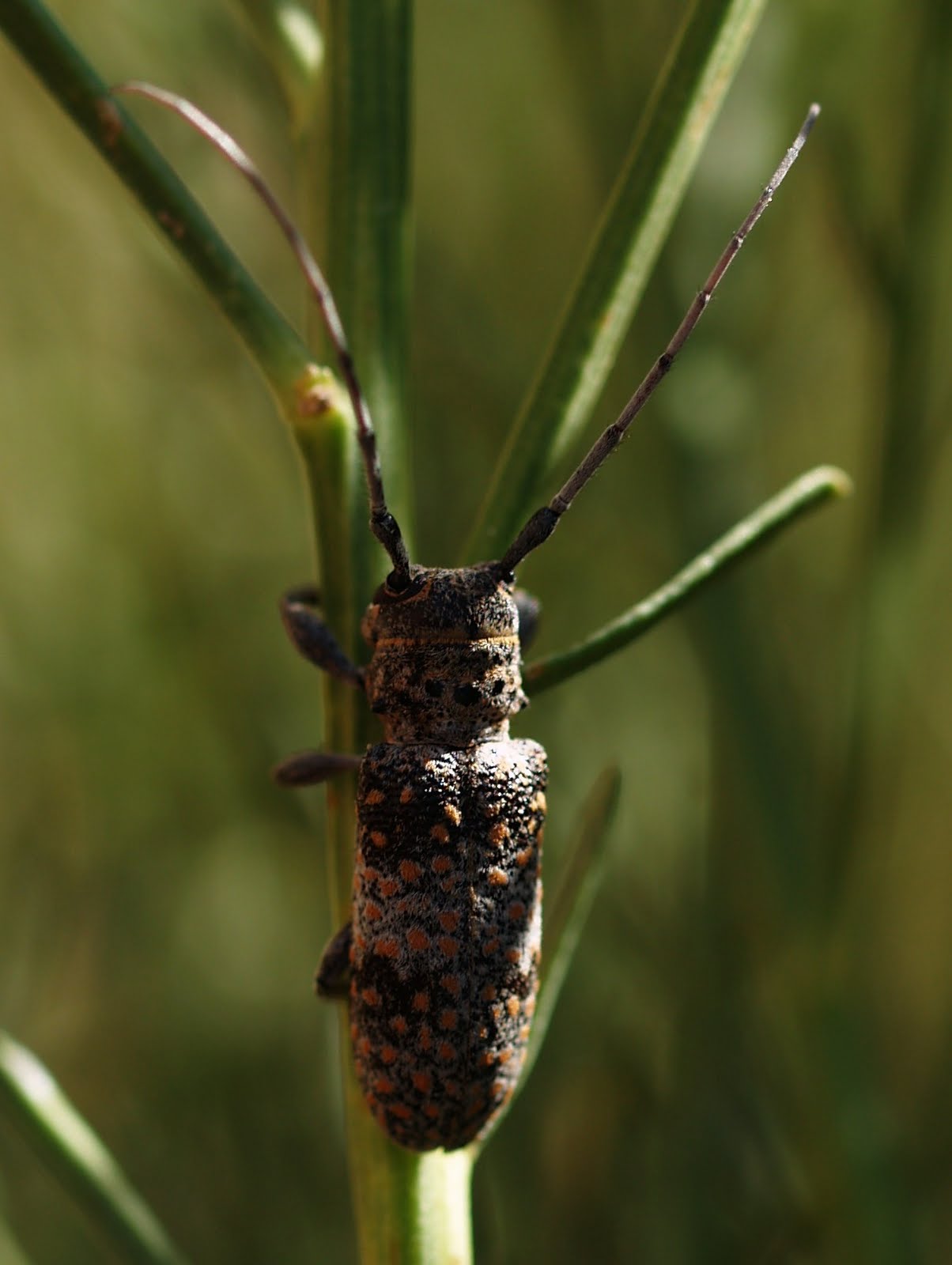
During the day the beetles rest motionless clinging to the bark of a tree, mostly well hidden by their cryptic wing pattern. Observed closely, the shades of dark-brown and silver-grey and the raised reddish dots are very attractive. The scientific species name Oncideres rhodosticta refers to those markings which distinguish this very common species from the related rarer Oncideres quercus and the much larger cousin Lochmaeocles marmoratus, all found in Arizona.

Arizona members of the tribe Onciderini. Mesquite Girdler on the right

Like most adult longhorn beetles, adult O. rhodosticta feed on plant material. The chew leaf buds and the green bark of fresh mesquite twigs. Sometimes the nightly feeding frenzy of the beetles leaves the ground under a tree littered with chewed-off leaf-matter and twigs.

Life cycle of the Mesquite Twig Girdler Oncideres rhodosticta :
Adult twig girdlers eclose from late August to early November. 
Towards the end of our summer monsoons, the female beetles create the most well-recognized sign of O. rhodosticta 'infestation' when they prepare a nursery for their off-spring: Dead or dying finger-thick mesquite (or sometimes Acacia) branches that stay connected to the tree and usually carry the wilted, bleached leaves like flags into the winter months.
The common name, Mesquite Twig Girdler, hints at the story: Before she lays her eggs, the female chews a precise, complete circle around a finger-thick twigs. This task can take up to two days. She bites all the way through the Xylem and Phloem of the bark and thus disconnects the branch from its water source. Then she chews a separate shallow grove for each of about 8 eggs in the distal, dying part of the branch. The larvae will hatch and live in the wood until they are grown, pupate, go through their metamorphosis and hatch as adult beetles by the end of the next monsoon season to restart the cycle.

Female Mesquite Girdler at her girdling site
Most wood boring insects attack sick, injured or dead wood rather than a living tree. This is partly because of the ability of healthy trees to fight intruders by ‘gumming’ them up, that is by drowning and encapsulating them in sticky resin rich tree sap. So the female Mesquite Girdler protects her eggs by cutting off the tree’s defense lines. A glob of fresh tree sap often hangs from the girdling cut: the trees attempt to fight the parasite which didn't reach its target. The nursery that the longhorn beetle creates is so attractive that several other insect species infest the girdled branches. I have raised more wasps, buprestids, anobiids, bostrichids and dermestids from collected girdled branches than O. rhodosticta adults.
Of course, the pruning-activity of  the beetles comes as a cost to the trees. They lose the carbohydrates stored in the girdled twigs and a part of their photosynthesis-machinery.  However, a study of Texas Tech. University showed no conclusive results concerning the use of the beetles to control the mesquite tree overpopulation of the grass lands.  Natural girdler infestation can cause an over 30% reduction of the canopy, which does not seem to harm the mesquite trees but instead to induce healthy re-growth in the following season.


Living and dead Mesquite Girdlers under the lights of the I 19 border patrol check point
Photo by Joyce Gross Sep. 2008 
Mass occurrences of members of a single species that last for more than a couple of vegetation cycles, as observed in the Mesquite Girdlers in southern Arizona since 2007, usually indicate a disturbance of the natural balance. In this case the overabundance of mesquite trees on former grass lands is certainly a contributing factor. The mesquite tree was introduced into the grass lands through the widespread practice of feeding mesquite beans to cattle. While the nutritious pods are digested, the seeds pass the bovine digestive system not only intact, but with an increased capacity to germinate. But the trees have been with us at least for several decades and the Girdlers seem to proliferate more than ever since 2007. A climate changing to drier and hotter summers seems to have favored this species, while its predators, parasites and diseases are still lagging behind. But there is no doubt among entomologists that these factors will eventually catch up to collapse the population explosion of the girdlers.

PS: The numbers of Mesquite Girdlers did indeed collapse in 2011. Since then I have not seen more than 3 to 5 on my nightly light trap, even during the prime season and in mesquite areas. I was wrong about one thing though: the summers from 2005 to 2009 were not particularly hot or dry in hindsight. It only got hotter and drier from then on.