Showing posts with label Cerambicidae. Show all posts

Wednesday, July 20, 2016

A magnificent Longhorn Beetle

About every three years the beetle collecting community - that does not include me, as a mere photographer - buzzes with new about the emergence of the spectacular longhorn beetle Megapurpuricenus magnificus   (Texas Canyon Longhorn). It's the beetle that used to be called  Crioprosopus magnificus, but when I had just learned that name, it was changed.


Many big beetles go through several years of larval development. But members of most species still emerge every year. But like the 17 year cicadas, the Texas Canyon Longhorns emergences appear to be rather synchronized. The beetles are very rare for a couple of years, then they appear in numbers, then again only a few individuals show up. Despite their common name, they do not only occur in Texas Canyon but in several sky island areas of Arizona and Mexico. The three year rhythm seems consistent everywhere, but the different populations all seem to be on their own clocks, so in a particular year they may fly in one mountain range, but not in the other.


Their host trees are several of the local live oaks, Arizona white oak, Emory oak, Silverleaf oak (Hovore 1983). In Arizona, the beetles seem to like smaller trees (or the host trees are stunted due to the beetles activity?) - the diameter of the stem  between knee and hip height is usually only about 10 inches. From Mexico there are damages reported, and those mostly occurred in pure Quercus potosina stands at 2500-2642 m elevations.  Under trees with fresh emergence holes you can often find piles of old saw dust that former generations of beetles pushed out when they emerged.


From Fred Skillman I learned a little about the beetle's biology. I'm not sure in which layers of the tree trunk the wood boring larvae feed, but when they are ready to pupate, they chew and exit hole to the outside. This is important because the adult beetle lacks the mouth-parts to chew its own way out. The hole is closed with a double plug of  wood pulp, then the larva pupates. When the imago (adult beetle) sheds the pupal skin in early summer it removes the first plug, but leaves the second in place. Behind it, the beetle is ready for the first heave rain of the monsoon.  At that time it emerges, neatly timed with its neighbors. Now males and females will be active for a short time, usually on warm mornings between 9 and 11 am and preferably after rainy days or nights, so they can find each other to start a new generation which will take flight after another three years.

If they don't get caught by collectors first. Luckily, the beetles behavior protects them to a degree: to find each other, they climb to the top of the tree canopy. The females may just sit up there and send out their pheromone signals, but the males can be seen cruising from tree top to tree top. In Texas Canyon, the oaks are fairly low and loosely spaced, so the beetles are quite visible once you develop a search image for them. Flying up there, the beetles are out of reach of most butterfly nets.

But there are other ways. Once I came upon a group of collectors on a friend's private property who were lounging on the soft carpet of leaves, leisurely watching the top of an oak.  In the morning they had found a female emerging from her pupal chamber in a nearby tree trunk.


They put her into a little cage and with a rope pulled her up into the tree canopy.  There she obviously did her chemical calling, because eventually we saw a male flying in.


 He circled, found the cage, landed on it. The collectors lowered it, reached impatiently with their nets, lost him. Warned, he disappeared. But soon another one showed up, and this one was caught.

 It took a lot of convincing to make the guys set him on a tree trunk for  me to take pictures. Believe me, their nets hovered right out of sight. They got three or four males that day, no harm was done to the population.


The female was eventually released, and after my photo shoot, she made her way up to the tree tops, this time without a lift and free to seriously enter the mating game.

It is not easy to harm insect species by collecting. The number of eggs that each female produces is enormous. So gaps left by the ones collected should normally be closed by the offspring of those that remain. None-the-less,  older collectors tell me that this particular species used to be much more numerous, if never common. Due to its popularity and its insular distribution, it may have been over-collected. But Fred Skillman also tells of occasional floods in Texas Canyon that may have drowned big numbers of beetles waiting to emerge - remember, most of their holes are only knee-high in the trees. And besides such local catastrophic events, there seems to be an ongoing decline of insect numbers not only in the Southwest, but all over the world may it be due to habit loss, insecticides or climate change. 

References:
Hovore F.T. (1983) 1984. Taxonomic and biological observations on southwestern Cerambycidae (Coleoptera). Col. Bull. 37: 379–387 (Full text)
Sánchez-Martínez G., Moreno-Rico O., Siqueiros-Delgado M.E. (2010) Crioprosopus magnificus LeConte (Coleoptera: Cerambycidae) in Aguascalientes, Mexico: Biological observations and geographical distribution. Col. Bull. 64: 319-328 (Full text)

Friday, September 17, 2010

Velcro bug, el Torrito, Mesquite Twig Girdler, or Oncideres rhodosticta: the most abundant beetle in Arizona after the monsoon

It’s Velcro-bug time again!
Anywhere between Green Valley and Sierra Vista, Arizona, and probably all over New Mexico and far into Texas, border patrol agents, gas station and supermarket employees, and everyone else who leaves his porch lights on at night is familiar with those half-inch long beetles that cling to every surface as if glued to it. They hold on with little hooks on their feet and even with their mouth parts. For a good reason, as in nature being picked up usually means being eaten by a bird, a grasshopper mouse or a lizard.


Male (left) and female (right) Mesquite Girdler
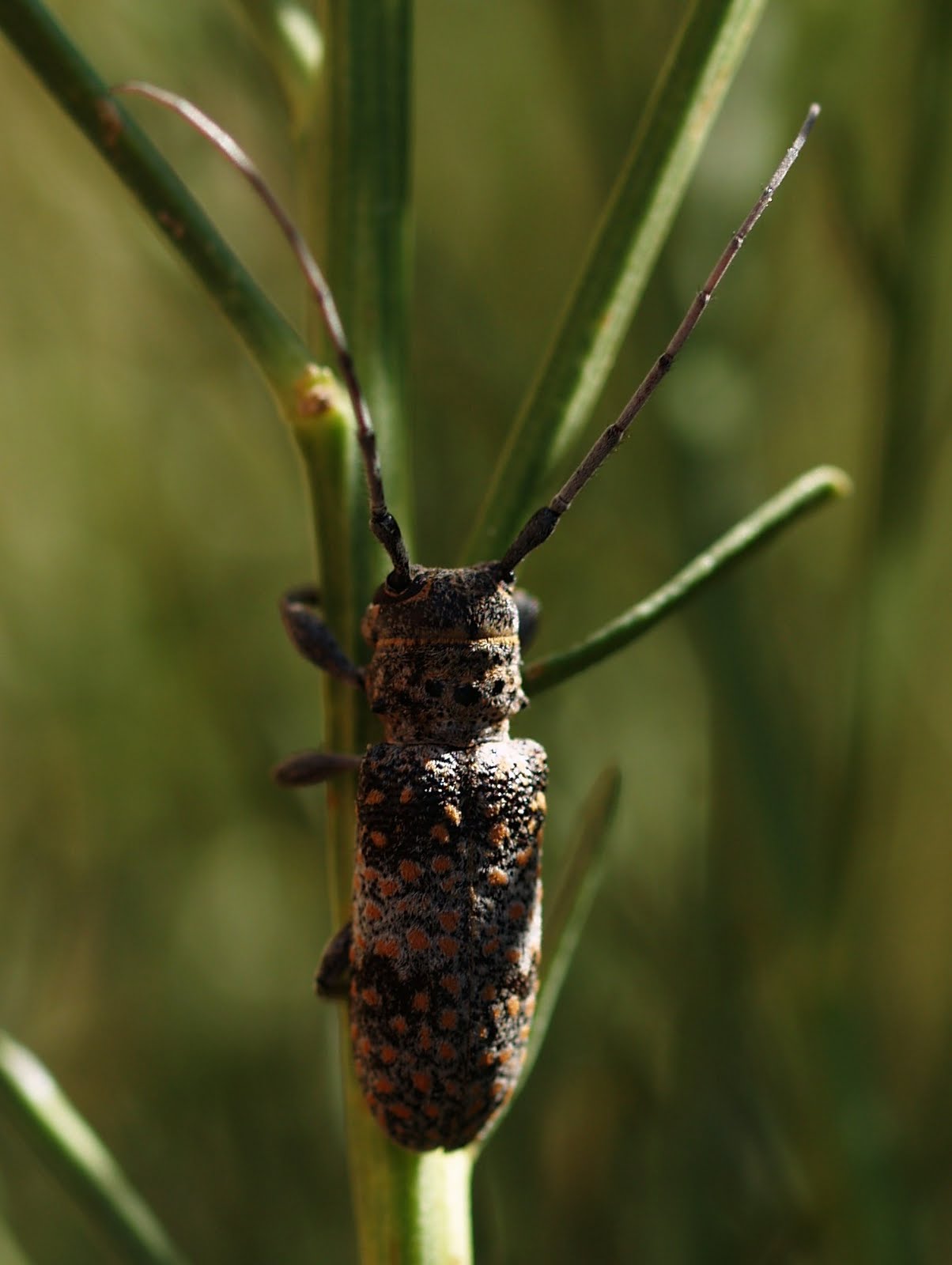
During the day the beetles rest motionless clinging to the bark of a tree, mostly well hidden by their cryptic wing pattern. Observed closely, the shades of dark-brown and silver-grey and the raised reddish dots are very attractive. The scientific species name Oncideres rhodosticta refers to those markings which distinguish this very common species from the related rarer Oncideres quercus and the much larger cousin Lochmaeocles marmoratus, all found in Arizona.

Arizona members of the tribe Onciderini. Mesquite Girdler on the right

Like most adult longhorn beetles, adult O. rhodosticta feed on plant material. The chew leaf buds and the green bark of fresh mesquite twigs. Sometimes the nightly feeding frenzy of the beetles leaves the ground under a tree littered with chewed-off leaf-matter and twigs.

Life cycle of the Mesquite Twig Girdler Oncideres rhodosticta :
Adult twig girdlers eclose from late August to early November. 
Towards the end of our summer monsoons, the female beetles create the most well-recognized sign of O. rhodosticta 'infestation' when they prepare a nursery for their off-spring: Dead or dying finger-thick mesquite (or sometimes Acacia) branches that stay connected to the tree and usually carry the wilted, bleached leaves like flags into the winter months.
The common name, Mesquite Twig Girdler, hints at the story: Before she lays her eggs, the female chews a precise, complete circle around a finger-thick twigs. This task can take up to two days. She bites all the way through the Xylem and Phloem of the bark and thus disconnects the branch from its water source. Then she chews a separate shallow grove for each of about 8 eggs in the distal, dying part of the branch. The larvae will hatch and live in the wood until they are grown, pupate, go through their metamorphosis and hatch as adult beetles by the end of the next monsoon season to restart the cycle.

Female Mesquite Girdler at her girdling site
Most wood boring insects attack sick, injured or dead wood rather than a living tree. This is partly because of the ability of healthy trees to fight intruders by ‘gumming’ them up, that is by drowning and encapsulating them in sticky resin rich tree sap. So the female Mesquite Girdler protects her eggs by cutting off the tree’s defense lines. A glob of fresh tree sap often hangs from the girdling cut: the trees attempt to fight the parasite which didn't reach its target. The nursery that the longhorn beetle creates is so attractive that several other insect species infest the girdled branches. I have raised more wasps, buprestids, anobiids, bostrichids and dermestids from collected girdled branches than O. rhodosticta adults.
Of course, the pruning-activity of  the beetles comes as a cost to the trees. They lose the carbohydrates stored in the girdled twigs and a part of their photosynthesis-machinery.  However, a study of Texas Tech. University showed no conclusive results concerning the use of the beetles to control the mesquite tree overpopulation of the grass lands.  Natural girdler infestation can cause an over 30% reduction of the canopy, which does not seem to harm the mesquite trees but instead to induce healthy re-growth in the following season.


Living and dead Mesquite Girdlers under the lights of the I 19 border patrol check point
Photo by Joyce Gross Sep. 2008 
Mass occurrences of members of a single species that last for more than a couple of vegetation cycles, as observed in the Mesquite Girdlers in southern Arizona since 2007, usually indicate a disturbance of the natural balance. In this case the overabundance of mesquite trees on former grass lands is certainly a contributing factor. The mesquite tree was introduced into the grass lands through the widespread practice of feeding mesquite beans to cattle. While the nutritious pods are digested, the seeds pass the bovine digestive system not only intact, but with an increased capacity to germinate. But the trees have been with us at least for several decades and the Girdlers seem to proliferate more than ever since 2007. A climate changing to drier and hotter summers seems to have favored this species, while its predators, parasites and diseases are still lagging behind. But there is no doubt among entomologists that these factors will eventually catch up to collapse the population explosion of the girdlers.

PS: The numbers of Mesquite Girdlers did indeed collapse in 2011. Since then I have not seen more than 3 to 5 on my nightly light trap, even during the prime season and in mesquite areas. I was wrong about one thing though: the summers from 2005 to 2009 were not particularly hot or dry in hindsight. It only got hotter and drier from then on.