Saturday, March 31, 2018

Will the Harris Hawks of Sandario Rd in Picture Rocks become homeless?

Watching a pair of Harris hawks at a tree that has hosted their family for years, maybe decades, made me wonder about the symbiosis between an endemic hawk and an imported tree.
Aleppo Pines were brought  to Arizona desert cities from Lebanon and Syria as landscaping trees. Most were planted 30 to 50 years ago. Although they were not really adapted to our typical rain pattern of monsoon showers in summer and soft. but productive rains in winter, they thrived for decades and outgrew in many cases their allotted space. Low slung ranch houses under towering, monstrous pine trees were a strange, but typical look for Tucson neighborhoods when I arrived here in the early nineteen nineties.

But nowadays, those trees are becoming rare. We lost a few on our own property: they became pale, nearly straw colored, produced a couple of panic crops of cones, and died. It made us sad and left us feeling guilty - thinking that we did not care for them properly.
Then there was a diagnosis: Aleppo Pine Blight.
 There was a lot of guessing as to the cause of this disease. Bark Beetles and 'nearly invisible' mites were blamed. I stripped the bark of our tree corpses: no tell-tale sign of bark beetle infestation at all. Anyway, those bugs like mountain air, not desert heat ... but still, bugs usually get the blame.

Bark beetle infestations leave typical tracks under the bark of trees killed by the beetles. They were not present in dying Aleppo pines.
By far not all plant diseases are caused by organisms (bugs). Disease may occur because moisture is not available to tissues; consequently, they malfunction or die as a result. Insect infestation may sometimes be exasperating the problems but they are usually secondary to climactic stresses. No insect infestation was found in most dead pine trees in Tucson. 
Excessive evapotranspiration occurs when soils are dry and sustained winds  blow at extremely low relative humidity. The high water loss from needles cannot be replaced by adequate water uptake from the soil. Climate change has increased these stresses over the last decade, so now even old, established trees are succumbing all over Tucson. Another factor: irrigation over decades might have leached nutrients from the desert soil and caused an increase in salts, while an ever increasing layer of caliche that further inhibits healthy root growth and water uptake. Temperature extremes are also increasing lately - maybe exceeding tolerance thresholds of the Mediterranean Pines.
But even if the huge pines were aesthetically uncool and also, while healthy, a burden on our limited water resources, they had a positive side: Harris Hawks loved them as nesting trees. 
Harris Hawks are superbly adapted to the Sonoran Desert in many ways. I am pretty certain that it was the pressure of this hard environment that made them evolve into the only social species of hawks: the resident, territorial pair allows several younger hawks to live close by. The hawks hunt as a group, share the kill, and the young 'satellites' help the main couple to raise its young. So an obvious advantage for the resident couple. From the viewpoint of the younger hawks, this altruism is a little hard to understand because genetic tests showed that the hawks are not usually related. So no kinship selection here. But, the entire group can take down larger prey than a single hawk could slay. This may be advantageous as so many small prey animals are night active here. Considering that about 50% of fledgling hawks usually die from starvation within their first year, communal living may give more time for the young guys to become strong adults.  Furthermore,  the younger birds are probably in an excellent position to take over territory if something happens to the owners.   
Free Flight Hawk Group of the Arizona Desert Museum
 Harris Hawks,  because they hunt cooperatively, can afford to be smaller than our other successfully free roosting desert birds of prey, Red-tails, Caracaras, and Great Horned Owls. (Kestrels breed in cavities, Gray, Black and Zonetail stay in riparian or mountain forests, Cooper's adapted well to human neighborhoods with trees).

Who knows who built this nest? GHO do not do it themselves
 But Harris Hawks share their habitat directly with their great arch enemy: the Great Horned Owl.  The owls hunt and slay birds up to the size of Harris Hawks, they rob hawk nestlings and they love to take over established nest sites like the classical Harris Hawk nest in the sturdy bowl of sheltering Saguaro arms. 
A different site, also now owned by the GH owls. Both Picture Rocks, west of the Tucson Mountains
 So Harris Hawks around Tucson may have really benefited from the prevalence of huge, dense Aleppo Pines - I knew at least half a dozen nests that successfully produced fledglings year after year.  I also know of successful owl attacks on some of these nests, but at least in one case, the hawks were back a year later. Maybe the dense pine branches give enough of an advantage to the smaller, maneuverable hawk over the large owl. 
Dead Pines along Sandario Road, still hosting an active nest
 Since we lived in Picture Rocks I saw Harris Hawks around, but although I found Red-tail, Screech and GH Owl, Cooper's, and Kestrel nests, I never found a Harris Hawk nest around here. But I always saw them flying, carrying branches or food,  into two huge pine trees at Sandario Rd. There had to be a nest! But it remained completely shrouded by those dark tree crowns. 
Sadly, this spring the needles are falling, the trees are nearly bare. There is a nest though, and the hawks have not quite given up on it. 
 Today I saw the female sitting on the rim of the nest. - freely silhouetted against the sky. Then she flew down, landed on a power line post, the male joined her and they mated. So the hawks are optimistic, life will go on, even in a dead tree. 

Friday, March 30, 2018

Molino Basin in March 2018

The drought is upon us. According to today's newspaper  the affected area stretches from northern NM to SW Arizona. To us, that's no news. So wildflowers were scares and very tiny. Still some bugs had found them.

Acmaeodera sphaeralceae on fleabane
 So every little Fleabane flower seemed occupied, mostly by Acmaeodera Acmaeodera sphaeralceae, one of our earliest spring bupestrids. I think this one is chewing on the ray flowers. Remember your asteraceae anatomy?

  As always (literally), at my first stop up Catalina Highway, I ran into Mary Kinkle and Fred Heath. They must live there! As they are Butterfly people, we watched a Spring Marble flutter by, being camera shy.


Some Comanche Paper Wasps were also flying and another big black bee-like thing that turned out to be a Scarab Beetle, Euphoria verticalis. The beetle achieves the bee-like flight by keeping its black elytra closed and pushing the membraneous wings out from under them through lateral gaps.


I beat some Mesquite and Palo Verde and a nice snakefly ( Raphidiidae » Agulla) landed on my sheet. I do not find these often. According to literature, Snakeflies are confined to arboreal habitats in the broadest sense, including all types of forests, macchias and even biotopes with scattered shrubs.

Pachypsylla celtidisvesicula (Hackberry Blister Gall Psyllid)
Beating bushes also resulted in finding this little guy - not even 3 mm long. I thought it was a Bark louse at first, but the clubby little antennae speak against that. Robert Velten helped id it: Pachypsylla celtidisvesicula (Hackberry Blister Gall Psyllid)


This came from an oak at Molino Basin. The winter-green live oaks are just leaving out, shedding their old leaves. I think it is a nymph of a leafhopper.


At Molino I wanted to look for Osmia, the bee genus that supposedly is the main pollinator of Manzanita. The bushes were blooming beautifully  But I found mostly Honey Bees, some big black Carpenter Bees, some Hover Flies in the genus Copestylum (3 species). The only blueish green bee that I found will probably turn out to be in the genus Andrena. No Osmia at all. But they were there in other years! I did see a couple of Golden-headed Scalloped-wings 


On a Manzanita Leaf, I found this little mound of gello. Because it was only 4 mm long I wasn't sure if it might be a cluster of eggs? But after looking at the enlarged photo, and seeing it moving around the jar I'm keeping it in, I thought that it is a slug caterpillar, just a very young one.



I learned now from Bruce Walsh  that it is rather the caterpillar of Dalcerides ingenita, the only Dalcerid around here. It does not seem to feed on the Mamzanita leaves I collected it with - it's crawling around in search of better food.Bruce thinks it's an oak feeder.

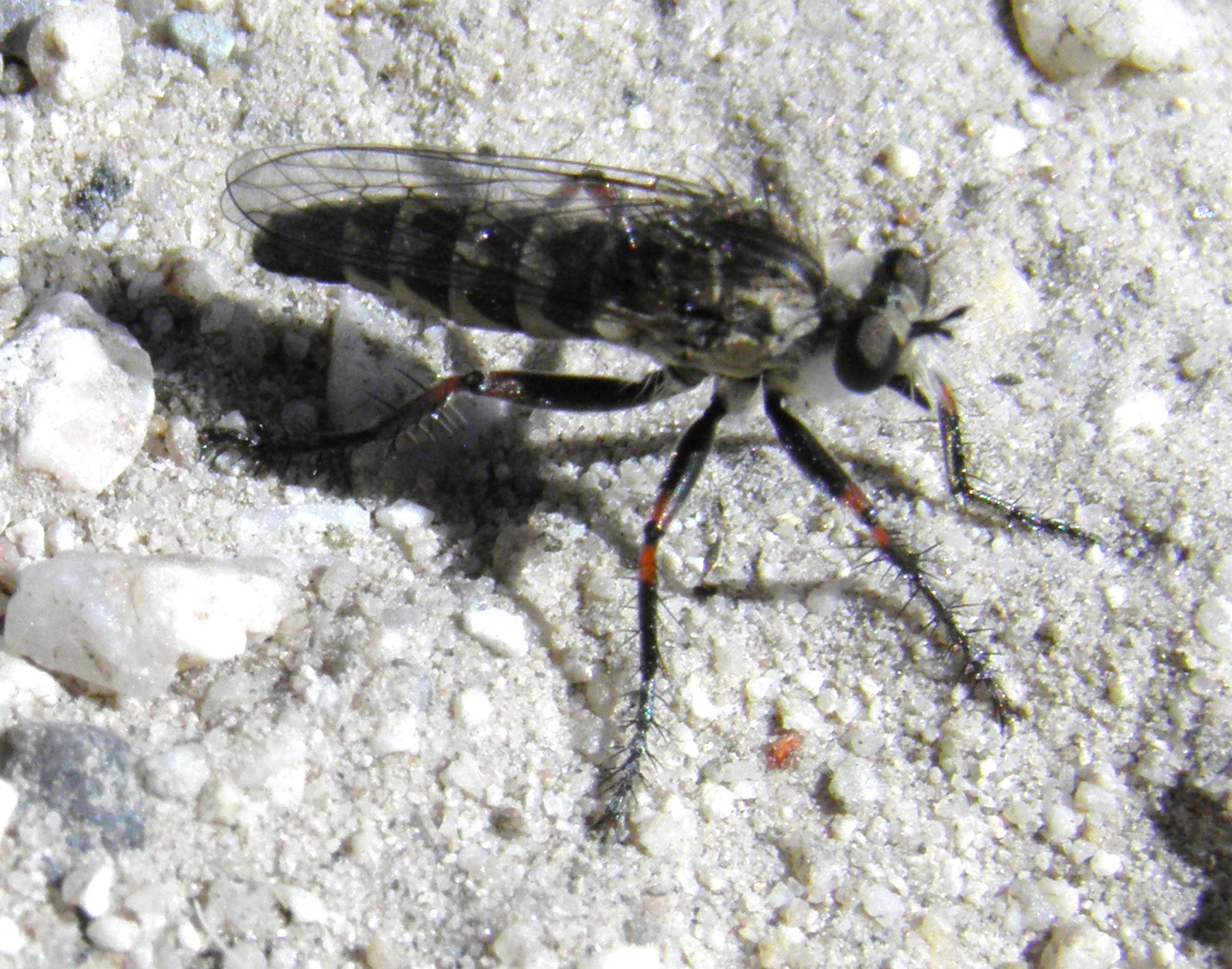
A small Robber Fly was staking out a territory on the path at Molino Creek. Close by I came upon the sad sight of 3 dead rat babies. They might have been clinging to their mother during transport when some kind of catastrophe hit.


 In other climates I would have expected Burrowing Beetles to arrive soon, but here the little corpses attracted only ants.


On blooming Rhus (?) I found some Cryptocephaline Leafbeetles and an Small assassin Bug genus Lophoscutus. Only when I checked out my photos, I found a Green Lynx Spider - do you see it?

Lophoscutus sp.
Chelinidea vittiger (Cactus Coreid)
 Chelinidea sp, a Coreid, flew in, probably from a near-by prickly pear cactus. No flowers on those yet - they seem late this year.


I saw tiny Scudderia sp. nymphs and a big, adult Schistocerca nitens. These bird grasshoppers seem to winter as adults here in Arizona. At nearly 3 inches long, my biggest bug of the day

Coleothorpa axillaris l

Wednesday, March 28, 2018

Who likes the Nectar of Aloe vera and little Petunias?

We try to keep our environment as natural as possible. We let the desert be desert and if we plant we try to stick to endemic plants. But some things were here when we bought the place. We ripped out ice plants and roses, but the Aloes got permanent residency because they are as desert adapted as our Agaves - just to a different desert. Coming to us from down under (South Africa) some also tend to bloom here in winter ...


 Their nectar is appreciated - by Gila Woodpeckers, Hummingbirds and Orioles, Verdins and by honey bees.  Of course, those are foreign imports as well. The woodpecker ingests them gladly in addition to the nectar. In South Africa, many Aloes seem to rely very much on birds for pollination, but honey bees also play an important role. (CT Symes et al. South African J. of Botany, Vol. 75, Issue 4, Oct. 2009)


 Not far from the Aloes, Cacti and Penstemon are blooming. The cacti may not all be endemics of the Sonoran Desert, but at least they came from near-by Baja and Chihuhua. Honey bees pretty much ignore them, but native cactus bees and little green sweat bees find those first cactus flowers within minutes. 


Anthophora bees are hovering among the Penstemons that they love and also nectar on the Creosote bushes that are the character plants of our sand flats.
 

 For the first time we had mini petunias in hanging pots this year and they surprised with an abundance of yellow and deep red flowers all winter long. They also have a weak fragrance. Our Costa's Hummer was mildly interested when his feeder was occupied by honey bees and nothing else was blooming. But he very much prefers the little Desert Honeysuckle and Cape Honeysuckle. I thought the Petunias, like the purple Barrio Petunias, might attract moths, but if so I missed it. An early Whitelined Sphinx instead hovered around our blooming basil plants, soon joined by the Costa's hummer.


But today I got a surprise: the yellow petunias had a yellow visitor: a Two-tailed Swallowtail. While Giant Swallowtails are rather common here thanks to numerous citrus trees in most yards, the Two-tailed is a butterfly of the sky islands where it patrols tirelessly along canyons and creeks. I most often saw it nectaring on thistles. We live in the lower desert of Saguaros, Creosotes and Ironwoods, and I have rarely seen a Two-tailed Swallowtails even  in the Tucson Mountains that are closest to us.


This nice and fresh looking guy payed several extended visits to our yellow petunia.   


The most common desert swallowtail is the Pipevine. In early spring it also appreciates Penstemon flowers while the summer generations have more divers choices.

I combined these examples of flowers and their visitors to point out that there is no great randomness in those pairings.  The flowers all offer nectar, and the visitors all seek those sweet calories but  the selectivity of those visits is caused by visual, chemical and structural characters of the flowers. Flowers with nectar evolved to attract pollinators, but a good pollinator is not a generalist that may squander precious pollen, but a faithful specialist that sticks to just one kind of flower at a time. So flowers evolved to limit access to their nectar to those specialists that evolved with them. This means of course that only flowers and pollinators that evolved together in the same part of the world can be perfectly in tune with each other. So our endemic bees stick with our endemic penstemons and cacti. Generalist honey bees and birds service aloes that are global transplants. Butterflies seem to be beneficiaries of  floral offerings, but due to their long legged anatomy they do not necessarily contribute reliable pollination services. By cross or maybe self pollination, our Aloes bear fruit, the penstemons are reseeding very nicely, the cacti produce well - only the little petunias have yet to show any inclination to make seeds, even though their flowers seem to be complete with all parts necessary. No idea what's going on.


Thursday, March 22, 2018

Cactus flowers, bees and rattlesnakes - spring in Arizona


Spring has sprung. Some Hedgehog cacti are blooming and the related, but non-native ladyfinger cactus on our patio. Cactus bees immediately spotted it, and pose. Little green sweat bees like it too, but are difficult to catch on camera. 


Our big rattler made a first appearance, I guess he was sleeping under the barbecue when Mecki charged into him - some rattling, lots of barking until I banned the dogs into the house. The dogs may need a refresher of their snake avoidance training, they were too close for my comfort, but at least their obedience rapport is firm.


Rattler proceeded to explore the entire patio. Seemed to be tracing something (a partner?) judging from his careful tongue-testing of the path. 


Tuesday, January 16, 2018

Javelinas in our Backyard


Our backyard gets visitors periodically, even though it's fenced as a dog run. They (the Javelinas) systematically uproot dozens of mamillaria cacti and eat the roots. So we pick up the buds and put them into sand-filled pots to reroot, then plant them for the next invasion. To get at least something out of it, I made the whole party pose for a painting.

 Even though they look deceivingly similar to wild boars Javelinas or Peccaries are only distant relatives of pigs. Taxonomically they are members of the same suborder, Suina, but are in their own family, Tayassuidae (New World pigs). They sport two pairs of big canines as opposed to just one in Oldworld Pigs.
But like pigs, they live in family groups, and root for their food with very similar snouts. As ours live in the desert, I never saw them enjoy mud baths, but our Arizonan, New Mexican and Texan Javelinas  live at the northern most tip of their distribution area which reaches all the way south to Argentinia. So they must use  many different types of habitats.
They are territorial and use skunk-smelling secretions of their  scent glands (below each eye and  on their backs) for marking and communication. If hunted for food, these glands have to be carefully and immediately removed or the meat is spoiled. I have eaten jerky and fresh, grilled tenderloin as guset of Mexican gold miners and it was very good.
Javelinas are rather nearsighted and also quite fearless, which results in frequent close encounters between them and human and caninen Arizona residents. Often the Javelinas just go quietly about their business. While house-sitting in the Tucson foothills at First Avenue, I once found myself surrounded by a herd  between garage and patio. They were so peaceful that I reached out to touch the big patriarch when he walked close to me. He screamed with indignation and bristled. Other people have been less lucky,  and those big canines leave bad wounds. My 40 pound Healer-type dog Bilbo got into a fight with a single Javelina last year, and he came away from it with a big, gaping chest wound. But at other times my dogs have cornered the entire resident herd including young ones and nothing happened. With Javies, you just never know.  So don't ever feed them, not even inadvertently by  keeping garbage or compost in accessible containers. The more the 'desert pigs' get habituated to humans and their houses, the more confrontations happen, and those usually end with killing or removal of the javelina herd, and our desert is all the poorer for it.

Sunday, January 7, 2018

Why is the sting of Velvet Ants so painful?

Dasymutilla  erythrina, D. gloriosa, D. sicheliana, all female
 First of all, though I have picked up many fast-running, wingless female Velvet Ants (Mutillidae, a family of wasps, not ants) to photograph them, my experience with their sting is all hear-say, as none of them ever tried to sting me. I've  also often swatted at males of nocturnal species that love to buzz around my reading light, but of course those males are stingless (the sting is the ovipositor)

Dasymutilla sicheliana male


Dasymutilla occidentalis (Cow Killer) from Eastern US, photo Barry Marsh
But the name cow-killer (a total exaggeration) and the bright aposematic colors of these insects that usually lead very unobtrusive lives on the ground, among sand and rocks, do hint at a potent weapon.  Justin Schmidt ranks their sting high in his sting index. High on the pain scale, but very low in duration or tissue damage.

Social wasps, Polistes sp. colony
 Among wasps and bees, most painful and harmful stings evolved in species that prey on very big, active and potentially dangerous prey that they send into an extended period of paralysis (tarantula hawk), or in social insects with lots of resources to defend. Nests of social wasps, bees and ants are sought after by many enemies because those nests offer a quite unique accumulation of proteins and carbs. Where else could a bear or a human village harvest  honey, pollen and larvae by the bucket? Of course, those social hymenopterans defend their riches with whole armies of rather expendable workers. The sting of these amazons is painful and often even harmful (tissue damage and central nervous effects) making sure that lessons are taught and remembered. Pogonomyrmex sp. Harvester ants, Fire Ants, Honey Bees, Yellow Jackets and Hornets are examples that most people know.

    .
Mutillids are neither social nor do they store larval food or even have their own nests. Their larvae develop as Ectoparasitoids of immature insects, esp. bees and solitary wasps (also flies, limacodid moths, beetles, and cockroaches). So the mutillid wasp is not guarding or defending those nests or larvae. There are many other solitary wasps like Scoliids, Cicada Killers, and Mud Daubers etc. with comparable developmental histories that are not known for an especially painful sting.


Male nocturnal Mutillid
 And there is even more to the defense system of Mutillids: Velvet Ants squeak (stridulate) when grabbed or otherwise trapped - I know that from a male that crawled into my husbands ear while we were reading in bed - To me it sounded like Micky mouse and Donald duck got into an intense  argument in his ear-canal.  
Some species of mutillids also release chemical defenses when caught. In addition, all of them, winged males and fast-footed females, are so heavily armored that they survive unharmed when swatted at or stepped on - even when chewed on by a naive predator I assume. This extra strong exoskeleton must be costly to build and heavy to carry.  Justin Schmidt also mentions that the legs of a female mutilid are about as strong and muscular as insect legs can get. That's easy to believe when you see them running. So these wingless wasps have a defensive arsenal that is not equaled by many other insects.
Dasymutilla cirrhomeris
So why? Schmidt suggests a reason in his book The Sting of the Wild: Longlevity as a strategy.
The majority of insects has a very short adult life span. After mating, females of many species lay hundreds of eggs in one big clutch on a host plant and then die. Even big wasps like Cicada Killers that provide food for their offspring don't live much longer than 40 days. Mutilid wasps are parasitoids of solitary bees or wasps. Their arid habitats are bare and thinly populated by any host species. Mutilids procreate by placing single eggs into late instar larvae or pupae of their host species. So even if the female Mutilid finds a leafcutter nest with a series of larval chambers, there might only be one or two that fits her requirements. So her egg production may be strung out over a long time and depends on her searching for just the right situation to lay one egg or a few.  This is possible because her adult life span, amazingly, is longer than a year. This longlevity ensures that the female has time to place enough eggs to guaranty the survival of the species.  The arsenal of defensive weapons provides the means necessary to survive that long.

With Justin Schmidt and his family: searching for mutillids and other arthropods in the dunes along Blue Sky Road in Willcox, AZ in July of 2017
Thanks to Justin O. Schmidt for his excellent book 'The Sting of the Wild' John Hopkins University Press 2016,  for including my Mud Dauber, and for great company in the field!

Sunday, November 26, 2017

Beetle Talk for the Butterfly Society


On Tuesday, November the 28th at 7 PM, I am giving a talk about the Beetles of Arizona for the Tucson Butterfly Society at the Lutheran Church in the Foothills. Given that I am working on a book with that title together with Arthur V. Evans for years now, the topic is obviously one of my faves. I hope that the lep folks get excited about it too!

My 5 posters will be available after the talk: Butterflies, Moths, Arachnids, True Bugs and Beetles.