Showing posts with label Willcox Playa. Show all posts

Tuesday, August 30, 2016

Border Bug Safari August 2016

'On August 8, Javier intensified into a 65 mph tropical storm near Cabo San Lucas.' That was on Monday. On Tuesday, my friends Joyce and Alice from CA and I met at Pena Blanca Canyon for our SE Arizona summer trip along the US Mexican Border. Just in time for the storm to come up north. It was  raining softly when I joined the two in their camp, so we decided to use the ramadas at the Ruby Road campground for shelter and to spread out our road maps.

Kuschelina jacobiana
A lucky choice: while Alice and Joyce photographed last night's bounty, I found some very nice Flea Beetles genus Kuschelina. The pretty beetles were sitting exposed, like waiting, on the pointed leaves of Desert Honeysuckle Anisacanthus thurberi. They flew easily when disturbed but kept landing on the same plant species. I soon located several mating couples. The species K. jacobiana is not observed very often, in fact, the only other entry in BugGuide is also from Patagonia. The reported host plant seems to be Desert Willow, but both the honeysuckle and the 'willow' are in the Acanthus family.  

Agrilus heterothecae
 The plant hosting  this Agrilus pair still needs to be identified, it's not the typical Heterotheca sp. either, but it's in the sunflower family and I've collected the buprestids from it before, at Sunnyside CG in the Chricahuas.

Stormy weather
We took Ruby Rd back to Rio Rico and connected there to River Rd and later to Duquesne Rd which starts at the 'Little Red Schoolhouse'.  From there on, there are endless stretches of dirt road closely paralleling the Mexican Border and therefore well maintained for US Border Patrol vehicles. Those officers were also the only human company we would keep for the next couple of days. The main reason: the weather. Javier had by now crossed into the US, legally or not, and was drenching the Canelo, Parker and Huachuca Mts.


While we were making our way along their southern water shed we were not ourselves being rained on, but we watched the clouds pile up north of us and around Lochiel the road had road turned into mud slides. Testing our cars' 4 wheel and all-wheel drives, getting acquainted with new warning beeps and lights when traction was lost. Glad it the worst was on downhill slopes.


Insects were hiding in this weather, but we still found them, gleaning, sweeping, or using a beating sheet. Arizona Claptrop, pink mimosas and white-blooming Acacias proved good places to look.

Cremastocheilus constricticollis
 Alice found a very nice Anteater Scarab Beetle that still sported a blond punk hair-do on its dark head: a very fresh specimen of Cremastocheilus constricticollis - they loose those hairs pretty soon after they emerge. This indicates that the second generation is already out - early for the season. 


The weather also brought out a few reptiles, though not as many as we would have hoped. The Desert Tortoise showed up early, along River Rd in Rio Rico, the Gophersnake was stretched across the dirt Road close to Lochiel and was smart enough to coil up tightly when my car straddled it. Alice called him 'one majorly pissed gopher'

The wash looked much more impressive in real life. It was very noisy, too.. That's the rancher's truck coming towards us Photo Joyce Gross

By late afternoon we hit the first deep wash south of the Huachucas. While we stood contemplating the already raging flood water a rancher came down from the other side and made clear in no uncertain gestures (we could not hear him over the noise of the stream) that we were not going to cross.

by Joyce Gross
 So we camped in the grassland above the crossing - set up our black lights and tents in a side road. Walking and searching, we found scores of insects and spiders - the spiders getting their webs ready for the night's hunt, the bees finding a grass blade to clamp onto to sleep.


At night , a BP agent stopped by and reported that the wash was now, with falling water, passable for his Ford Tahoe. He wanted to redirect us to Parker Lake along a ridge road to keep us from getting caught in some run-off.  But that would have taken us far of our planned route. In the morning,  the old rancher from the day before  came checking on us. He was still running cattle on his families original homestead. We then continued east following our original plan. At a couple of washes we had to move boulders and  avoid some deep ruts, but no problem. Thankfully the splashing water rinsed off some of the clay that our cars had accumulated the day before. I was too excited to take photos, though.


The south flank of the Huachucas was greener than I had ever seen it. Where I remembered tiger beetles running on bare soil, there were thick grasses harboring legions of chiggers. I was beyond caring because I'd been thoroughly exposed just a week before and still itching, but Joyce later stopped counting at 220 bites. As we climbed to higher elevations, Joyce got her first opportunity to look for gals on oaks. There were fewer flowers and hence fewer flower visiting insects than I had seen in other years.


  A little orange-blooming clover  was full of nectaring insects.  If I'm not mistaken, that's the plant that years ago stirred Doug Yanega's curiosity because he thought he had observed a close relationship between the flower anatomy and a certain bee. I did see only one species of little bees in attendance. these bees are in the genus Calliopsis (John Ascher det.) Most species in this genus are oligolectic or monolectic (they collect pollen from a few related species or just one species). In addition, there also many individuals of a bee fly species that also seemed, for the moment, specialized on the orange flowers. Skippers were visiting as well.


We had planned to spend our first night in Copper Canyon, but now arrived there in the early afternoon. So we first made a trip up to Montezuma Pass. Behind us the view includes the Hereford/Sierra Vista area on the left and Mexican borderland on the right. Coronado marched through here on his tryst towards northern cities of gold.

Beetles from Montezuma Pass and Montezuma Canyon Road
For us, greater riches lay in the diversity of insects that we found at the top and then again in the lower part of Montezuma Canyon Rd. The area in between is not only off limits for collecting, it was also where the ever threatening cloud bursts finally caught up with us.

Montezuma Canyon Rd descending through Coronado National Monument
The next night we finally got to spend at Copper Canyon. That place is usually very rich in diversity quite special because it's so open towards Mexico. But this time, I found it rather disappointing. The very recent rains may have dropped the temperature below the activity threshold for many beetles.

Our MV/UV set up by Joyce Gross
But we also had to deal with what I can only describe as a case of unpleasant bullying from a group of moth collectors who arrived after we had already set up out lights and our sleeping arrangements for the night. Those 3 guys, actually led by an acquaintance of mine,  set up 5 generators and 7 MV lights all around us. Then they kept driving up and down the roads with blindingly bright light bars on the top of their truck to check on all those light traps. Their noisiest generator ended up only about 20 yards from our camp, on higher ground than our light, with no buffering vegetation in between. Out complaints only caused them to bring in a quieter generator and the remark 'We are all in this together, you are welcome to take the bugs we don't want from our lights.'

A sample of Alice's haul at Copper Canyon at night
  For me, that night was pretty much spoiled. And the beetles did not oblige either, they probably do not like bullies any more than I do. Alice, however, proved that adversity like that cannot impress a true bug enthusiast, and produced a series of beautiful photos. Joyce and I eventually just switched off  the intruding light. So we all got our deserved night sleep and in the morning we got another good load of day active bugs in the grassland of the canyon, all under the curious eyes of the local cattle.

Copper Canyon day-activity
After so much mountain rain we headed  for the hot and sunny Willcox Playa, hoping to find it drenched by last week's rains, so the puddles would be full, the flowers blooming and the tiger beetles hatched.  All that proved to be true to a degree. I've seen the playa more covered in flowers but also more dried up.


We first stopped at the Railway Road where only some Milkweed patches were buzzing. Clerids, Tarantula Hawks, and little Milkweed Longhorns posed nicely. Sleeping colorful blister beetles hugged fleabane flowers like feather beds

Alice and I, fishing in murky water. Photo by Joyce


Flat puddles of the color of coffee au lait bubbled with the activity of air-gulping tadpoles - baby spadefoods are huge and ravenous, not shy of biting off the tails of smaller toad larvae.


Several freshwater shrimp species were bobbing up and down, impossible to photograph. But when we found triops, I remembered Piotr Naskrecki's beautiful photos and got out a bowl with clear, fresh water. It was worth it. I had never seen the red underside, nor seen their gills constantly fanning.


Even in the dunes along Blue Sky Road, Tiger beetles were rather scarce. Not too surprising, as other entomologists had reported the main emergence by the end of July. But a few were still mating and thus not too easily disturbed.


 We spend a lot of time on the hot sand under the merciless sun with them. After that, we were ready to head back to the closest mountains - the Chiricahuas Mts.


Driving up Pinery Canyon Road we were greeted by a male Montezuma Quail who was not afraid at all and posed willingly with different backgrounds. In fact, he was back 2 days later when we had to say good bye to his mountain range.


Our campsite in the oak belt allowed Joyce to search for more galls. As the night was humid and warmer than at Copper Canyon, and our light was the only one around, we  had a nice variety of bugs flying in.


Alice's  oatmeal trail also brought a nice number of Jerusalem crickets, camel crickets, shieldbacks,  and and an impressive Rove Beetle.


In the middle of the night a huge boulder, dislodged by all the previous rain, rolled down the mountain slope towards our camp, but luckily its momentum ended harmlessly on the other side of the creek. I saw my first snake fly, ever, also thanks to that creek.


Rustler Park was our high elevation goal for the next day. I had been up there shortly with Robyn and Gary the week before. Since then much of the Sneezeweed in the meadow had wilted, but many other flowers were still in their prime. But there was little insect activity.


Interestingly, I found my second ever Calligrapha multiguttata on a flower in the exact spot where I'd seen my first in 2008.

 Also just like back then, a Pine Sawyer came flying to our parked cars.

Content of my aspirator vial after collecting under bark
Most of the other interesting bugs of this day were found under the loose bark of dead trees that were still standing from the huge forest fire some years ago.  There were Tenebrionidae and little Rove Beetles, Clown Beetles and Weevils, Bark Gnawing Beetles, and Dry Bark Beetles. Most of them shared the sames cigar shape that allows them to move around


We stopped at many promising oak-gall-sites on the way down, always with an eye on building thunderheads. While Joyce searched for galls, a little Short-horned Lizard played hide and seek with us.

We gave Willcox Playa another chance - this time at the bird viewing area at the golf course. There were lots of Black-necked Stilts and other wading birds, but I've rarely payed as little attention to them before. Instead we were again tiger beetle hunting. They tantalized us with all shades of blue, but in the end, none of them was the famous Black Sky Tiger Beetle. Alice and Joyce found an amphibian friend, though. And you can see we were rather sun-baked by then, but quite happy.


Our last stop as gang of three was in Picture Rocks. Home, for me! The dirt roads had a thick new layer of loose sand and Randy said that we had gotten a lot of rain over the last 2 days. We showered, gave Randy some short account of our exploits, played with the dogs, and heated some Pizza - and all the while the MV light was already shining out over the Creosote flats and Ironwood washes of our property.


 And the bugs came! Some surprises even for me, and I've black lighted in that spot pretty regularly since 2007.


In the morning,  when Alice and Joyce left for some more days of adventure, I was quite envious. Let's do something like this again, soon! But I had to process (photograph on white back ground) the score of beetles that I'd brought home with me. That took at least as long as the whole trip. - and then there was this blog to write ... but now I'm ready for my next trip, too - It'll be to Sonora, Mexico.

Saturday, August 21, 2010

Nothing is what it seems at Willcox Playa

August 8, 2010.Charlie O'Brien and I arrived at Willcox Playa around ten thirty and the temperature was already climbing into the upper nineties. On the flat salt pan, there is not much shade. The white sand reflects the sun and seems to double its intensity. Looking for bugs, we spent a lot of time close to the radiantly hot ground. Cooling off in the air-conditioned car between stops kept us going.


A dirt road parallels the tracks of the Union Pacific Railroad. We followed along with a shipment of huge windmill blades going to California. Far ahead, water was rushing. Across the road? We could see it churning and spilling down from the higher eastern embankment. Charlie and I couldn't quite agree where it was coming from. It seemed to be spouting out of a huge pipeline. But the closer we got, the smaller the stream of water became. Finally, there was no water crossing the road at all. All we found was a muddy pool of standing water on the west side of the road. Everything else, a mirage.


Those temporary pools of murky rainwater were full of life. Little pulsating openings turned out to be the mouths of big golden tadpoles, floating up-side-down while skimming debris off the surface and probably gulping air into their developing lungs. Just when my brain had formed the search image 'tadpole' I realized that some of the creatures had oddly segmented tails. Tadpole Shrimp (Triops sp.)! Dormant eggs had been hidden in the dry sand since the last flood maybe a year or two ago. The recent rains made them hatch and the little crustaceans developed within days in warm standing water. They have to race through their whole life cycle and produce new eggs before the temporary desert ponds dry out again. They have done this in nearly unchanged form for the last 70 million years and are considered the oldest animal species on earth. I had read about these predatory living fossils, but I had no idea that they would be so big (about 3 cm).

Metallic green insects, nearly invisible in the glare of sun on white sand, were running and flying like wasps or flies along the water's edge. I didn't fall for that deception: Tiger Beetles were my main interest on this trip.We caught 4 species but we saw many more. They had the wind on their side: it kept blowing any that flew up out of reach across the water. Some additional species came to the black light at night at Twin Lakes. We'll have to return for the other 70 or so species.


The rains had also triggered many wild flower seeds to sprout. The dominant plant, a purple-blooming nightshade, seemed to be already covered in reddish berries (most likely poisonous). Or were they Lady Bugs? They turned out to be the larvae of Ten-lined Potato Beetles, Leptinotarsa decemlineata. I assume that they can advertise their presence with their contrasting colors because they are as indigestible to predators as their alkaloid-loaded host plant. Their similarity to bad tasting Lady Bugs may enhance the protection (Müllerian mimicry)


At closer inspection, some of the narrow, silvery buds of the nightshade turned out to be beetles that fit exactly in color, shape and even venation: Epicauta tricostata (above and below, left). These are blister beetles, with chemical defenses of their own and probably rather safe, even if their cover is blown.
But some of the beetles were just harmless imitators: False Blister Beetles, Oedemeridae (above, right). The silvery white color of both beetle species is of course not just cryptic or deceptive: like the surface of the silvery leaves of the nightshades, it serves as sun protection.


Something was running on the ground between the wide-spaced grasses. It looked nearly like a fairly big spider and certainly acted like one. So at first I hesitated to reach for it, just long enough to let it get away. Then, of course, we caught it in a container. It turned out to be another Meloid, Negalius mamoratus (all Meloid ids by John Pinto). This one was dark, but an air cushion under slightly inflated elytra seemed to efficiently protect it from overheating by radiation.


There is a narrow range of optimal temperatures for any ectotherm, active organisms. We noticed later that these beetles climb up into higher grasses to sleep as soon as it gets to cool to keep the running-spider illusion going.


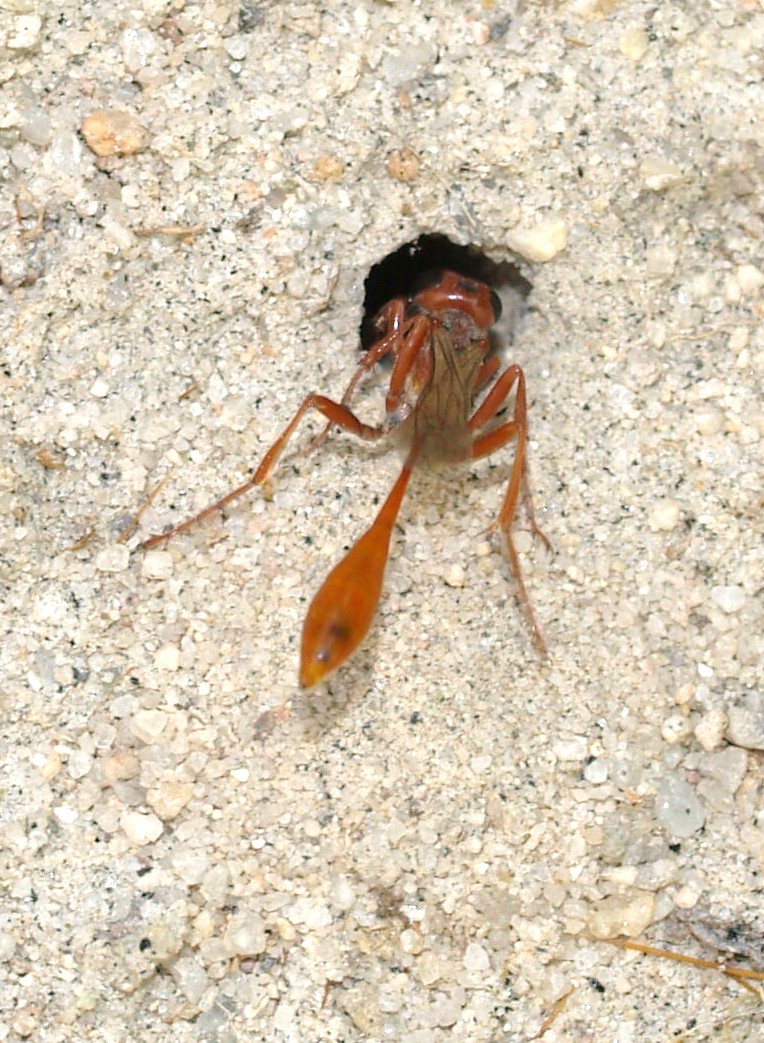
At Twin Lakes, a bare, round sandy spot of several feet diameter with an off-center entrance hole seemed to indicate a Harvester Ant nest. After some painful experiences, I approach those only carefully. But I always check around them for Anteater Scarabs, genus Chremastocheilus. So far without luck, so that will be another story. This time the entrance hole, while in the right location of the arena, was quite small and very round. Only a single hymenopteran was working, a harvester-ant-mimicking Ammophila wasp (A. formicoides or A. wrightii. thanks, Eric Eaton for the id options). She slipped inside, grabbed an 'armful' of sand, moved all the way to the outside of the flat area to drop her load on an inconspicuous slope, and immediately returned for more. She kept using the same dump site and her times inside the hole kept getting longer and longer as she dug deeper. Eventually she'll catch and paralyze a caterpillar, drag it into her hole, lay an egg on it and seal the chamber. Her larva will develop inside the living, paralyzed host until she pupates and then hatches as another winged huntress.


We moved on to the dunes of Blue Sky Road. By now it was afternoon and a thunderstorm over the Chiricahuas sent chilling blasts of wind into the Playa and the sun dissapeared behind clouds. All around the dayactive insects were retiring. A beetle in the genus Rhipiphoris nearly had me believe that he was a wasp - with his long clear wings, reduced elytra, imitation of a hymenopteran waist, and huge shiny eyes, and the way he was clinging to a dry stick just like a sleepy wasp in the evening .


A small fuzzy Clerid, Enoclerus analis (ID Jaques Rifkind), hanging on a blade of dry grass, and a dusk active Carabid, Panagaeus relative Micrixys distincta (Haldeman), running on the ground, gave both convincing imitations of female velvet ants that are famous for their painful sting.


On a Cholla Cactus several weevils of the species Gerstaeckeria unicolor were clinging to the tufts of glochids where they were nearly invisible, except to a weevil expert like Charlie who knows exactly where to look.


A round, moving dot in the sand could have been a tumbling seed or maybe a spider, but the little hairy Tenebrionid Edrotes arens did not at all look like a beetle.


Finally Charlie scared up a very pretty Checkered Garter Snake, Thamnophis marcianus. These shy reptiles usually just glide away as fast as possible. Instead, this one tried to intimidate us by taking the defensive stance of a rattler.


Mimicry, warning colors, cryptic shapes and behaviors, camouflage colors and patterns, and protective behaviors are used by animals of all habitats. Just check out the page from an old German Lexicon. But at Willcox Playa, deception seems to be the rule. There, due to a complete lack of cover, everyone has to hide in plain sight.