Showing posts with label Ammophila. Show all posts

Saturday, April 27, 2013

The other Spider Wasp


When I think of spider wasps, usually the big Tarantula Hawk (Pepsis or Hemipepsis) comes to mind first. They are the most impressive members of the family Pompilidae or Spider Wasps. Huge, colorful, rating three out  of four on Justin O. Schmitd's pain index scale ...and we have many more species of the same family here in Arizona. I am finally learning to recognize them by their sturdy shape and the spurs on their hind tibiae, even when they are not dragging their name-giving prey around.

When caught and stung, the spider is paralyzed by the wasp's venom. The adult wasp will not feed from its prey but store it in a hole, dug by the wasp or often even by the spider itself if she was ground-dwelling. The solitary wasp will lay one egg on the spider and over time the wasp larva will develop, slowly eating the paralyzed spider alive. The wasp larva will then pupate and later emerge from the burrow as an adult.

Most primitive Hymenoptera follow this pattern. Provisioning the larvae with a nectar/pollen mix as practised by bees and some wasps is considered a phylogenetically higher development, as is the cooperative raising of the brood by several or many related females in the social wasp, bee and ant species.
.
Isodontia elegans with a katidid
 Like the Pompilidae, wasp in the family Sphecidae (Thread-wasted Wasps) also provision their brood with paralyzed prey. Every species in this family targets its own very narrow range of  prey species. In an earlier blog I have described the two closely related Chlorion spp., the Steel-blue Cricket Hunter and the Cyaneus Roach Hunter that are easier to identify by their prey preferences than by their looks. 


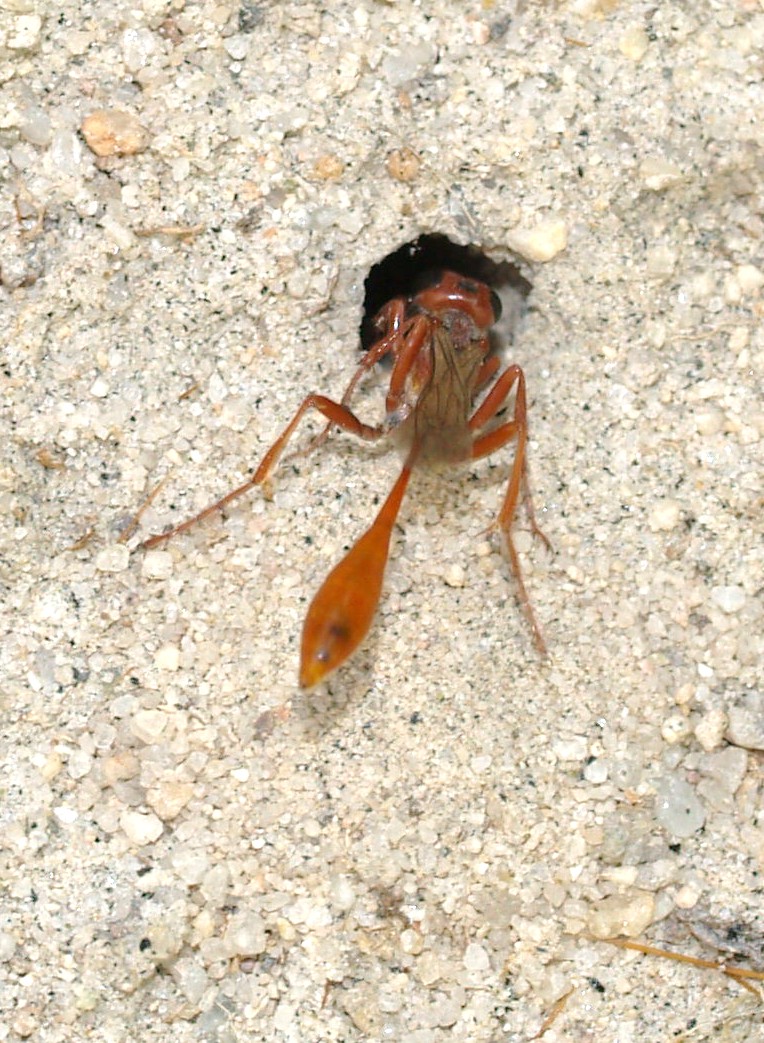
Ammophila sp., I imagine that the long abdomen serves as a counter-weight for the long-bodied caterpillars that the members of this genus have to transport

 As a family Sphecides (Thread-waisted Wasps) can be easily recognized by the extremely elongate and thin waste, or petiolate abdomen, that all member-species have in common. It provides the wasp with the flexibilty to bring the stinger at the end of the abdomen forward to sting the prey insect that she is holding with her long legs.

While some Sphecids like Ammophila build rather simple ground nests that they close by pushing sand over the opening with their foreheads, others, like Isodontia (Gass Carrier Wasps)  close the entrance with a plug of specially collected grass cuttings. 


Other family members build far more elaborate structures. Last winter, Randy and our friend Frank watched a wasp flying repeatedly into the water heater cabinet on the side of Frank's house. When they finally told me, the wasp was gone but a cluster of mud cylinders, one of them still open,  was attached to a waterline. To my relief it was the line that feeds the swamp cooler, so the young wasps were in no danger of being cooked alive when Lyn and Frank were taking a hot shower.
I kept visiting the nest ever now and then, planning to eventually wrap it in gauze to catch at least one of the inhabitants.
From December to March nothing happened. 


 In mid April (yesterday), there was suddenly a second hole in the clump of hardened mud, and something seemed to be going on in the cylinder that was always open. When a slender black and yellow wasps suddenly emerged I wasn't prepared and only got a very blurry photo before he disappeared. By now I sensed that things would quickly begin to happen in the other chambers, too, so I removed the whole nest carefully and brought it home (to our bedroom where the light is best).


Black and Yellow Mud Dauber, Sceliphron caementarium, emerging

 I heard buzzing from at least two chambers. I now see that I positioned the nest up-side down, that may have aggravated the kids. The noise made me wonder: to buzz like that, they must be already clad in a well-hardened exoskeleton. No wonder Number One had made such a fast exit. But now I was ready.
Soon moist spots appeared where two cylinders were plugged with concrete-hard mud. Next a pair of mandibles pushed through and cut out a circular area which then fell outward. The head showed, the front legs, and seconds later the whole wasp emerged: A  Black and Yellow Mud Dauber,
Sceliphron caementarium.This one took off right away, too.

The next one allowed me to get my little camera ready for a short birthday video with sound:


Here is a link to the flickr version of the same video. I think the quality there is somewhat better than the blogger-direct-upload and not as cluttered as u-tube


Empty exuvia left in the chamber, spider leg top left side

 Removing the sidewall from the now empty chambers I found the empty, parchment like pupal exuvia and a single spider leg. A female Black and Yellow Mud Dauber catches spiders of many different species to stock the nursery before she lays one egg in each cylinder.  There is another, related Mud Dauber that preys mainly on Black Widow Spiders. Our healthy young wasps had finished all their provisions before they pupated.


 Here are 2 pupae that I removed before they hatched but that turned into adults later

  I am very grateful to Gary R. McClellan for allowing me to use his images of a Black and Yellow Mud Dauber nest that he opened before the wasp larvae had eaten the spiders. The photos clearly show the variaty of spider species in the wasp nest.

Prey assembled in the nest of Sceliphron caementarium (Black and Yellow Mud Dauber) Photos by Gary R McClellan


Sceliphron caementarium


Atkins versus High Glucose diet:
While the growing larvae needed to build up their bodies and hence lived on a high protein diet, adult Mud Daubers need fast burning calories for their high energy flight muscles. Their live now centers on finding a partner, building a mud house, and hunting. To support this lifestyle they are nectaring on flowers, especially on those easily accessable ones of the parsley and carrot type (Umbelifera). For lack of any wildflowers I offered Lantana to our kids, but they didn't like it at all and buzzed off. There are always our hummingbird feeders...


P.S. The first time I saw a Mud Dauber actually collecting mud I was watching dragonflies at a pond on Fort Huachuca. That was when it was still open to aliens like me. Here at home in the very dry bajada of the Tucson Mountains, I had never seen any wasps of that genus. But some years ago, Frank put in a bird bath that is always overflowing and creates a little mud puddle while also feeding one of his huge mesquite trees. The wasp found this mud source and began building her nest not far from a porch light that attracts hundreds of moths and consequently spiders at night. In the morning I often still find spiders hanging around. They need to watch out! 7 new Daubers are on the prowl and they tend to establish nests in the same place where they hatched.


Sceliphron caementarium

Classification:
 Hymenoptera (Ants, Bees, Wasps and Sawflies) » Aculeata - Bees, Ants, and Stinging Wasps » Apoid Wasps (Apoidea)- traditional Sphecidae » Sphecidae (Thread-waisted Wasps) » Sceliphrinae » Sceliphrini » Sceliphron » Sceliphron caementarium (Black and Yellow Mud Dauber)

Saturday, August 21, 2010

Nothing is what it seems at Willcox Playa

August 8, 2010.Charlie O'Brien and I arrived at Willcox Playa around ten thirty and the temperature was already climbing into the upper nineties. On the flat salt pan, there is not much shade. The white sand reflects the sun and seems to double its intensity. Looking for bugs, we spent a lot of time close to the radiantly hot ground. Cooling off in the air-conditioned car between stops kept us going.


A dirt road parallels the tracks of the Union Pacific Railroad. We followed along with a shipment of huge windmill blades going to California. Far ahead, water was rushing. Across the road? We could see it churning and spilling down from the higher eastern embankment. Charlie and I couldn't quite agree where it was coming from. It seemed to be spouting out of a huge pipeline. But the closer we got, the smaller the stream of water became. Finally, there was no water crossing the road at all. All we found was a muddy pool of standing water on the west side of the road. Everything else, a mirage.


Those temporary pools of murky rainwater were full of life. Little pulsating openings turned out to be the mouths of big golden tadpoles, floating up-side-down while skimming debris off the surface and probably gulping air into their developing lungs. Just when my brain had formed the search image 'tadpole' I realized that some of the creatures had oddly segmented tails. Tadpole Shrimp (Triops sp.)! Dormant eggs had been hidden in the dry sand since the last flood maybe a year or two ago. The recent rains made them hatch and the little crustaceans developed within days in warm standing water. They have to race through their whole life cycle and produce new eggs before the temporary desert ponds dry out again. They have done this in nearly unchanged form for the last 70 million years and are considered the oldest animal species on earth. I had read about these predatory living fossils, but I had no idea that they would be so big (about 3 cm).

Metallic green insects, nearly invisible in the glare of sun on white sand, were running and flying like wasps or flies along the water's edge. I didn't fall for that deception: Tiger Beetles were my main interest on this trip.We caught 4 species but we saw many more. They had the wind on their side: it kept blowing any that flew up out of reach across the water. Some additional species came to the black light at night at Twin Lakes. We'll have to return for the other 70 or so species.


The rains had also triggered many wild flower seeds to sprout. The dominant plant, a purple-blooming nightshade, seemed to be already covered in reddish berries (most likely poisonous). Or were they Lady Bugs? They turned out to be the larvae of Ten-lined Potato Beetles, Leptinotarsa decemlineata. I assume that they can advertise their presence with their contrasting colors because they are as indigestible to predators as their alkaloid-loaded host plant. Their similarity to bad tasting Lady Bugs may enhance the protection (Müllerian mimicry)


At closer inspection, some of the narrow, silvery buds of the nightshade turned out to be beetles that fit exactly in color, shape and even venation: Epicauta tricostata (above and below, left). These are blister beetles, with chemical defenses of their own and probably rather safe, even if their cover is blown.
But some of the beetles were just harmless imitators: False Blister Beetles, Oedemeridae (above, right). The silvery white color of both beetle species is of course not just cryptic or deceptive: like the surface of the silvery leaves of the nightshades, it serves as sun protection.


Something was running on the ground between the wide-spaced grasses. It looked nearly like a fairly big spider and certainly acted like one. So at first I hesitated to reach for it, just long enough to let it get away. Then, of course, we caught it in a container. It turned out to be another Meloid, Negalius mamoratus (all Meloid ids by John Pinto). This one was dark, but an air cushion under slightly inflated elytra seemed to efficiently protect it from overheating by radiation.


There is a narrow range of optimal temperatures for any ectotherm, active organisms. We noticed later that these beetles climb up into higher grasses to sleep as soon as it gets to cool to keep the running-spider illusion going.


At Twin Lakes, a bare, round sandy spot of several feet diameter with an off-center entrance hole seemed to indicate a Harvester Ant nest. After some painful experiences, I approach those only carefully. But I always check around them for Anteater Scarabs, genus Chremastocheilus. So far without luck, so that will be another story. This time the entrance hole, while in the right location of the arena, was quite small and very round. Only a single hymenopteran was working, a harvester-ant-mimicking Ammophila wasp (A. formicoides or A. wrightii. thanks, Eric Eaton for the id options). She slipped inside, grabbed an 'armful' of sand, moved all the way to the outside of the flat area to drop her load on an inconspicuous slope, and immediately returned for more. She kept using the same dump site and her times inside the hole kept getting longer and longer as she dug deeper. Eventually she'll catch and paralyze a caterpillar, drag it into her hole, lay an egg on it and seal the chamber. Her larva will develop inside the living, paralyzed host until she pupates and then hatches as another winged huntress.


We moved on to the dunes of Blue Sky Road. By now it was afternoon and a thunderstorm over the Chiricahuas sent chilling blasts of wind into the Playa and the sun dissapeared behind clouds. All around the dayactive insects were retiring. A beetle in the genus Rhipiphoris nearly had me believe that he was a wasp - with his long clear wings, reduced elytra, imitation of a hymenopteran waist, and huge shiny eyes, and the way he was clinging to a dry stick just like a sleepy wasp in the evening .


A small fuzzy Clerid, Enoclerus analis (ID Jaques Rifkind), hanging on a blade of dry grass, and a dusk active Carabid, Panagaeus relative Micrixys distincta (Haldeman), running on the ground, gave both convincing imitations of female velvet ants that are famous for their painful sting.


On a Cholla Cactus several weevils of the species Gerstaeckeria unicolor were clinging to the tufts of glochids where they were nearly invisible, except to a weevil expert like Charlie who knows exactly where to look.


A round, moving dot in the sand could have been a tumbling seed or maybe a spider, but the little hairy Tenebrionid Edrotes arens did not at all look like a beetle.


Finally Charlie scared up a very pretty Checkered Garter Snake, Thamnophis marcianus. These shy reptiles usually just glide away as fast as possible. Instead, this one tried to intimidate us by taking the defensive stance of a rattler.


Mimicry, warning colors, cryptic shapes and behaviors, camouflage colors and patterns, and protective behaviors are used by animals of all habitats. Just check out the page from an old German Lexicon. But at Willcox Playa, deception seems to be the rule. There, due to a complete lack of cover, everyone has to hide in plain sight.