Showing posts with label Insect. Show all posts

Saturday, June 4, 2011

Dorms for Aculeate Bachelors


Longhorn Bees, Melissodes paroselae
The males of several solitary wasp and bee species come together at dusk to sleep in dense aggregations of bodies. The phenomenon has been described repeatedly - Eric Eaton had two blog chapters last summer and John Alcock in his book 'In a Desert Garden' also devoted several chapters (and many evening hours) to sleeping bees.
The bees or wasps cluster conspicuously on free standing plant parts, and it is difficult to see the advantage that this behavior entails.  I was tempted to call it 'bachelor parties' in the title, but yesterday at the Santa Cruz River in Marana I watched a group of Sand Wasp males come to rest on a twig of Burro Weed: No partying going on.

Steniolia sp.

I found the sleeping place by following several slow-flying wasps that caught the evening light very nicely. They led me to clump of wasps that were already settled. The newcomers picked a place, shuffled and pushed their neighbors a little, sometimes had to fly up again and find a new spot, but then immediately became very quiet and non-responsive. To collect one, I simply pushed him into a vial. No protest from him or his neighbors. Alcock  had observed the same passivity towards a Bee Assassin Bug who just came and collected his victims while the others slept on.

Bee Assassin, Apiomerus flaviventris 
Alcock also observed the bees' unwavering drive to settle on their chosen branch and nowhere else. They would come back to the same twig for several nights, even after he experimentally moved it to a slightly different location, but they did not accept a similar one that he placed in the original location. Chemical traces of last night's gathering seemed to play a role in this preference. I remember seeing the long horn bees several times in the same spot last year, but since neither they nor the sand wasps are in my own backyard I didn't have a chance to really follow up in detail.


Yesterday I filmed the landing of several new arrivals in the sand wasp group and noticed in the video that at least two stuck out their proboscis repeatedly. They didn't seem to actually lick anything, so what were they doing? I am aware that the chemical sense of insects is not limited to their mouth-parts but is located on the antennae and even the pads of their feet (flies). But why did these arriving males stick out their tongues like tasting the air around them? Check out the video on you tube and judge for yourself.

Tarantula Hawks, Pepsis sp.
On a cool morning in May of 2008 I found more than fifty Tarantula Hawk males resting on a knee-high herbaceous plant. There were no flowers offering pollen or nectar - the wasps had probably spent the night there together and were just getting active. This clustering behavior is in strong contrast to their day-time attitude: Tarantula Hawk males are known to stake out territories centering around hilltops or tall bushes.

Chlorion sp. Cricket Hunter
In June of several years  I watched  large numbers of wasps in the late afternoon in a row of Desert Broom (Baccharis sarothroides) bushes along an irrigated cotton field of the Avra Valley. They were not all of the same species, not even the same family. The majority were in the Sphecid  genus Chlorion. Dozens of those big dark metallic wasps were running around on and then settling  to sleep among the slender Desert Broom Branches.

Cicada Killer, Sphecius convallis
Velvet Ant, Timulla sp
unidentified Eumeninae (Potter and Mason Wasps)

Paper Wasp, Polistes dorsalis
There regularly were also males of two species of Cicada Killers (Western and Pacific), Tarantula Hawks, Velvet Ants, Pottery Wasps and even two species of Paper Wasps (flavus and dorsalis). Although there was a long hedge of similar looking bushes, the wasps seemed to frequent just a few of those. The observations were made in June of three years when the Desert Broom was not yet oozing any juices, and the wasps did not seem to be chewing to release any plant juices as they do later in the season. Taking into account  Alcock's branch-displacement experiments, one could speculate that there was a chemical signal emitted by the wasps that drew more wasps, in this case even across species limits.

Three is a crowd
So the  tendency among male wasps to seek each others company for the night seems to be widespread, but depending on the species this can range from loose aggregations (which can be multi-species) in the same bush to dense clusters on the same branch. Densely packed groups seem to always consist of just one species.

The evolutionary advantage of this behavior is not clear. To me it seems that the loose aggregations maybe the more primitive version which excludes group-thermoregulation as a primary incentive. All these males are without stingers, so they can't deter predators in a group-response. Actually, they are so passive, they don't even seem to profit from the increased vigilance of a multitude of  eyes. Alcock concludes that the aggregation may result in a dilution of risk for the individual, but one could argue that such an accumulation of rather sluggish prey could also draw predators? If I can learn how to find the wasps reliably and repeatedly, shouldn't generations of predators have figured it out as well?

Friday, May 20, 2011

The Secret of the Moon Flower

Sacred Datura III watercolor by Margrethe Brummermann


 Datura wrightii is blooming again on the sandy banks along the Santa Cruz River and Sabino Creek:  Thornapple, Jimsonweed, Moon Flower, Tolguacha, Sacred Datura - this perennial herb in the Nightshade family is appreciated by many but also abhorred  by a few.


Plagiometriona clavata
Although it's protected by powerful alkaloids (atropine, hyoscyamine and scopolamine), there are several Leaf Beetles that regularly feed on its leaves. The Tortoise Beetle Plagiometriona clavata can be found in July, and two year-round regulars are in the genus  Lema:


Leaf Beetle on Solanaceae - Lema trabeata - male - female
Lema trabeata
Lema daturaphila. The name means 'Datura loving'


Trichobaris compacta
Of the three weevil species that live and breed exclusively on Datura, two Thrichobaris species are 'leaf notchers' that betray their presence through punctures all over the leaves, but the third species utilizes the flowers and I have yet to find it.


The Manduca caterpillar or hornworm loads up on alkaloids wherever he finds nightshade plants. In our area he would have to find somebody's  tomato patch to match the juicy Datura leaves.


  Leafhoppers, Antianthe expansa and their nymphs suck sugar water from the phloem of the Datura stems.


Sacred Datura IV, Watercolor by M. Brummermann


The tightly rolled Datura flowers unfurl before dawn. The huge delicate funnels seem to be illuminated from within. In our climate, they only last til the late morning.


Georgia O'Keefe found eroticism in those deep trumpet shapes. Shamans and  teenagers have been seeking hallucinations from the plant. Witches used it in love potions. Insects find protection from predators with the help of the plant alkaloids that they ingest. Some art show visitors have asked me with astonishment why I would paint such a poisonous weed that also has an unpleasant smell. I was told that it's illegal to grow it in Arizona (luckily, nature doesn't care)
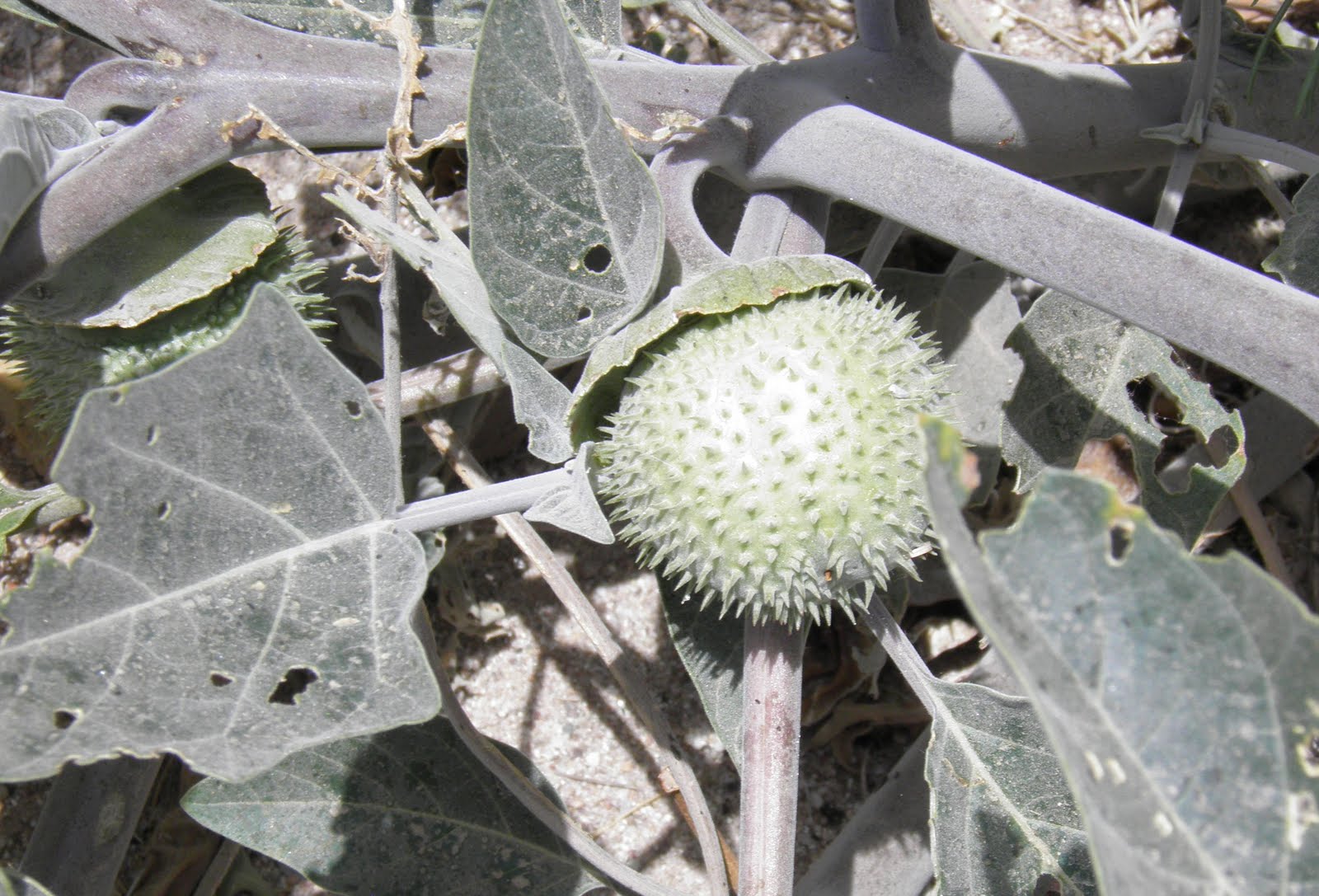
Besides its beauty, I admire the staying power of the Datura. It's a leafy, lush, delicate plant, completely exposed to evaporation and wind damage in our desert environment. Only its fruit, the thorn apples, seem to fit in where almost all vegetation is leathery, succulent, and covered in spines and thorns.


Of course, the Datura prefers to be close to water or else dies back completely during the dry season (9 months out of 12 it seems lately) Only the root stays alive. I once saw an over ten feet long Datura root system exposed in the wall of Antelope Canyon, one of our beautiful, treacherous slot canyons.


For me, the Datura flower holds another mystery. When I point my camera into the flower to shoot tiny White-masked Bees of the genus Hylaeus, I often notice a lump obstructing the depth of the white throat. Checking flower after flower, I find it in nearly all of them, even in the wilted ones that are more than a day old. At closer investigation the lump turns out to be a pretty substantial beetle..


The only way to get to it is to rip the flower lengthwise. I find a sleeping scarab wedged deeply inside. 


Elytra and actually the whole back-end are a dark cream color, the pronotum is a rich brown, and the head, which is the body part stuck most deeply in the flower, is shiny black. That's also in the name of this scarab: Cyclocephala melanocephala (black-headed round -head). 

It's in the Subfamily Dynastinae, which makes her (I only found females) a cousin of Hercules and Rhinoceros Beetles. 


For night active scarabs, these guys are surprisingly alert. When the flower is forced open, the beetles immediately start walking away and even buzzing off in a short, tumbling flight. Did I mention that I stopped by the river on a cool morning on my way to work?
This ectotherm beetle seems more active than it should be, given the outside temperature. 


Once I get to the entomology department (only a little late) I ask Carl Olson directly and Bill Warner by email if they know why the beetles are in the flowers? Carl speculates that the flowers open right when the night-active beetles seek shelter and offer a nice bright landing platform to an insect that is always attracted to lights. He adds: "..and it might be warm in there?"
Bill Warner soon emails back: "Cyclocephala melanocephala is known from Datura flowers; it frequents other types of flowers (I think including ariods) in the tropics.  There are some papers about Cyclocephala and flowers--some species are primary pollinators and some aroids "heat up" their flowers specifically for Cyclocephala." (Aroideae are Jack in the pulpit type flowers).


So is it an example of coevolution between the beetle and the plant?
There seem to be a number of advantages for the beetle.
The majority of night active scarabs flies during humid, warm monsoon nights. But in May, C. melanocephala will often experiences temperatures in the low sixties and even fifties, so a warm hiding place would be an attraction. (Elevated Floral CO2 levels, indicating elevated respiratory activity and thermogenesis were found in Datura Flowers).
The beetle fits snugly into the long throat of the flower and is not only hidden from predators but also engulfed in the peculiar smell of the chemical defenses of its host. The beetles hind-end matches very well the creamy white of an aging Datura blossom, a likely adaptation to this preferred hiding spot. The dark head and pronotum always face into the depth of flower.

I don't yet understand whether there is an equal advantage for the plant that would justify the cost of extra metabolic heat production. Some researchers assume that the elevated CO2 levels serve as a signal to the primary pollinator, Manduca sexta, Our beetle with its smooth surfaces seems indeed an unlikely pollinator. When crawling into its hiding place, the beetle passes the reproductive organs of its host flower, but it wouldn't be useful to transfer pollen between individuals because it seems to stay in just one flower for the day. So what am I missing? I'll have to ask some more experts....If I find out more, I'll add it here. 


Datura II, Watercolor by M. Brummermann


Literature:  
Context- and scale-dependent effects of floral CO2 on nectar foraging by Manduca sexta  Joaquín Goyret, Poppy M. Markwell, Robert A. Raguso PNAS March 25, 2008 vol. 105 no. 12 4565-4570 
The Role of Thermogenesis in the Pollination Biology of the Amazon Waterlily Victoria amazonica
ROGER S. SEYMOUR* and PHILIP G. D. MATTHEWS, Ann Bot. 2006 December; 98(6): 1129–1135.

Thursday, April 22, 2010

Springtime Blister Beetles of the Southwest

After a year of severe drought, record heat, and parched desert landscapes, this year's spring rains brought us glorious carpets of annual flowers all over the Southwest. Yet, according to my records beginning in 2007, there still seem to be much fewer insects than usually in March and April. The reason may lay in the prolonged drought or just the cool night temperatures that we are currently enjoying...

However, the large stands of Lupines, Desert Chicory, and Brittle Bush have attracted a multitude of colorful beetles of a family that is superbly adapted to our desert environments: The Blister Beetles or Meloids.

Blister Beetles occur all over the world except in New Zealand and Antarctica. Of the 335 US species the majority lives in the Southwest. We also have the most bizzare and colorful ones right here in our deserts.

This month, you'll see them everywhere where there are plenty of fresh flower petals to eat.


At Saguaro National Park West you may come across
aggregations of Iron Cross Beetles Tegrodera aloga (right) wandering along the path in the morning or hanging suspended from weed stalks during the hotter part of the day.


Big Master Blister Beetles Lytta magister weigh down the Brittle Bush Flowers in our backyard in Picture Rocks.


Identification
A Blister Beetle is recognizable by his big square head, narrow pronotum, an elongated soft body, long legs (Tarsal formula 5-5-4) and thread-like or beaded antennae.

Meloid Poison
The bright and striking color combinations of many Meloid species are probably a warning to predators: Blister Beetles are poisonous. Their blood and soft tissues contain Cantharidin. The chemical is produced by the male, transferred to the female during mating, and can also be found in the body of the larva. Blister beetles respond to disturbances by reflex bleeding from knee-joints and other body parts.

Skin contact with this fluid can raise painful blisters.
Grazing animals like horses can suffer digestive and urinary tract damage, inner hemorrhages and even death if they are unlucky enough to ingest too many beetles with their feed. Epicauta vittata and Epicauta occidentalis reportedly cause the most damage. They are not among our spring species but occur during the summer months. The lethal dose for an adult horse is more than 150 beetles. Horse owners here in Arizona are keeping a weary eye on grasshopper population explosions because they are usually closely followed by Epicauta  mass occurrences. (Epicauta larvae feast on grasshopper eggs).  Current alfalfa harvesting techniques involving waltzing the plants before baling sometimes trap hundreds of the beetles in hay bales. Alfalfa harvesting methods that avoid crushing the beetles and letting them instead escape before the hay is baled are available and are currently researched at the University of Colorado.


In folk medicine of many cultures extracts from Blister Beetles have been used for their presumed potency as an aphrodisiac and are still in use a remedy against warts.


Red-eared Blister Beetle Lytta auriculata (left) and metallic green Lytta stygica (right) devour Lupine and Cream-cup flowers in Catalina State Park


.
Red and black banded Elegant Blister Beetles Eupompha elegans pose openly on white Desert Chicory flowers in Sabino Canyon.


The big flight-less Oil Beetles Meloe barbarus hide in shady spots on a cow pastures of Picture Rocks. They hide so well actually, that the female I found is only the 5th AZ state record since the species was described.
read more about the amzing life cycle here: http://thesmallermajority.com/2012/10/08/life-saving-beetles/


Inflated Beetles Cysteodemus armatus carry insulating air pockets under their wings. They are at home mainly in the Mojave and the Colorado Desert but they have been found as far east as the White Tank Mountains close to Phoenix. (I went looking for them last weekend - no luck - so this photo is by Phillip Ruttenbur, copyright 2005)


Phillip Kline (copyright 2010) found this beautiful Pleuropasta mirabilis in Arivaipa Canyon in Pinal County and sent me the picture for identification. He graciously allowed me to add it to this blog.


Dull orange beetles of the genus Nemognatha love the thick pink heads of New Mexico Thistles. Their elongated maxillae form a sucking tube that allows them to compete with bees for the nectar. On the flower heads they also find mates and lay their eggs.


Life Cycle
While the adults are vegetarians, Meloid larvae are predatory or parasitoid. The females of several Meloid genera position their eggs on flowers. Highly mobile, long-legged larvae emerge and hitch a ride on a visiting bee to get to its nest. From the BugGuide: 'In at least one Meloe species, the larvae climb to the top of a grass or weed stalk as a group, clump together in the shape of a female solitary ground bee, exude a scent that is the same as, or closely resembles, the pheromones of the female bee, and wait for a male ground bee to come along. When he does, he tries to mate with the clump of larvae, whereupon they individually clamp onto his hairs. He then flies away, finds and mates with one or several real female bees, and the larvae transfer to the female(s) and with them to the bee's nest.' There the larvae change into short-legged grubs that consume the bee off-spring as well as the pollen and nectar provisions. The winter diapause is spent in form of legless coarctate larvae which in early spring change again into short-legged but mouthless creatures only to prepare the pupal chambers. There they pupate and the adult beetles hatch ready for the next spring flower season to start the cycle over. This highly complex cycle is called a hypermetamorphosis.


A-triungulin; B-caraboid stage; C-coarctate larva;D-scarabaeidoid stage; E-pupa
F-adult beetle (imago) of a Striped Blister Beeltle, Epicauta vittata

The best is yet to come
Here in Arizona, the monsoon rains will trigger another burst of fresh vegetation in summer, and with it many new species of Meloids will emerge, mostly in the genera Epicauta and Pyrota.Three species of the genus Pyrota that we'll find again in Arizona from July to October.