Monday, March 14, 2016

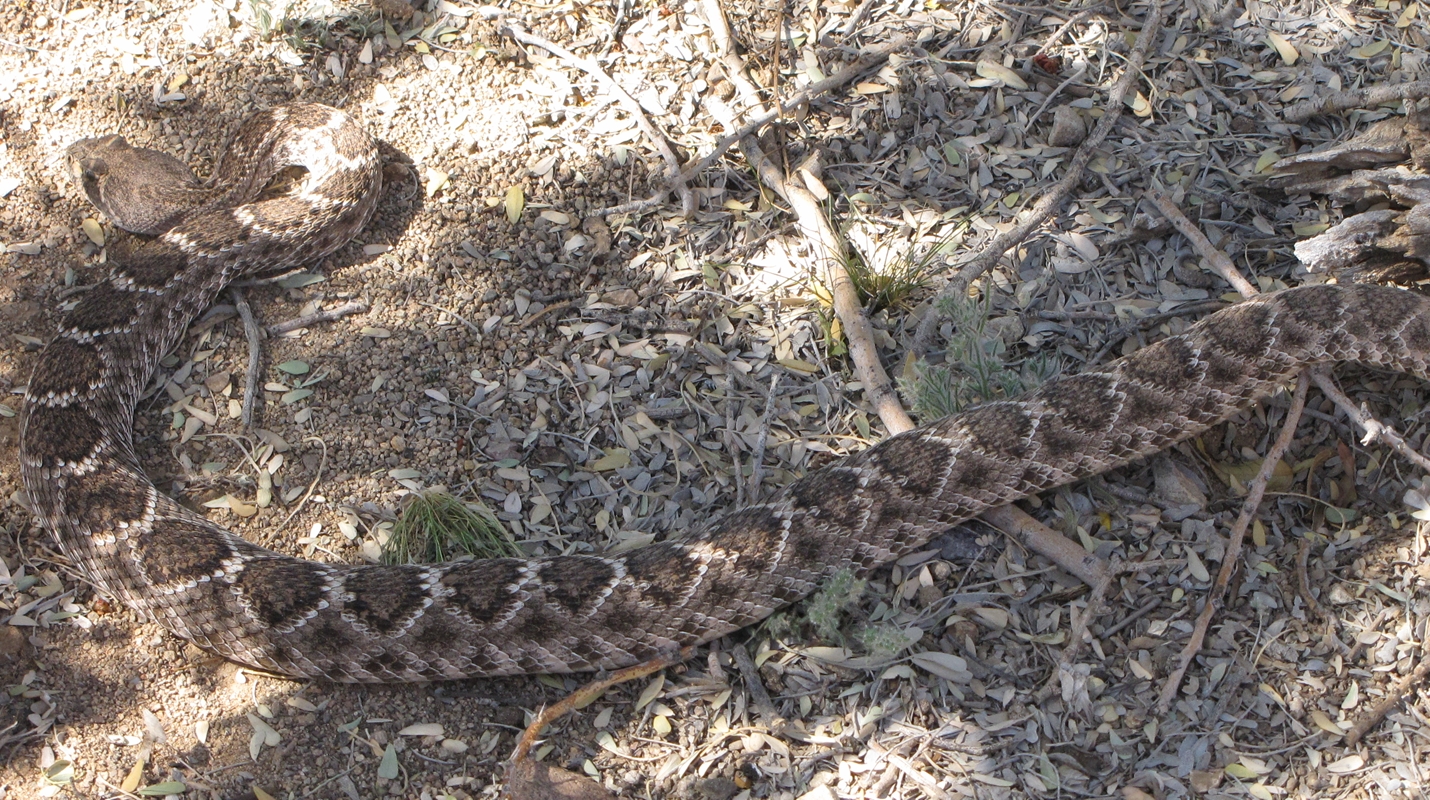
A Western diamondback rattlesnake in the garage, again


Coming back from Cortaro with a trunk full of veggies and library books, we had to park by the side of the garage because my new car now resides inside, together with my art show van. We carried our haul through the side door. Then Randy went out again to return the cooler to his car, but instead he came to get me with the words 'come, he's back!' No idea who's back, but I'm always curious and we live a lonely life out here.


The rattler in the garage door hadn't just moved in. He obviously came out of the garage to bask in the sunshine in the open door. Of course he did not want to move all the way out, but retreated back in, between all those stored butterfly nets, beating sheets and collecting buckets and what else we store there. Too much stuff! After pushing him back and forth between us, mostly out of sight under the shelves, I finally managed to grab him behind his head with my snake stick and carefully pull him out.


He was released right there again, on the other side of our main entrance under a great Ironwood tree and in the company of a metal quail family that my friend Mary Lee made.


We noticed how docile he was - he never rattled through the whole ordeal and then patiently waited to have his picture taken. I wonder how long he lived in the garage ... we have a pack rat problem there.


We released him also very close to our first blooming hedgehog cactus. Maybe that will make him want to stay outside?


Sunday, March 13, 2016

Birds around the house in early March


The Hooded Oriol was very conspicuous for about three days, chattering and scolding. He discovered a hummingbird feeder on the patio  and still likes our Aloes.

 As usual, he has to share those with the Gila Woodpeckers. They are claiming saguaro cavities and use our old antenna as a sounding board.


Pyrrholoxia male and female are calling after we have not seen them all winter long. I hope they'll stay around. Maybe we should bring out some sunflower seeds.


Ladderback Woodpeckers show up from time to time, they especially still like the old dead peppertree, but I have never seen nesting attempts.


The Gilded Flickers are interested in several existing cavities. It would be nice if they could use one instead of hammering out a new hole. We have so many in our saguaros that some  arms and even center trunks are breaking off. I have sold the boots that develop as scar tissue around the nests to an artist friend, but I prefer healthy saguaros.


Roadrunners are also preparing to nest, we hear their unnh-unnh-unnh calls all morning during breakfast.


I hope the Roadrunners don't catch our patio Desert Magister - we saw her grow up over several years after our dogs and cats wrecked havoc among the population when they were young. That seems to be under control now ...


White-winged Doves just showed up, only to find the invading Eurasian Collared Doves already in residence and on eggs    


Turkey Vultures have been arriving for at least a couple of weeks now, but today the dogs got really upset and chased a pair of Black Vultures through the property. Those are rare here, but until my camera was ready, they had already gained so much height that they hardly show up in the pictures. Too bad, they were circling each other like they were courting.


Good news from the Dark Female: Our resident Red-tailed Hawk is again using one of her saguaro nests, this time the one closer to us. I'll have to check my records, but it seems that she's been raising her broods here now for at least 5 years, if not longer.


The Kestrels are also very territorial around their chosen saguaro, so there are probably eggs in the nest as well.


There is a constant din from the metallic songs of white-crowned and Black-throated Sparrows. They are everywhere, but not very eager to sit for photos. Phainopeplas are better - sitting pretty on top of trees - we did not pull down mistletoe  for a couple of years and those silky guys are happy.

Friday, March 11, 2016

Marbles in Florida Canyon

One day after my birthday we - Randy, the pack and I - hiked up Florida Canyon Trail towards the saddle. A beautiful, if slightly muggy day.


From the highest point, we had great views all the way over downtown Tucson to the Pinal mines and Green Valley.


On the way up I told some birdwatchers to look for Montezuma Quail and when we met them again higher up, they proudly reported that they actually saw some: 'and suddenly two rocks began to move!'


Heading down I let go of  Mecki because he kept getting in my way on the steep trail with loose rocks. He stayed nicely on the trail until he saw the quail too. He is usually no hunter, but this time he ran. I normally trust our dogs to be smart enough to find us again, but this time we had to wait ominously long. We called and whistled and felt rather bad that he was running free and anxious that he was lost, or worse. There were signs posted along the trail warning of a dead horse that might attract predators. We saw neither carcass nor pumas ...
and Mecki eventually turned up behind us on the path, panting and wet. Very tired, too.


There were only some Blue Dicks and a few Sand Verbenas blooming and we saw few insects with exception of very active Carpenter Bees that constantly droned across our path.We did find some interesting butterflies, though, mating pairs of Desert Marbles, Euchloe lotta.

Looking down from the trail into the Santa Rita Research Station I recognized some familiar figures with beating sheets and nets: Charlie and Lois O'Brien and their Canadian guest Robert Anderson were searching for weevils. So our hike concluded with  a nice visit with them and station manager Mark Heitlinger.

Wednesday, March 9, 2016

Insect photography in canine company


Today I hiked the De Anza Trail. Well, I followed in the footsteps of that Spanish explorer for at least a couple of miles. And I had my own army to organize. Because Randy was working on a paper, I took all 4 dogs, even though I still don't trust Mecki and Frodo to be friends or at least peaceful. So in the car, Mecki sits in the passenger seat and the others in back.


Then, to hike, they get organized in pairs- Mecki and Bilbo and Laika and Frodo share leashes. To add to the confusion, Bilbo was bitten by either neighbor dog or Javelina, licked the wound until its size quadrupled and was turned into an inverse cone-head with the help of an Elizabethan collar. That thing swings from side to side with every step, and since he's decided to just ignore its existence,  he bangs it into legs, car doors and dog noses as if he enjoys it.

 The sandy path along the Santa Cruz in Marana used to produce a multitude of natural and planted spring flowers, but in this deceptive el Nino year they are few and far in between. Even sparser  are  the insects that are usually attracted to the flowers. But I anyway brought my camera and the dogs are getting their training in photography-cooperation.


Some metallic Sweat Bees collect pollen from Desert Marigolds, joined by a Buffalo Treehoppers (Ceresa)  


Some nice Anthophora Bees are visiting Parry's Penstemon but they prove very difficult to photograph.

The blooming Brittlebush has nothing to offer except a big hover fly Copestylum apiciferum which probably grew up in a decomposing cactus in the less cultivated parts of this river park.


A tiny beetle is perched on a petal of a surprisingly white desert Primrose. The beetle turns out to be Lytta auriculata, not even half as big as  these beetles usually are. Most likely it grew up as a brood parasite in the nest of a bee that only stored a minimal amount of provisions.   The plant seems to be The Dune Evening Primrose which is out of place here, but as I said, some flowers were obviously put here by well meaning city gardeners and are not quite native to the Sonoran Desert


My dogs quickly learn not only to sit quietly around the wildflower spots but they even begin to determinedly walk towards them. They know that a reward follows every successful photo session.

Monday, January 18, 2016

Sandhill Cranes at Whitewater Draw


This year I had a show in early January and no time yet to see the wintering cranes around Willcox Playa and Whitewater Draw close to Tombstone.


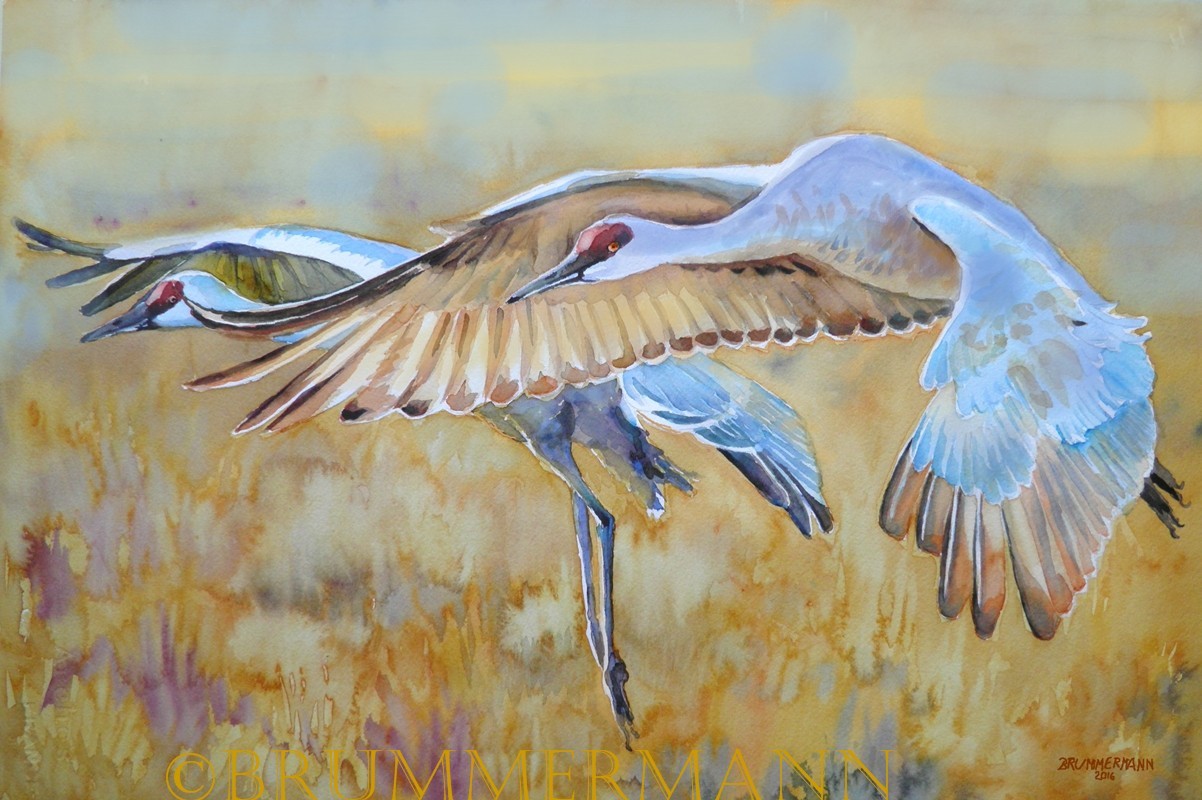
So I revived my memories by looking through slides and photos from previous years. The result are my first watercolors of 2016


Cranes taking flight into the morning sun. The spray of drops and the edges of the birds' wings catch the light. Otherwise the birds are blue shadows against the warm colors of the reflections on the shallow water that hardly covers fields of old cornstalks.

In the evening, a pair of Sandhill Cranes against a hillside rich with the jewel tones of sunset and deep blue shadows.

Prints and Originals are available. For prices see my Watercolor blog

Sunday, January 17, 2016

Falcons, Hawks, Owls and Sheep Dogs


Last week Ned Harris and I made a trip into the Santa Cruz Flats around Picacho Peak to look for Caracaras and other raptors.

Ned's photo
 We found several groups of the big birds that are momentarily considered Falcons - they used to be ranked with vultures - in freshly plowed fields, mostly in mixed flocks with Ravens. I heard that the Caracaras feed on pecans, but I cannot confirm that. The oily nuts are appreciated by ravens - some in Patagonia had learned to crack them and spent days harvesting - but I have yet to see a caracara try that. They often fly up into the old pecan trees along the roads, but to feed they seem to concentrate on grubs and worms in freshly turned soil. I have also seen them turn over clods of turf  with their feet. 


Kestrels, Redtail Hawks and one very shy Prairie Falcon were roosting on power lines and posts. As photographers we made our peace with those ugly perches because the birds definitely love them. Without those artificial perches, the birds could make little use of wide open agricultural areas.


Burrowing owls slept in front of burrows and drainage pipes that they probably use for nesting.


A Great Horned Owl posed willingly, if rather sleepily. Did all the owls have a really hard night?


Several Roadrunners crossed our path, Shrikes perched on dead branches, hundreds of Meadow Larks were everywhere.


On a little pond I found a Snipe, but got no good photo. Still, it was nice to at least see it so clearly. Greater Yellow Legs were poking around in a freshly tilled fields.


Repeatedly, huge migration flocks of  sparrows flew up from the grasses. But we both aren't good at identifying sparrows. Raptor man Ned calls them simply prey.  


Surprisingly, we  spent the longest time watching herds of sheep. Lambing happens early here in Arizona, so there were no newborns anymore, but the lambs were still at a cute age. What fascinated us, though, were the two big white dogs that were in control of the large flock.


As we got out of the car with our cameras, the dogs raced up and barked, but they never left the direct vicinity of their charges. And they soon recognized that we were neither mountain lions nor wolfs. The sheep were not alarmed by the barking: they came walking up to their protectors and joined them. These were classic old European flock-guarding dogs, probably a close descendant of the great, white Eastern sheepdogs that slowly spread across Europe over 2,000 years ago: the Karabash and Akbash sheepdogs of Turkey, the Kuvac of Slovakia, the Kuvasz and Komondor of Hungary and the Pyrenean Mountain Dog of France are all of this type. Ours looked particularly similar to Italian Maremma Sheep Dogs.


Dogs like these are raised with the sheep and feel that they are an integral part of the herds. A while ago I heard that international help organizations are giving puppies to herders in developing countries as an aid project, especially in areas close to National Parks in Africa. Of course, they are primarily there to protect the live stock from predators and thus reduce the losses that the human owners may incur. But of course the big dogs also indirectly serve to protect lions and wolfs from the wrath of herdsmen who might hunt or poison any predator that they perceive as  a threat to their herds.


We later found signs that warned hikers and bikers of the presence of the big, unattended dogs and gave advice how to behave around them. I wonder if a person who doesn't already know that those giants are harmless as long as you don't mess with their sheep would learn it from the fine print on those signs.

Saturday, January 2, 2016

Happy New Year - with a True Bug Poster

This is number three of my Arthropods of Arizona Collection - and I have some more ideas based on the photos in my sock drawer. For these posters I use photos that I have taken over the last ten years. All are of living insects - if possible I photographed them on white background, but some are also liberated from very colorful natural backdrops. Some legs and antennae needed to be rearranged or even graphically replaced...

On this poster 28 families (29 if you count Phymatidae) are represented by 73 identified species. A black and white template and the species list organized in taxonomic groupings comes with the poster if you order one. So this one has much more info than the other two - I have more practice now. The poster are 18 in by 24 in and cost $35 plus shipping. It is a fully archival art print. You can order here (send me
a message).

 Here are the first two, I just reordered them from the printer, so I have a few of them in stock, too.
To order, please send me an e mail to mbrummermann@comcast.net

Best regards Margarethe