Friday, October 16, 2015

Insects at the Gravel Pit in Marana

As stated in the previous blog, the vegetation around the Coachline Gravel Pit is heavily disturbed. Large areas are covered exclusively in Cocklebur (Xanthium sp.), others in Dock or Sorrel (Rumex sp.). Two species of Salt cedar (Tamarix top left) lost some ground during the flooding but are making a rejuvenated come-back. The only Native tree competing successfully is the Mexican Palo Verde (Parkinsonia aculeata top right). Much of the ground cover consists of imported grasses and at least 5 species of Night Shades (among them Ground Cherry, bottom left). Over the last year, Russian Thistle (Salsola bottom right), one of the tumble weeds, has been gaining ground.


All this is not the best base for a very interesting insect fauna, plus a lot of subterranean eggs and larvae probably succumbed to the widespread flooding. Anyway, I keep checking, hoping for something interesting.
 I found a number of flies which, to me, are most difficult to identify. So I will add taxons later, whenever I (or experts) figure them out.

Therevidae (Stiletto Flies) ?
Lordotus sp. , Bee Fly
mating pair of Physiphora sp., family Ulidiidae
Robberfly genus Megaphorus
  On dryer parts of the park Rabbit Bush Hymenothrix wislizeni still bloomed and supported the its typical insect fauna of bees and Longhorn Beetles plus a curious little Ground Mantis (Litaneutria minor)

Exomalopsis sp.

Longhorn Beetle (Crossidius suturalis)
Ground Mantis (Litaneutria minor)

Blister Beetle (Epicauta sp.)
The green version of Melanoplus lakinus (Lakin Grasshopper) is unusual here, but more common further east

Melanoplus lakinus (Lakin Grasshopper)
 So it wasn't a great photographic haul, but one never knows, and it's only minutes from home..

Thursday, October 15, 2015

At the Coachline Gravel Pit in Marana


Earlier this year, the Santa Cruz River jumped its bed during a flood and started rushing into an old gravel pit in Marana (Pima County, Arizona). Bird watchers were delighted, Frisbee golfers who had their parcours  there were not, but resigned themselves to a course and stations under yards of slightly smelly water. That water quality seemed a problem to me. High in nitrogen, it favors invasive plants over the local desert vegetation. The site attracted migrating water birds and birders, but was otherwise as disturbed as I've ever seen an area. Eventually the river was forced back into its bed with a dam of sand and seeping and evaporation lowered the water level considerably. But, different from previous years, the pond never dried up completely.


When I visited yesterday, I first scared up a Cooper's Hawk from the ground. Above, a Harris Hawk drew clumsy circles. Killdeer screamed, and a flock of 'Peeps' swooped back and forth.


 On the water, there were some Northern Shovelers,  a few Mallards, and two small ducks that I could not identify because they are all in their drab summer dos.

Egrets were strutting, along the muddy bank, more coming in for early roosting spots.


A single Yellow-headed Blackbird perched on some old tires. Only one Vermilion Flycatcher alternated between perching and swooping over the water - very much like some of the dragon flies. I saw Mexican Amberwings, a Darner, Black Saddlebags, Variegated Meadowhawks, Roseate Skimmers.


Flapping of heavy wings and a lot of splashing drew my attention back to the water: a single White American Pelican was cruising there, trying to fish in the muddy water that was quite obviously to flat for his big beak. Still, he must have gotten something because he kept going.


After his meal, he thoroughly preened and I got a better look at his wing marker. I reported the number later to the Utah Division of Wildlife Resources.
   

But it turned out I wasn't the first to do so. anyway, now I know that he was tagged near Gunnison Island in the Great Salt Lake on July 22 of this year. At that time, he was too young to fly. So that's his baby picture, sort off   (Photo Utah Division of Wildlife Resources).



Saturday, September 19, 2015

Arizona Beetles

I am preparing powerpoint slides for a talk to the Docents of Sabino Canyon about the beetles of their beautiful park. The canyon begins on the desert floor and eventually reaches up the highest elevation of the Catalinas at above 9000 feet. Few hikers will follow it that far, but most of it know how to connect with it again after driving up Catalina Highway. Theoretically, this vertical expansion over many different types of vegetation and habitats could allow us to find almost all AZ beetle species right here. Even recent arrivals from south of the border often make their way here after a couple of years. Missing are of course specialists of sand dunes and some other extreme niche habitats and the northern much populations that are more connected to Utah and Colorado than southern AZ. So my talk about Sabino Canyon Beetles will very much be an introduction to Arizona Beetles in general.


After posting this title slide on Facebook, I got many requests for prints. I don't really do mass produced posters. Instead,  I am offering a special  limited edition of giclee prints size 20 by 34 in. These frameable prints are printed on heave acid free paper with archival pigment ink. I am offering them for a limited time to my naturalist friends at $60, which is way below my normal price rate. 


I got so many requests for posters that I inquired into having them printed: This 18 by 24 in version will cost $20 plus shipping in a tube. I'll order them if I get at least 10 orders.

Update: I have more than enough orders, so if you'd like one, let me know soon so you get included. email me mbrummermann at comcast.net 

Thursday, September 17, 2015

The patience of snakes


 It's snake weather again. Each year, our rattlers show several bursts of activity. One is beginning now at the end of the monsoon season after a few good soaking rains. Diamond Backs even have a second mating season in fall. So every evening Frodo, our snake barker, announces his sightings on and around the patio.


Yesterday I heard a loud buzz when the dogs were running up to get their dinner. A big Diamond Back was curled up in their path, looking somewhat annoyed, but sat quietly while the dogs were being fed 10 feet away and then let into the house. He then moved on, too. Go, get those packrats!


This morning we walked into the state land right next to our place, happy that for once we heard no 'puff puff puff' noise from the guns of dove hunters. But we aren't able to pay enough attention to two things at once. On the way back I nearly stepped on a curled-up Sidewinder with Randy's tracks firmly imprinted on both sides and Bilbo's nearly touching the snake's body. That had been very close.


Temperatures in that sunny spot were approaching the nineties by then. Nevertheless, the snake was tightly curled up, snuggled in and keeping a low profile as only Sidewinders do. I thought that he'd soon be too warm, so he'd probably be close to moving on. I had not seen the 'side-winding' motion and was determined to make him demonstrate it. Camera in one hand and a thin, dry creosote branch in the other, I tried. Gently. No reaction.


A little more forceful. He acknowledged me with a flick of his tongue. I pushed the stick under him. He turned out to be much easier to flip than a pancake. I unraveled his coil, admired the small, perfect rattle, he just gave me a look.


I felt more and more guilty about disturbing his peace. I moved him back to his favorite spot, tucked him back in and rearranged his coils. Not quite right, he sighed and perfected it himself.


I apologized for disturbing him so rudely. I still haven't seen a Sidewinder side-wind. He dozed off for another hour or so.
This blog has links to 2 videos on flickr. Please click on the orange highlights in the text to see them. And trust me, while clumsy, I was gentle.


Wednesday, September 2, 2015

Chemical messages of Soft-winged Flower Beetles are still not understood

Collops quadrimaculatus
 Our Mesquite trees are blooming for the second time this year. Among the insects drawn to nectar and pollen are colorful little Melyrids (Soft-winged Flower Beetles) probably of the species Collops quadrimaculatus. The whole genus is in need of revision, so who knows.
The larvae of Melyrids are predatory. Several species live under bark and prey on wood boring insects. Adults feed on pollen, nectar, but also other insects or their eggs.

Collops bipunctatus feeding on moth that a crab spider dropped
 I've even seen Collops grab prey from crab spiders, and I often find them lurking around the webs of cribellate spiders.
 These observation raise the question how these soft little guys can dare to be so bold?
Vivid aposematic (warning) colors seem to indicate that they are distasteful or even toxic.

Collops bipuntatus specimen with protruding vesicles photo Sam Droege

In addition, when disturbed the beetles can protrude red vesicles from the sides of prothorax and basal abdominal segments. But so far, attempts have failed to show that  predator deterrents are either on those pouches or are released from them. 


Now to some friendlier aspects of chemical signals: In males of the genus Collops several basal antenomeres are greatly enlarged. I have watched a male approach a female and present his vibrating antennae for her inspection, touching them to her antennae and sweeping the knobs across her head and pronotum. It looked as if he was maybe releasing pheromones towards the chemoreceptors on her antennae. Some literature suggests that he might release a substance that she would lick - which would make her receptive to his advances. In the case that I watched, she was not interested. He kept waving his antennae at her very persistently, but she eventually walked off. So my observation does not allow to decide whether he presents just pheromone communication or offers gifts and treats.  

Friday, August 28, 2015

Parasitism and Symbiosis


Thousands of Hippodamia convergens converge on mountaintops 
In summer in the mountains of AZ, we often see huge congregations of Lady Beetles. They may migrate up to higher elevations to escape the oppressive heat in the valleys.
In the mountain meadows around Flagstaff, a little parasitic wasp is ready for them: Dinocampus coccinellae, a braconid wasp, stings a ladybug to oviposit. The wasp's larva then develops feeding on the beetle's heamolymph. Also transferred is a virus: D. coccinellae paralysis virus (DcPV for short). The virus multiplies in the developing wasp larva and eventually infects the ladybug's nervous system. At the time the wasp hatches and pupates, the virus immobilizes the ladybug. The brightly aposematic and toxic beetle is forced to stand guard over the silk cocoon that its former unwelcome guest has spun beneath it, basically providing protection for the pupa. The beetle is still able to move, but not to walk away. The DcP virus may actually enhance the deterrent effect by making the beetle twitch. In a recent study, no wasps without virus were found, so there was no test group to see what happens if the wasp pupa has to develop without its protector. Surprisingly, researchers did find that a fair percentage of beetles actually makes a full recovery. Who would have thought? It is not clear though if those recovered beetles are still able to reproduce. And would the be possible hosts to the same sp. of wasp again? Would they be immune to the virus the second time around?


The wasp cocoon in my photo was already empty, and the beetle looked quite healthy, if still tethered. Ready to go, actually. I found it and several others on a mountain meadow near Snow Bowl, Coconino Co. AZ  8/5/2015'

Original research by The topic was recently also treated by Eric Eaton in his blog and by National Geographic' website.

Monday, August 24, 2015

Butterflies at Proctor Road

Jeff in action, here shooting an owlfly, not the hister on the right, that's something that happens later at the U of Madison, WI

 On Saturday morning (8/22/2015) I met with Jeff Gruber at Proctor Road, Madera Canyon to go bug hunting. Jeff is the most excellent macro photographer whose virtual insect collection  on BugGuide years ago gave me the first glimpse into the possibilities of stack montage photography. He was searching for myrmecophile beetles (beetles that live in ant nests).


A nest full of friendly ants and my attacker - the Pogonomyrmex whom we were not bothering at all
Because this involves the slightly Sisyphean job of turning rocks of the size one just about cannot manage, we started earlier than usual for insect observations. At the first nest  Jeff found a tiny (around 1 mm) hister (?). I leaned in to get some shots of workers and pupae for my impending talk about ants at the Senior Academy.  
While the ants who had the roof lifted off their nest were quite peaceful and never bothered Jeff, three members of a neighboring Pogonomyrmex colony  climbed up inside my wide cargo pants and nailed me. Outch! I was wide awake after that.


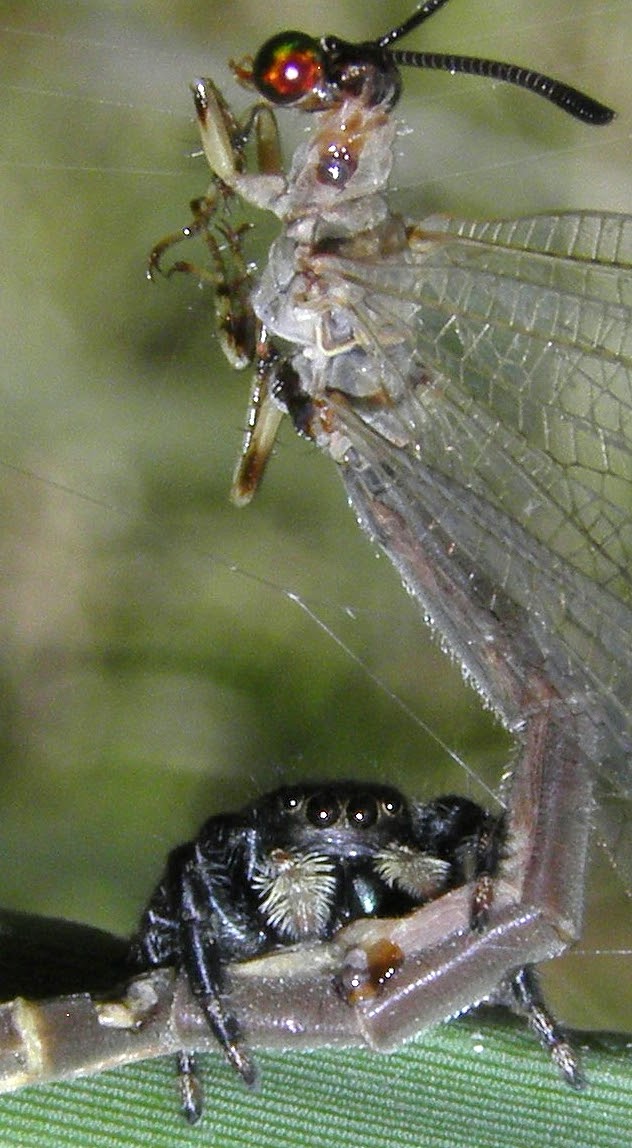
In grasses and shrubbery, night active neuropterans were hanging out for the day. There was one Owlfly,  but most were anlions (I hope their larvae will get a lot of Pogos!) that lined up along Sotol leaves and blades of grass. There, they all moved around in unison, trying to hide behind their narrow perches. 


This behavior made photography difficult but did not deter hunting jumping spiders in the genus Phidippus.     


Along Madera Creek and Proctor Roads, Robber Flies seemed to be even more prevalent than usual. Most of them perched at the ends of twigs surveying the area for prey. The ones that were already  feasting all had beetles for breakfast: so that's why I could hardly find any.


The notable exception were leaf beetles of the species Leptinotarsa haldemani on a completely leafless Wolfberry bush and Zygogramma signatipennis whose larvae had shredded the leaves of Tithonia thurberi until only fine lacework was left. 


Still, the asteraceae were in full bloom and attracted scores of butterflies. We are both no lep people, but the amazing sight was not lost on us. A local butterfly hobbyist stopped by because he saw our nets: within minutes he yelled back that he had seen 28 species, including  Microtia elva (Elf ) that he was trying to breed. 


Luckily I had documented the tranquil scene before he showed up - just the creek rushing, Gray Hawk fledglings calling, and dozens or hundreds of butterflies dancing among the flowers in the dappled shade of hackberries, junipers and oaks. For better quality, please watch the video through this link


Eventually around 2 pm the thunderstorms forced us back to our cars. I drove home via Mission Road through the reservation and found myself in the aftermath of a downpour where the road was covered in sand, rocks and other debris. 
The radio program was constantly interrupted by 'damaging wind and hail' warnings and on the intersection of Ajo and Mission it felt like a load of rocks was pelting the car. But I escaped westward into bright sunshine and watched the dark wall rushing behind me towards Tucson.