Saturday, June 6, 2015

Following Coronado's Trail

In 1541 the Spanish explorer Coronado traveled north through what are now the eastern most  counties of Arizona: Graham, Greenlee and Apache. Coronado did not find gold in the city of Cibola as he expected, and I also missed out on my trip last weekend. All I wanted to see were some interesting AZ beetle species that I had not yet photographed, but along  Coronado's Trail it began to first rain, then hail and finally even snow, and I knew that I was out of luck.
But I did thoroughly enjoy myself anyway. While the Phoenix Valley was sweating under 105 degree Fahrenheit and Tucson wasn't much cooler, we (my new dog Mecki and I) were on our way to Hannagan Meadow, which according to Wikipedia is one of the coldest inhabited places in Arizona.

But first we had to get there, and the early part of the trip right after turning north from I 10 on Hwy 191 is not very pretty. The Safford stretch was endless and boring. Mt Graham invited on the left, but we it wasn't on our list this time.

Clifton on the San Francisco River
Clifton at the San Francisco River is still quite picturesque with its towering red cliffs, old buildings and some narrow old downtown streets. We missed out on the big Horn Sheep, except on traffic signs.


In Clifton Mecki stood unmoved and yawning right next to a rumbling train that shook the ground under out feet. The little guy is fearless.

In Morenci, it got depressing.  Freeport-McMoRan offers pull-outs to scenic views of about the worst destruction that humans can wreak on the earth. The huge pit mine, plus smelters and ponds of toxic sludge - eye sores praised as attractions - from horizon to horizon.

Freeport-McMoRan Copper Mine in Morenci
North of Morenci, though, I had miles of beautiful winding mountain road all to myself.  It is a popular trip for motorcyclists, but I met hardly any this time.  Wildflowers and fresh leaves on Gambel's Oaks and Aspen were soon contrasted by dark green conifers because the road gains quickly in elevation.  Stopping along this road used to be difficult to impossible and letting a dog out of the car was a real challenge. But since my last visit about 13 years ago many trail-heads, day use areas, little horse corals, and campgrounds have been added. The Apache-Sitgreaves National Forest has become much more accessible. A heavy price was paid, though: the Wallow fire of 2011 was started by an unattended campfire and left acres upon acres of burned trees and eroding soil behind. The scars are  healing very slowly.


But the fire had also opened up many areas for fresh growth and wildflowers, perennials and annuals alike.

Parey's Agave, Asclepias sp., (Milkweed), Erysium sp. (Wallflower), Orobanche sp, (broomrape), Yucca baccata (Datil yucca or Banana yucca)
The rocks in many areas were porous like sponges but extremely heavy and hard as glass indicating their volcanic origin. I bumped my feet against them repeatedly, but only a delicate little flower made me look properly.  The blinders of special interests.

Corydalis aurea – Golden Smoke, Scrambled Eggs
As soon as the sun broke through the clouds, insects were collecting nectar and pollen. Some plants in the mint family were completely covered in butterflies.

Strymon melinus (Gray Hairstreak and Callophrys gryneus siva (Siva Juniper Hairstreak)
Missing from my shots are the many Common Buckeyes. But the Juniper and Gray Hairstreaks were interesting and cooperative.


A lush Milkweed had attracted Valley Carpenter Bees and Sweat Bees as well as Small Milkweed Bugs and Hairstreaks, but no Monarchs, sorry.


 Surprisingly, a Bee Fly's proboscis proved long enough to reach into the deep throat of a Lonicera-like flower.  Acmaeodera bodwitchi (Jewel Beetles) were meeting on  Fleabane (Aster). At this elevation Oaks and Juniper predominate.

Looking east into New Mexico
Fantastic views opened as I climbed up into the Blue Range, new home of the first Arizona Wolf packs in decades. As problematic as their reintroduction turned out to be, it still gives hope.

Cirsium neomexicanum – New Mexico Thistle
  Along the road were fewer flowers at higher elevation, but some thistles supported a kaleidoscope of interesting insects and arachnids.


Sharpshooter Oncometopia alpha female burdened with some red mites, a leafbeetle genus Chryptocephalus, two juvenile jumping spiders genus Phidippus and two bees,  Dianthidium sp. and  Apis mellifera (Honey Bee) were only a few of the insects and spiders on the big thistle. They all had a great view!

Monochamus scutellatus (Whitespotted Sawyer)
At over 9000 feet elevation, the mixed conifer forest showed heavy fire damage from 2011, I had expected some wood-boring beetles to emerge from piles of dead wood that are still left everywhere. But the only one I found was a Monochamus scutellatus  that sadly had been stepped on on the stairs of the historic lodge at Hannagan Meadow. I saw another one flying, but could not get to it. So the photo became a restoration project. Still, the species is variable and I'm happy to have an image that has still all the characters of the specimen from Hannagan Meadow. See my reconstructed image on the right.

Left and middle Formica fusca, workers with larvae and pupae, right swarming Liometopum luctuosum
Most dead Pine trunks were crawling with ants of many species.  Camponotus sp. stood out for their size. One downed Ponderosa trunk seemed to boil with life. Large alates and agile small workers of Liometopum luctuosum  were pouring out from under the loose bark by the thousands. Seeing that, I understand finally why some pupae are so much bigger than others and much bigger than the attending workers. They must be the pupae of prospective alates, young queens and males.

Lacon pyrsolepis, Elateridae
Among all those ants, a click beetle slowly made his way, surprisingly unmolested. Its upper side was strangely textured, it nearly seemed covered in reddish-golden scales. I have no idea if it had anything to do with the ants, but most beetles have to expect vicious attacks if they venture so close to the nest of a colony. When I reached in to collect the beetle, I immediately felt ants all over me and they were stinging. The Click Beetle turned out to be Lacon pyrsolepis  (Blaine Mathison det. P.J. Johnson confirmed). While some Elateridae are obligate myrmecophiles (like those with bio-luminescence) PJ Johnson says about this one: 'Lacon spp. have no known associations with ants. Their larvae are saproxylic, mostly in conifer logs, snags, stumps, etc., where they are predatory on other inverts. On occasion they can be found in the same logs as Camponotus or Formica ants; I suppose they might opportunistically eat the ant larvae or pupa if given the chance. I have observed both Camponotus and Formica examine and then ignore adult Lacon.'

Nicrophorus guttula (Yellow-bellied Burying Beetle)
At night, I placed my uv light on the side of my van, but under a full moon and temperatures in the forties a single Nicrophorus guttula (Yellow-bellied Burying Beetle) was the only taker.


 The next morning, Mecki and I started around sunrise to explore some trails through mixed conifer stands and aspen. 


Interesting spiders: a cobweb spider on the wall of a restroom, a colorful Mecaphesa dubia ambushing insects on a cactus, a Tibellus oblongus was sitting on my dogs head, and finally an orb weaver trying to hitchhike in the window of the van.

Linyphia rita, Jillian Cowles det.


Jerusalem Cricket and Camel Cricket

Tenebrionid, Aphodius fimetarius,  Sphaeridium scarabaeoides
Under logs and old dry cow dung waited a whole different world - more spiders, but also Jerusalem Crickets and Camel Crickets, one as big as the other. Tenebrionidae, Aphodine Scarabs and Hydrophylids were hiding in those cool moist places.


Hannagan Meadow Lodge
After a good breakfast at the lodge and Mecki's short fight against two incredibly huge Malamutes I continued towards Alpine in rain and sludge.  
On the other side of the ridge, towards Eagar, there was no rain. At an old cattle ranch that is now the Sipe Wildlife Viewing area, the caretaker told me that it had not rained for years, but that the ranch boasted an average of over 30 in per year in earlier decades.

Western blue flag, Rocky Mountain iris, and Missouri flag. Iris missouriensis
I saw no elk or antelopes, only their droppings. The area was disturbed, very high in nitrogen and full of non-native grasses. Botanically the only redeeming factor were clusters of beautiful irises, which are of course considered a weed by ranchers because livestock cannot eat them. 

Broad Tail Hummingbird
Still, a creek ran through the area, so it was interesting. The thrilling noise of Broad Tail Hummingbirds accompanied me while I looked for small scale wildlife and found some. 

Callibaetis ferrugineus hageni, Ephemeroptera (Mayflies)
 Rarities for our dry state: Mayflies were emerging to begin their very short life as winged adults. Soon they were clinging to my jeans, my camera, my hair ... 


On a tent of caterpillars an assasin bug,  Pselliopus zebra seemed drawn to the motion within. Due to the low temperature and rain, all the caterpillars stayed home and were quite safe from this visitor.

Cryptocephalus pinicolus

Merhynchites wickhami (Western Rose Curculio)
Wild Roses grow along the creek, hosting leaf beetles and weevils. I had seen the weevils before in CA, but now I can use them in good conscience for my AZ beetle book.

 
Gnathacmaeops pratensis

 Some small umbelliferous plants that seemed to be quite invasive on the disturbed grassland just came into bloom. I found one single flower longhorn on them. With Bob Androw's  help I learned that it's Gnathacmaeops pratensis and this may actually be a range extension for this northern species (?).

Greer
When we approached the little mountain hamlet of Greer I had to seriously make up my mind if we should spend another night as planned or rather head home. From earlier visits I have a strong emotional attachment to the little log cabin town, touristy as it may be. So I had to see how it had survived the fire. Actually, one could hardly tell, even the White Mountain Lodge had been rebuilt.

at the Little Colorado River
The Little Colorado River still runs clear and fresh among willows and alders, the only Stinging Nettles I know of in AZ are still growing,  and Mecki absolutely loved it. 
But when the rain started yet again, I carried my camera to safety and began our long drive home.



Friday, June 5, 2015

A better look at a very secretive Rattler: the Sidewinder Crotalus cerastes


On our morning walk, Randy and Laika stopped to show me this rattler. It was coiled right between them, and they, man and wolf-dog, stood maybe three feet apart.  A Sidewinder. Only the second I've seen. The snake much better camouflaged than our usual diamond backs. They are rare here as far as I know, we are at the eastern border of their distribution. But the habitat fits well: Sandy washes, creosote flats, and k-rat burrows.
 Great encounter, but stupidly, I'd left  my camera on the kitchen table. So I marked the spot with a line in the sand and trotted home, dropped of my dog and grabbed two cameras.  You never know.


15 min later, the snake had never moved, I got a series of shots. Now Randy says they are boring, because I didn't make the snake 'side-wind', but it was so contently snuggled in.


 But by not disturbing the snake, I had time to study its upright, slitted pupils, the little horns above the eyes, the perfectly regular pattern and the keeled body. I never saw or heard the rattle even though I was very close. A snake that relies on camouflage must be reluctant to give itself away. Rattling would be the last resort.  Often snakes of this species actually curl up UNDER a layer of loose sand. I wonder how often we walk right by them.


Saturday, May 16, 2015

Sabino Canyon in May

My friend Ned Harris, in the official uniform of the Santa Catalina Volunteer Patrol (memo to self: take a photo!), and I walked the lower canyon on this overcast cool morning that only around noon turned into a balmy windy day. So the insect world was subdued and the herp-world seemed non-existent for most of the trip. But we still found what cannot hide - nests and sedentary creatures and a few that were driven by a purpose stronger than the instinct to hide in a warm spot.


Here is the turreted entrance to a spider burrow. Big enough for a small tarantula, but tarantulas do not invest in such structures. Large wolf spiders of several genera do, and while I've never seen the inhabitant, I have seen Hogna sp. hunting at night in the vicinity of these turrets. Maybe they build them? According to 'Common Spiders of North America' Hogna builds a burrow with a big entrance (>30 mm) with a turret constructed of silk, grass blades, and small twigs. In this case: dry leaves of Canyon Ragweed.


Our special reason for the trip were these paper wasp nests, and we were happy to find that the cool weather not only kept the wasps at home but also made them extremely approachable. So we were able to document some interesting overlap between two local subspecies of the species Polistes major. The wasps on the left nest are all of the dark brown subspecies (?) Polistes major castaneicolor that I have seen for several years in the location (the roofs of restrooms along the tram line). But on the right nest  you see only two dark individuals (lower right) while the otherones are of the  yellow-brown banded subspecies Polistes major. These two nests were under the same roof, only a few feet apart, but there were more nests like this in other locations, even in a Cain Cholla cactus on Rattlesnake Trail.


In mesquite trees near the dam of the creek, we found clumps of  nymphs of the Giant Mesquite Bug Thasus neocalifornicus, Coreidae. Even against the white sky they were recognizable by their antennal disks. From close up, their colors were dazzling, especially in the diffuse light.


 Their colors are warning colors - they have some dorsal glands that release acidic substances when the bugs are threatened. We smelled it.
 Among all the hundreds of mesquite trees in the lower canyon, only a few have Mesquite bug nymphs all over their developing beans. And not only that, Ned told me that over the years always the same trees were hosting these hungry armies. Since the bugs feed mainly on the developing beans, damage to the trees is difficult to quantify.


Chelinidea vittiger, the Cactus Coreid, was guarding a whole clutch of offspring on on a nearly spineless Opuntia at the Bluff Trail. This genus reminds me of art nouveau  jewelry.


The tiny Zelus renardii, Leafhopper Assassin Bug, nymph, a Reduviid, had caught a gnat nearly its own size. Z. renardii seems to be much more common in Sabino Canyon than Zelus tetracanthus, the dominant species in Madera Canyon. I wonder what the reason may be.


In the cool weather, even flies just sit still to have their photo taken. Here are a Therevid (Stiletto Fly), Tachinid, Tabanid, and a Ulidiid (Picture-winged Flies).


A pair of Nephrotoma sp. (Tiger Crane Flies) are making the best of it. Crane Flies best are adapted to cooler, humid climates. In Arizona they are most often found early in spring or close to riparian areas. This may be N. wulpiana or ferruginea, in which case the riparian forest is the typical habitat.  The larvae inhabit earth or leaf mold and feed on decaying plant debris and grass roots.


A mating aggregation of Lycids (Net-winged beetles) Lucaina discoidalis on Cat Claw Acacia. I find these every year on blooming acacia or mesquite trees. Interestingly, one tree may be absolutely covered in beetles, but there's nothing on the next one. Pheromone attraction may cause these aggregations of hundreds of beetles. Lucaina discoidalis can often be found in mixed groups with Lucaina marginata.


Saguaro and the first Agave blossoms are rarely seen against a cloudy sky. I liked the saturation of all colors provided by the diffuse light.


Shooting a cardinal directly against the white gray sky is still a strange idea, but at the cost of  blowing out all the lighter colors it produced a Japanese-woodcut quality that I like well enough.


And any hummingbird competing with bees for flower space is worth shooting in any light.


Ned just sent me this photo of my approach to one of the wasp nests. I am bracing the camera against the wall, about a foot from the nest. The aggressiveness of Polistes is often overrated.

Tuesday, May 12, 2015

Cottonwood Gall Aphids (Pemphigus populitranversus)


Madera creek is gurgling, Canyon Tree Frogs are croaking, dusky capped Flycatchers are adding their soft whistle and the Cottonwood trees at Proctor Road at Madera Canyon are lush with fresh leaves. The scene rinds me of our excursion to a sky island in Sonora Mexico last spring. There I learned about aphids in leaf-stem galls of cottonwoods, so now I'm actively looking for them. Sure enough, there they are.

 
Many galls that I find on oaks contain only a single eggs/larvae of a wasp or fly. These galls on cottonwood leaf-stems (petiole) contain a big group of petiolegall aphids, and maybe more than one generation.


A forest service web page helps to understand what my photo shows. the following is a mix of quotations and my own interpretation:
Eggs are laid in fall in bark cracks on Aspen and Cottonwoods. In spring,when new, young leaves appear, eggs hatch into nymphs.  The nymphs feed on developing leaf petioles through their tubular, sucking mouthparts. Feeding induces the host plant to produce a swollen growth, called a gall. The gall completely envelops the developing aphid ( should this be plural or does every nymph get her own?).


'The aphids are pale green with a dark thorax, and covered with a waxy substance'. (Actually, the cavity was nearly filled with that stuff, I removed some to make the aphids visible. They have
short, thread-like antennae and lack the terminal abdominal tubules, the characteristic aphid cornicles. Usually excess sugary fluid is expelled through the cornicles: Honey dew. Inside a gall, this seems not possible. So are the aphids producing the waxy substance instead? It seemed attached to/expelled by those cornicles.
Judging by their size of the aphids I found yesterday I'd say they were still nymphs. They will grow into wingless, asexually reproducing females. These will produce a new generation that will stay within the gall until full-grown. Those new females will have wings. During late June and July the galls will split open, and the winged adults will fly to their summer hosts:
 Plants in the cabbage family. They settle underground on the roots of those herbaceous plants. Several asexual female generations may be produced on the summer host, all living in wax covered colonies. At the end of summer, winged adults emerge and fly back to their winter hosts, the Cottonwood trees, where they give birth to small, mouthless males and females that mate, and then the males die. After mating, each female, which is less than 1/25 inch (1 mm) long, lays one egg that is almost as large as she is into the bark of the host tree and now the cycle is ready to start over.

Saturday, May 2, 2015

Parasitism among arthropods

Insects, like all of us, live in a world of limited resources and try to claim their share. If another organism tries to also use the same, already claimed and often processed resource, we call it parasitism. Parasites can be thieves of provisions (klepto-parasites), invade a host's body (endo-parasites) or just suck its heamolymph (ectoparasites) share the meal of a predator (commensals), smuggle their offspring into a nest (brood parasite), hitch a ride to food .... Parasite host interactions are always interesting and full of complex strategies and behaviors because of course the host tries to prevent the parasite from reaching its goal. But in several cases, surprising symbiotic relationships have evolved over time. As usual, I tackle the topic in its broadest possible form. 


It seems that wherever there are insect eggs or larvae, there are also parasitic wasps around. Here a Platygastrid inspects the eggs of Chelinidea, a cactus bug.


The ichneumon Rhyssa persuasoria is able to find wood boring larvae under inches of wood and determine if they are suited as hosts. She then pushes her incredibly long, thin ovipositor through the wood to place her egg in the wood borer. Some ichneumonids pupate within the host, so the pupa appears draped in the skin of the larva that the wasp larva parasitized.


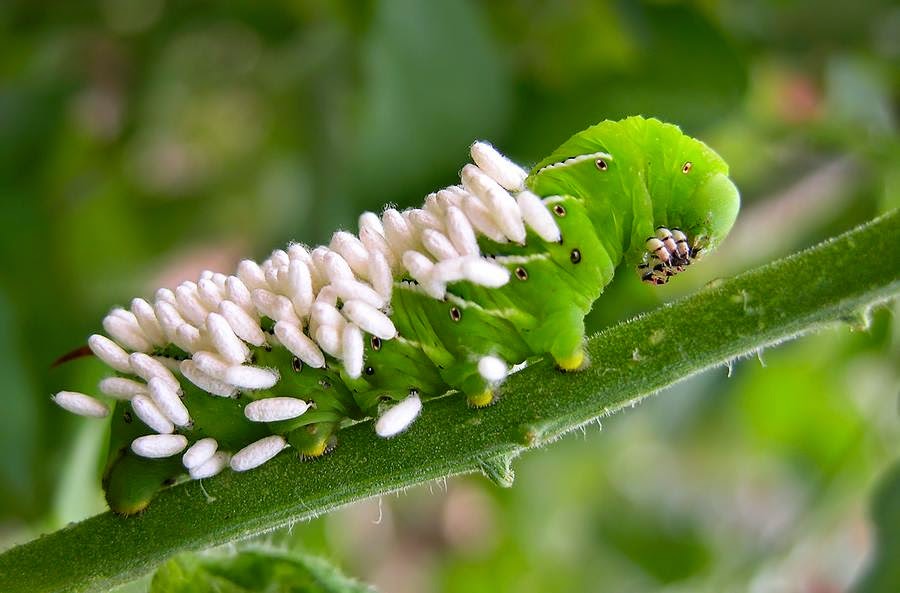
When I was trying to raise a big caterpillars in Germany as a kid, hundreds of parasitic wasp larvae emerged from it and pupated on the outside of the dying caterpillar. I was so shocked that I did not try raising any butterflies from caterpillars for a very long time. Nowadays, having worked with Dave Wagner, I know a save way to get healthy caterpillars: catch a pregnant female, wait for her to oviposit and raise clean caterpillars from those eggs. Of course, that does not help if you need to solve the mystery of an unidentified caterpillar found in the wild.


 I collected fat green caterpillars from my winter lettuce here in Arizona, and trying to raise them, I invested a lot of extra lettuce leaves, but got only tachinid flies for my efforts. One or rarely two flies hatched per caterpillar and they emerged only after the lepidoptera pupa was formed. The typical barrel shaped fly pupa was found next to the lep pupa which had a big hole at one end.

 . 
Tachinid eggs can often be seen firmly attached to adult beetles. The development of the fly has to be quite fast to be completed within the lifespan of this relatively short-lived host.


The big scoliid Campsomeris ephippium seems to be a recent arrival from Mexico. We have been seeing them only since  about 2012 in SE AZ. Their hosts are the grubs of our big scarab beetles like Dynastes. Likely scenario: wasp locates a grub, digs down to it, stabs it to paralyze it, and lays an egg on it: Idiobiont parasitoids.

Many wasps provide paralyzed hosts for their off-spring, the most well known is probably the Tarantula Hawk. But many species in several different families of wasps follow the same pattern, all very host-specific and often with extreme athleticism and surprising orientation capacities. They dig their nests, then go out to find prey, bring it back, lay their egg and close the nest entrance, patting the sand back into place with a rock held between their mandibles.


But even these parasitic wasps have to worry about super-parasites themselves: 
while Ammophila is stashing her big caterpillar into the prepared hole, a little cuckoo is watching. When Ammophila drops her guard for a second, the little Argochrysis wasp slips in and lays her own egg. The egg of the small cuckoo wasp hatches first and probably eats the ammophila egg as well as the caterpillar.

Brood parasitism is extremely common in hymenoptera that provide for their offspring but do not stay around to guard the eggs and larvae. Solitary bee nests produce any number of Bee Flies, Blister Beetles, Wedge-shaped Beetles and Velvet Ants. But may parasites or cuckoos are actually closely related cousins in the same family of bees, for example Megachilidae.


But even ants, who care for their offspring in the most devoted altruistic way have uninvited guests: Several beetle families like weevils, carabids, Bess Beetles and scarabs have members that are adapted to living with ants as nest parasites. They somehow get around the ants' vigilant guards and then feed on the ants' food stores or even their brood.
This anteater scarab, Cremastocheilus mexicanus was flying around some ant hills on Kitt Peak road. In typical fashion, it crash landed and played dead, with legs sticking up ... Now the ants should have come out, ca...rried her into the colony like prey... but once in there, the beetle somehow avoids getting eaten by the ants. I have noticed that she can fold all extremities and even her head very tightly against her body, with no attack point for the ants sticking out. My theory is that this protects her initially against what the ants usually do to beetles: they tear them apart, pulling from all sides. After some time in the ant nest, the beetle might have absorbed enough of the nest-perfume to blend in and for the ants to ignore her, at which point she lays eggs that produce larvae that feed on the rich food supplies and also on the brood of the ants.

probably Lasius (subgen. Acanthomyops) latipes
 But why just sneak in and feed on food storage and brood if you can capitalize on the entire colony, resources, structures, workers and all.  Queens of one of the parasitic subterranean Lasius species   sneak into nests of other Lasius species like L. alienus or L. neoniger, kill the resident queen, and use the sizable worker force to start raising her own brood. After a couple years, the worker force will have completely turned over to the parasitic species. Colonies are entirely subterranean - you will rarely ever see workers above ground - they tend scale and aphids on plant roots. Acanthomyops ants are not uncommon but they are patchily distributed. They have an alarm pheromone that smells strongly of citronella. Id and info by Alex Wild


There may be more parasitic wasp species than any other group of  parasites, but wasps are also  hosts for a very interesting order of obligatory parasites the Strepsiptera (Twisted-winged Insects):  As I understand it, Taxonomists were not quite sure where the order of Strepsiptera would fit into the phylogenetic tree, but the current understanding is that they are closest to coleoptera (beetles). Their bodies seem highly modified for their lifestyle as endoparasites. At least larvae and females live for the most part of their lives inside the bodies of other arthropods, often in hymenoptera. The short lived winged males fly and find females to mate top left photo). The eggs hatch within the female, who never left  the host, and the young larvae move out from her body cavity to find new hosts.


Many arachnids are exoparasites,  like ticks and many mites. Those often switch from  parasitism as larvae to a predatory life style when mature.  Even those darned chiggers fall into this category. In the picture a  Cobweb spider Euryopis sp. carries a trombidioid larva while a trombidioid adult mite is striking out on its own.


Mites on a carrion beetle are NOT parasitic as in feeding on the beetle or even stealing his food when he carries them to a delectable little corpse. This is an example of phoresy (one animal attached to another exclusively for transport). But the story is interesting, if disgusting to some: The beetle and his mate will bury the dead bird or mouse and masticate it into a ball of food for their larvae. They'll actually stay with their brood and care for them. But before the beetles got a hold of that prize, other insects have already laid eggs on it, for example flies. Supposedly, those phoretic mites,  deutonymphs in the genus Poecilochirus, will destroy that competition, feeding on eggs and small larvae of flies. But being predators, the mites are also a threat to the beetles' own offspring, maybe that's why the beetle parents keep such close watch?
Similar mutualism exists between mites and dung beetles.


Here are more phoretic hitchhikers:  Peudoscorpions, being flightless arachnids and very small, use big strong flighing beetles as public transportation.  Trichocnemis spiculatus neomexicanus is over 2 in long and the pseudoscorpions were hidden under its elytra. But I have also found them clinging to feet and even antennae of beetles, and that probably slows smaller longhorns down considerably.

Avery special case of cohabitation and phoresis was just posted by Alex Wild on Face Book: Attaphila, a tiny cockroach living in Atta (Leafcutter Ant) nests and travelling with young alate queens to their new colonies. See the link here


When predators cannot enjoy their meal in peace, but are joined by flies that are drawn to the smell of the slaughter we call that comensalism - those flies are co-eaters. Here an Assassin Bug (Pselliopus sp.) killed a Mason Wasp (Eumenidae) and a number of  Milichiid flies invited themselves to the feast.

These are only a few examples of the many types of parasitism that can be observed in the insect (or spider world). It is a very complicated and fascinating field.