Friday, March 15, 2013

Adaptable Immigrants

Parry's Penstemon on the left, pink flowers
After an unusually cold January when temperatures dipped to -8C for several nights, in mid-February our Parry's Penstemon was already pushing up its new flower spikes. They seemed to grow fast enough to watch them get taller.

5th instar caterpillar, leaf-cradle pulled apart
 But two of the stems were bent and crippled.  Each one hosted a single leaf-rolling caterpillar in its tip. The caterpillar had pulled the young leaves into a cluster and thus interrupted the growth spurt, causing bending and twisting of the stem. As the caterpillars seemed close to their presumed final size, I collected the two culprits with enough plant material to finish their development. The rest of the penstemons survived a rare snow fall, and  now they are blooming beautifully.


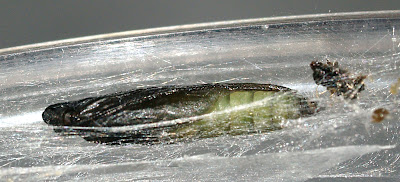
On February 28th one of the caterpillars had pupated in a loose mesh of silk on the rim of the container and I thought the other one might have been killed by the fungus that eventually enveloped the collected plant tissue. I was wrong, I found another adult moth on the ceiling of my studio today.

Antigastra catalaunalis
 On the evening of March 13, a fresh new crambid moth fluttered out of the container. Avoiding the only light in the room, it spiraled right up to the ceiling, causing me to run to the garage for a step ladder and to take this overhead shot. While it's not the straight on dorsal photo that I was aiming for, it shows the flange on the front tibia that seems characteristic for the species. An elegant little moth and a mystery for a while - I had it on BugGuide and sent it to some friends who work with moths, but got no results. Until I posted it directly to Maury Heiman's fb page. Thanks again, Maury!

His Id lead to more information: The little moth in the family Crambidae (Crambid Snout Moths) » Subfamily Pyraustinae » Tribe Spilomelini » Genus Antigastra is called Antigastra catalaunalis (Sesame Leafroller Moth - Hodges#5181). It is an introduced species that is now widespread in tropical and subtropical regions of the world. In the US it is found from Southern Arizona to the eastern Mojave Desert and north to the northern areas of Utah.

Indian Insect Life: a Manual of the Insects of the Plains by Harold Maxwell-Lefroy.
Older descriptions which I found on Wikipedia call it an Indian Moth, but mention its migratory habits and a rather wide variety of host plants: The larvae feed on Antirrhinum, Linaria vulgaris, Sesame and Scrophulariaceae and Pedaliaceae species.

A research paper from India studying the moth's life cycle on Sesame as the host plant finds that warm temperatures and low rainfall and humidity favor population explosions of the moth. Those are conditions  that it will find here in Arizona.
In October of 2012, Carl Olson (duh, I could have just asked my friend and collegue right away!) found that reports were flooding in about unusual damage to landscape plants, such as Tecoma stans (yellow bells) and Tecoma alata (orange jubilee). Dark larval droppings, webbing and a loss of green leaf tissue were the obvious signs and symptoms of activity by the leaf-tier caterpillar, Antigastra catalaunalis. He suggested that since the caterpillars were tightly rolled up in leaves they were protected from most predators and contact pesticides but might be controlled using high doses of products based on Bacillus thuringiensis.

Since to our knowledge the moth hasn't been in Arizona for long, not much is known about its life cycle here, but I can now say that there is at least an early spring (Penstemon) and a summer (Tecoma) generation. These plants in the families Scrophulariaceae and Bigoniaceae and common in the wild as well as in landscaping around Pima ad Maricopa County. The landscaping plants, being grown in high concentrations and often under sub-optimal conditions, will probably suffer more than their wild relatives. I imagine that the population of the species might shoot up to an initial peak as many introduced species do, but then decline gain as diseases and predator populations catch up.  
In 2012 Carl Olson speculated that these immigrants may not be able to survive our occasional cold winters (the winter of 2011/12 had been very mild). But  my early collection date, right after the very heavy freeze of 2013 (Jan 13 to 16), indicates that the moth (its eggs?) might be rather freeze tolerant.


Penstemon parryi and Pipevine Swallowtail (Watercolor by M.Brummermann)


Wednesday, March 6, 2013

Mating season for backyard raptors


Prairie Falcon photo by Ned Harris
This morning we watched an aerial ballet high in the sky above our backyard. A falcon was soaring, but with his feet hanging down, then banking, spreading his tail feathers, diving a little, catching himself again...I first thought that it was a Kestrel hunting insects. But when Randy brought my binoculars I recognized it as a bigger bird, a Prairie Falcon. He kept circling, diving and banking for more than 5 minutes and was finally joined by his partner. They circled together and then sped up towards Panther Peak.


 We don't seem to have an American Kestrel pair in our saguaro this year, but we sometimes hear  mating calls and see the male fly over. They are probably nesting in the State Land to the north.


Our Dark Female, the Red-tailed Hawk, has flown over a couple of time too, and now she is settling in the Saguaro nest that she used two years ago, she seems to alternate nests regularly. Both sites are along a wash in the state land, only about 300 feet apart.


Great Horned Owls are hooting at night from the Twin Peak on the east side of our land. We found a dead one this winter, but there must be a resident pair again.
 We also found a dead adult Harris Hawk. We have no power lines here that could electrocute them. I hope they aren't dying from an environmental poison. High in the food chain, raptors are always at risk.   


The Cooper's Hawks are also getting territorial. For the first time ever I saw the female go very aggressively after a juvenile Red-tail that likes to hang around.
We also have a ghost, a silver grey male Northern Harrier, but he only visits regularly every winter and then disappears for the breeding season.
With all those raptors getting ready to breed, we are hoping for enough rain to keep the land green and productive. But does the next storm have to hit right during my next art show in Dove Mountain? On my birthday???


Friday, March 1, 2013

It may be all about the temperature

When I turn on my black lights during a cool winter night I always hope to find something special. While there are bug collectors beating on every bush and mercury vapor lamps glowing in every clearing in July and August in Arizona, not many out-of-state entomologists come out here in winter and even we locals prefer a warm fire place to a cool bug light.


Last night I found a few geometrid moths, some spiders, and a lonely click beetle. Two leggy insects looked like they might be a type of Thread-legged Bug. But the antennae seemed wrong and the abdomen too heavy.  At closer investigation they clearly had the head of a crane fly, but no wings!
When I enlarged my photos I found that they did have tiny, obviously dysfunctional wings.
The other obvious difference to other crane flies was the body shape: The thorax was hardly wider than the elongate abdomen. 'Normal 'Crane Flies that have a pair of long narrow wings support those with a bulging, muscular thorax. No functional wings, no big flight muscles...

Dactylolabis (Eudactylolabis) vestigipennis
 The fly I found seems to be Dactylolabis (Eudactylolabis) vestigipennis. Thanks to John Carr on Bugguide for the identification. Dactylolabis is a genus of crane fly in the family Limoniidae. It is placed in its own subfamily, Dactylolabinae. Most species are winged.
The type specimen of D. vestigipennis, curated at the Smithonian was collected in the Tucson Mountains, and I found mine in the bajada of those mountains. Others were reported from the Mojave Desert further west and all around this time of the year.
 This means that the temperatures that these nocturnal (?) crane flies are likely to experience during their adult lives are very low.  In February the night temps in the Desert hover close to the freezing point. Yesterday I measured 36 F.

Flying is not only a high energy sport in itself, its apparatus also requires a certain minimum temperature to function. Many good fliers among insects, like bumblebees, sphingid moths and big beetles are able to generate the necessary heat metabolically. They shiver just like birds and mammals.  So at times they are endotherm  like those higher vertebrates.  But while most birds and mammals maintain high body temperatures almost constantly, these insects turn on the heat production when needed, that is when they need to fly at low ambient temperatures.   
The obvious reason is the cost of that heat production as the energy consumption of those shivering muscles is high. When bumblebees in cold climates live around flowers that provide only small amounts of  nectar (asteraceae) they don't fly on cloudy days and remain cold-blooded, while those with access to high-yeald flowers (Fire Weed) will increase their body temperature and fly on rainy days. (Bumblebee Economics, B. Heinrich, 1979, Harvard University Press)

The small moths in the family Geometridae that are coming to the lights right now are unable to increase their metabolic rate for heat production. They don't have the energy to spare, because they don't feed as adults. Their mouth parts and digestive system are reduced and non-functional. Investment in these structures would be wasted because they fly mainly in winter when there are hardly any nectar-sources available, even here in Arizona. So they rely on the resources that they amassed during their larval state. Still, the light, slender males are able to fly in cold temperatures due to their large wing size and special adaptations in their enzymatic make-up. Interestingly, in many species the heavier females of these winter moths are wingless and earth-bound.

Dactylolabis (Eudactylolabis) vestigipennis

Surprisingly little is known about crane flies, considering that some winged species are inch-long and in-your-face-obnoctious if you sit outdoors by candle light on warm summer evenings. The larvae usually feed on decaying plant tissue; some species are carnivorous, and others damage the roots of cereal and grass crops. Most are found in semi-aquatic or at least moist habitats. The feeding habits of the short lived adults are not well described. Some possess a long slender proboscis and feed on plant nectar. Not surprisingly, I couldn't find any info on the life cycle of this tiny (11mm) inconspicous species.


The tip of the abdomen

the narrow thorax with reduced wings


the head
But I think I can guess why these flightless guys should turn up during cold winter nights. Even under the microscope I cannot find a proboscis, so they may not feed at all. The two that I found may be females - the males may be able to fly? I will place them into a flight cage tonight to see if they attract the opposite sex. Anyway, I assume that the reduction of wings in this species is an adaptation to a biological niche where the ability to fly would be very costly because of the low ambient temperatures that these insects live in. 

Winter and night activity opens an ecological niche to insects that have little other protection against predators. They live their adult lives in the cold, maybe without food, but also out of reach of day-active birds, summer-active bats, and most predatious insects so they can focus on their only purpose: finding a mate to propagate their genes.

Tuesday, February 26, 2013

Arizona Oddity

Great Fair, Fountain Hills
 From January to April the art show season in Arizona is in full swing and I am busy preparing inventory, booking shows, setting up my tent, selling art, book-keeping and tax-paying, and then producing more inventory...So there is little time left for nature walks, photography and blogging.  But the shows are outdoors. Last weekend in Fountain Hills in Maricopa County, I was greeted every morning by a beautiful if strikingly unecological sight. And I don't mean the fountain itself...

"The eponymous fountain was built in 1971 by Robert P. McCulloch, the same year that reconstruction of the London Bridge in Lake Havasu City, another of McCulloch's projects, was completed.The fountain sprays water about every hour. The plume of water rises from a concrete water-lily sculpture in the center of a large man-made lake and is driven by three 600 horsepower (450 kW) pumps. When all three pumps are on under zero wind condition, the fountain can reach over 560 feet (170 m) in height. When built, it was the world's tallest fountain and held that record for over a decade." Wikipedia

Fountain Hills prides itself to sport the world's tallest fountain. True or not, it's certainly a waste of a lot of energy and  water here in the desert. It only raises up once every half hour, but even the pond, surrounded by manicured lawns, is produces a constant water loss due to evaporation....

Island of the Fountain Pond
 No natural vegetation, desert or riparian, is allowed to grow and upset the groomed appearance..
But still, the water attracts avian winter visitors as well as human snow birds. There are usually many wigeons and coots that graze the lawn and some diving ducks grebes that may indicate some fish in the sterile looking water.


 But this year a new group of birds had discovered the little island in the pond. About forty cormorants and two dozens Great Egrets perched in the bare branches of its single tree. Here they spent the night protected from prowling predators.


As soon as the sun broke the horizon south of the snow covered Four Peaks the cormorants stretched their long necks and the egrets shook their silky long-trailing breeding plumage. Then bird after bird glided off its perch, the cormorants dropping nearly down to the water level and the egrets gaining height right away with heavy flapping wing beats.
By the time most artists and customers arrived at the show all  cormorants and egrets had left for better fishing waters, maybe along the Verde River. But at night fall they were back to sleep on the island.


The garden planners left or even planted two lonely saguaros on the island. Their ghostly silhouettes added the strangest touch to this assembly of water birds against the clear morning sky of the desert.


Wednesday, February 20, 2013

Our Blizzard

Even if the weather forecast on tv sounded dramatic for days, blizzard conditions in Tucson are relatively tame. But snow in the desert is still exciting to us so here are some photos to speak for themselves.


Saguaro National Park West


Tucson Mountain Park


Ocotillos with their first green leaves


Not everything that's white is snow. Hundreds of tiny white flowers were already blooming on the desert floor.


Our friends' weekend retreat in Picture Rocks turned into a snowy-mountain cabin

Tuesday, February 19, 2013

Bighorn Sheep in the Waterman Mountains


Yesterday, Randy and I took the dogs to the Waterman Mountains. They are part of the Ironwood National Monument and visible from our house, but I had only been there once before with Bob Beatson. The desert there seem harsher than even our own Tucson Mountain bajada. I wanted to do a bird count for the GBBC but I soon forgot about it because there seemed to be just Black-throated Sparrows, White-crowned Sparrows and Gila Woodpeckers.

Nichol's Turk's Head Cactus, Echinocactus horizonthalonius var. nicholii
 We were also looking for Turk's Head Cacti which Randy hadn't seen before, and he actually did spot the first one. We found all sizes, from little round balls to nearly knee-high  twisted columns. Buds were promising early flowers which I have yet to see.
 Judging from the healthy, not frost-damaged foliage of the Ironwood trees and the freshly sprouting ocotillo leaves, this area was less hit by the latest freeze than the Tucson Mountains. Yesterday around noon the temperature had probably climbed into the seventies. After hiking in about 2 miles, steadily uphill on a loose-gravel road that made walking a little awkward, we were hot and the dogs were thirsty.   

Desert bighorn sheep (Ovis canadensis nelsoni) in the Watermann Mountains
 When we were about to turn back our Coydog Frodo barked alarm. The object of his interest was high up on the slope above us: a small herd of Desert Bighorn Sheep. About eight of them, several rams with big horns, and some smaller animals with lighter horns, probably not females but young males(they form bachelor groups like deer). The were rather camouflaged. Without Frodo we would not have seen them at all. They moved effortlessly up the steep slope and they seemed sturdy and well-fed.

Big Ram (Watercolor by Margarethe Brummermann)
 After a stabilization in numbers from the sixties to the eighties, Desert Bighorn Sheep lost ground around here over the last 20 years. The Catalina Heard is probably completely extinct. It is thought that the drought weakened the animals and also destroyed the vegetation that they used for cover. The predation pressure of Mountain Lions under those changing conditions may have been too much. The Red Rock herd not far from the Waterman Mountains was decimated some years ago by a devastating eye disease. A developer had brought in domestic goats to clear vegetation of his land. They were carriers of the disease and infected the wild sheep to whom it proved deadly.

So we were very happy to see this healthy little group.  

Bighorn Sheep petroglyph
 For thousands of years Bighorn Sheep have been very important to the human inhabitants of our area,  not just as prey for hunters but also as inspiration for artists. They figure prominently in petroglyphs all over the Southwest and they are a big part of the imagery of Picture Rocks that was name-giving for our own little community northwest of Tucson.    


Friday, February 15, 2013

Great Backyard Bird Count

My friend Carol Tepper invited me to take part in the GBBC, a citizens science project by the Cornell Lab of Ornithology and Audubon. Their web site is very nicely organized with a specific pop-up bird list for every gps point that you log on their map. You can still join for another couple of days, and the data do NOT have to be from your backyard, you can also send the list of a short birding trip.
So I spent a leisurely hour on our property this morning, with my new Papilio (Pentax) close-focus binoculars that I'm really fond of.

Mourning Dove and Gambel's Quail
 The most common and numerous birds by far were Mourning Doves, followed closely by Gambles Quail as long as there was bird seed on the ground. The noisiest are always the Gila Woodpeckers, and the most in-our-faces-at the breakfast table are the Costa's Hummingbird males. A Cactus Wren investigated between the pages of Randy's newspaper. No great surprises so far.

White-crowned Sparrow, Black-throated Sparrow, Brewer's Sparrow and House Sparrow (two left photos by Ned Harris)
 Then a whole group of sparrows flew in, searching for seeds among dried up bunches of cheat grass.  We used to weed after rains to keep this introduced species out, but when the rains became rare so did the grass. Now we appreciate it for its golden color and its attraction for Harvester Ants and birds. The sparrows, very clearly smaller than our usual White-crowned and Black-throated, and very lightly marked, were Brewer's.


Cactus Wren, Ladder-backed Woodpecker, Pyrrhuloxia, Lesser Goldfinch,
Curve-billed Trasher, Verdin, House Finch, Phaenopepla
Lesser Goldfinches used to appear in groups like that, but today I found only two singing territorial males and their mates. The same for the Phainopeplas: In early January, there was a couple of them on every Mistletoe bunch but today I found only one male sitting close to last years nest in a mesquite tree. Verdins were also close to new nests and territorial, so were the Black-tailed Gnatcatchers that I heard and then attracted by pishing. They were paired up, but I noticed no black cap on the male yet. I'm pretty sure about the species though, because I believe that I know their warning call and they have been nesting in that wash for years (with black caps). I will watch them though...could we have Blue-grays this year?

Gila Woodpecker and Gilded Flicker
 At the border between our property and the adjacent State Trust Land a huge saguaro has lately lost its tallest trunk. A Woodpecker perched on the break turned out to be a Gilded Flicker female. She slipped into a fresh cavity and stayed inside for a long time. I hope they will raise a family, this species has become rare over the last dry spell.
A sharp 'zick' announced a Ladder-backed Woodpecker. The markings on the head of this female were so dark that I could have sworn she was a Nuttal's, but those simply don't range this far east.
I found a Mockingbird, a Cardinal and male and female Pyrrhuloxia. Curved-billed Trashers began singing as soon as it warmed up a little.
A young Red-tailed Hawk was sitting in his usual dead Ironwood, but on this cool overcast morning the other raptors didn't show. Only a pair of Ravens flew by with heavily swishing wing beats.
The only introduced species were Eurasian Collard Doves and House Sparrows. The sparrows are trying to claim a saguaro cavity that was used by Ash-throated Flycatchers last year.

My morning count took an hour from 9 to10 am, covered loosely 14 acres of Sonoran Desert Shrub in the bajada of the Tucson Mountains, the temperature was about 55 F, under an overcast sky. I logged 24 species plus one unidentified Vireo.