Last year we happened upon a red-tailed hawk nest in a Saguaro not far from our house. Two nearly grown chicks were raised by a female on her own. At least we never saw a male around. But the chicks were so big then that we hoped that they all made it.
In February of 2012, last year's nest was not in use. But close by, an even older nest, also in a saguaro, was being renovated. To our dismay the birds used a huge black plastic bag for decor. It worried me how it would withstand our fierce winds or whether it would suffocate the nestlings when it got really hot...
By mid-March, the dark female was sitting on eggs and she never seemed to move from the nest - we kept our distance. Around her, the plastic bag was rattling in the wind, but it was being shredded by the cactus thorns.
When we came back in early April, the female was sitting in an Ironwood tree close to the nest, and her warning call brought the male from his distant hunting ground. He is very light colored. Together, they told us that we weren't wanted.
In the rough cluster of creosote branches that constitute the nest, a little white downy bump was visible. The head of at least one small chick.
The little white spot is hard to see, but it moved, and very shortly, there was a second one to the right of it.
This morning, more than two weeks later, we went back, were screamed at again, and got a short view of at least two rather large but still downy chicks. They were hunkering down in the nest, but did keep a wary eye on us. So we quickly left. I hope that next time we visit we will find them already standing up and loosing their downy baby fluff.
Friday, April 27, 2012
Thursday, April 19, 2012
Cutworms are beautiful
In fact, I am absolutely smitten with their velvety texture and beautiful, delicate patterns in soft earth tones highlighted with metallic accents.
It didn't start that way. In early spring, when I turned rocks or dead wood around our house, instead of the interesting tenebrionid beetles I was looking for I found fat, hairless brown caterpillars. They were everywhere, even under dry cow pies. They were so indistinct that I got no reaction when I posted one on Bugguide and it took Eric Eaton's blog on cutworms to make me realize what they were. I learned that they do not feed on dead wood, fungus or dry cow dung, they just hide under it during the day. At night they go out to chomp off young plants at the base, hence the name.
This year, our winter rains made the desert annuals sprout, so lots of caterpillars had food to develop into adults. My first cutworm moth of the season had crawled behind one of my paintings on display at an out-door art show. As it darted out (Dart is the other name mostly applied to the adult moths) my customer backed off in disgust. After the show, another moth, or maybe the same art loving creature, got itself loaded into my van, woke up at night during the drive home and fluttered into my face. At least it kept me from falling asleep on Interstate 10.
Then Dave Wagner, author of several books on eastern moths, visited and got me to look more closely at some day active Owlets, very pretty and in the same family as the cutworms.
When it got warmer I began running black lights at night again.
I have two lights, one in our driveway and one at our neighbors' house across the street. Both places have sandy soil, lots of Creosote, Saguaros, Palo Verdes, Ironwood Trees and a few Mesquites. The annuals are mostly Fiddle Neck Amsinckia intermedia, Scorpion Weed Phacelia, Bajada Lupine Lupinus concinnus, Filaree Erodium cicutarium, Evening Prim rose Oenothera primiveris, a small mustard and a small very common Cryphantha species. This relatively limited number of food plants supports an amazingly divers population of cutworms.
Including the ones that still need identification I count at least 12 to 15 different morpho-species that appeared since the beginning of March. It seems that every night brings new ones. The two lights, about 400 yards apart, show surprisingly different results, maybe because one is closer to a (dry) wash.
These pretty lichen-patterned ones for example only come to the light at our house. Most identifications are by Maury J. Heiman. Thank you so much, Maury!
Cutworm or Dart moths form the subfamily Noctuinae in the huge family of the Noctuidae, the Owlet Moths.
From my own observations I'm pretty sure that cut worm moth populations here in the desert sharply increase in years with winter rains and resulting spring flower emergence. I can very well imagine how constant irrigation and spring seeding of crops offer ideal conditions for high Cutworm populations in agricultural settings. Under those conditions some species in this group can become economically important pests.
It didn't start that way. In early spring, when I turned rocks or dead wood around our house, instead of the interesting tenebrionid beetles I was looking for I found fat, hairless brown caterpillars. They were everywhere, even under dry cow pies. They were so indistinct that I got no reaction when I posted one on Bugguide and it took Eric Eaton's blog on cutworms to make me realize what they were. I learned that they do not feed on dead wood, fungus or dry cow dung, they just hide under it during the day. At night they go out to chomp off young plants at the base, hence the name.
![]() |
| Euxoa auxiliaris |
This year, our winter rains made the desert annuals sprout, so lots of caterpillars had food to develop into adults. My first cutworm moth of the season had crawled behind one of my paintings on display at an out-door art show. As it darted out (Dart is the other name mostly applied to the adult moths) my customer backed off in disgust. After the show, another moth, or maybe the same art loving creature, got itself loaded into my van, woke up at night during the drive home and fluttered into my face. At least it kept me from falling asleep on Interstate 10.
![]() |
| Heliolonche carolus and Schinia miniana |
Then Dave Wagner, author of several books on eastern moths, visited and got me to look more closely at some day active Owlets, very pretty and in the same family as the cutworms.
![]() | |
|
Striacosta albicosta, Euxoa serricornis, Abagrotis
reedi, Anarta trifolii
|
I have two lights, one in our driveway and one at our neighbors' house across the street. Both places have sandy soil, lots of Creosote, Saguaros, Palo Verdes, Ironwood Trees and a few Mesquites. The annuals are mostly Fiddle Neck Amsinckia intermedia, Scorpion Weed Phacelia, Bajada Lupine Lupinus concinnus, Filaree Erodium cicutarium, Evening Prim rose Oenothera primiveris, a small mustard and a small very common Cryphantha species. This relatively limited number of food plants supports an amazingly divers population of cutworms.
![]() |
| Only the last one in this row is identified so far: Anarte mutata |
![]() |
| Lacinipolia sp. |
Cutworm or Dart moths form the subfamily Noctuinae in the huge family of the Noctuidae, the Owlet Moths.
From my own observations I'm pretty sure that cut worm moth populations here in the desert sharply increase in years with winter rains and resulting spring flower emergence. I can very well imagine how constant irrigation and spring seeding of crops offer ideal conditions for high Cutworm populations in agricultural settings. Under those conditions some species in this group can become economically important pests.
Monday, April 16, 2012
Master Blister Beetle Procession
Walking with our dogs along the Santa Cruz River in Cortaro, we found dozens of 1 1/2 inch beetles crossing the road. All of them seemed to be determined to reach some unknown better place. They were Master Blister Beetles, Lytta magister.
Even mating pairs were on the move even though the females had to walk backwards. So the goal probably wasn't some super attractive pheromone source ... but then what?
Then again, the beetles probably asked a the same question watching the procession of human bikers, joggers, hikers, and even multi-species groups pass them ...Some beetles were definitely trying to get a better look
![]() |
Thursday, April 12, 2012
Backyard Ant Hills
![]() |
| Mounds of the Leaf-cutter Ant, Acromyrmex versicolor, left and right. Middle: Smooth Harvester Ant Messor pergandei |
I must admit that I lived surrounded by those ants for years before it dawned on me that there were two very different species at work and the differences are quite apparent.
At one type of colonies, the single minded efforts of a never ending procession of ants result in an accumulation of fresh green, purple or silver plant clippings that sit there for a day and then disappear into the crater (top right). These are the leaf-cutter ants that I will describe in a later blog.
The plant material circling the other type of colonies looks old and discarded. The ring around the mound seems to be the permanent waste midden of the colony (above, middle).
This is the work of the Smooth Harvester Ant Messor pergandei. In this and the following blog I will not describe the social structure of ant communities that both species have in common, but rather point out the most striking differences in the way of life in these two local crater-building species...
![]() |
| Messor pergandei, the Smooth Harvester Ant |
![]() |
| Erodium cicutarium, Redstem Filaree |
Workers were bringing seeds with their spiraled attachments from all over and carriwd them into the dark entrance hole of the colony. Other pieces that were brought up from the inside and then tossed over the crater's rim to end up on the colony midden. These are just the inedible parts, which include the intact seed. The sweet elaiosomes have been removed and remain in the under-ground granaries of the colony.
Messor ants like Erodium diaspores so much that most middens that I checked in March 2012 consisted of nothing else. This raises the question whether seed dispersal is actually achieved. While the seeds are removed from the mother plant, they still end up in dense piles, exposed to elements and rodents. If this is a glitch in the system, it's probably because Erodium and Messa really didn't co-evolve. I would like to observe the behavior of local ants in the Mediterranean home countries of the plant. But, alas, when I studied insects in Yugoslavia, Greece, and Italy, ants were not very high on my list. However, if the spread of Erodium in our backyard and the adjoining state land is any indication, it's a successful symbiosis, even here in Arizona.
| Veromessor pergandei refuse heap in October after a good monsoon: hulls of cheat grass seeds are rejected and piled around the nest entrance |
![]() |
| Messor pergandaei queen |
Pogonomyrmex, and that was the most painful insect encounter I can remember (and I have been attacked by fireants in Florida)
![]() |
| Pogonomyrmex sp. nest and worker |
P.s. the Genus name Messor has been changed to Veromessor for the US species since I wrote this entry

Labels:
Acromyrmex,
Harvester Ants,
Leaf-cutter Ants,
Messor,
myrmecochory,
Pogonomyrmex,
Queen ant
Monday, March 12, 2012
Brittle Bush Bee Heaven
Last year a late, very strong freeze kept many Brittle Bushes in the Tucson Mountains from blooming. In March it felt as if all kinds of interesting bees had found their way into our protected backyard habitat. Of course, the distances that these small endemic bees travel are really quite small. But for whatever reason, my BugGuide entries for last March show dozens more species than I'm finding this year.
So far I saw no Colletes (left), few Anthophora (middle) even though the Penstemons are already past their prime, and the long horned Eucera (right) are still missing. While a Leaf-cutter bee in Saguaro National Park volunteered to star in a video, I hardly see any in our backyard. The cactus bee Diadasia will certainly show up once the cacti are in flower.
Lasioglossum sisymbrii (left) is here, and several Agapostemon species (middle and right), some of them very pretty and shiny green. Some Agapostemons had been invading our living room windows throughout the winter to the delight of a resident Kukulcania Spider.
In the early morning hours, Honey Bees seem to be taking advantage of their greater body mass and thermoregulated hives: they visit the Brittle Bushes when it is still rather cool. (this observation is contrary to the info in BugGuide - Maybe the remarks there refer to climate conditions different from Arizona's)
Around noon, by far the dominant genus in our backyard is Adrena, recognizable by their furry faces (facial fovea). I'm seeing at least 2 morpho-species, a brown one and one with a partly rust-colored abdomen. The females collect pollen into tibial brushes similar to those of honey bees. They will take the pollen to their solitary ground nests. Each egg will be laid on its own ball of pollen and sealed in its own chamber. Our sandy, dry soil is just perfect for these Mining Bees.
Adrena males are smaller and more narrowly built, with the light face that is characteristic for many male bees. They spend their time hovering and zigzagging over the flowers. They rarely land to refuel with nectar. All bees that are quietly collecting attract their attention. Although pheromones prevent greater confusion, these eager males zoom in on anything from Agapostemon to Honey Bee. It's quite annoying if you are trying to photograph.
If they find a conspecific female they grab it, and in most cases a struggle ensues which usually makes both bees fall off the flower and out of focus. To get photos I finally just focused on an attractive female and waited for the males to show and that worked like a charm.
The abundance of Adrena females also drew another visitor with a quite different agenda. Today I found my first Nomada Bee and promptly misidentified it as a wasp. Nomadas got their name from the fact that they have no nest of their own. Instead, they are clepto-parasitic cuckoo bees, depositing their eggs into the nests of the other bees, mostly in the genus Adrena.
Labels:
Adrena sphaeralceae,
Arizona,
Mining Bees,
Nomada,
Solitary Bees
Tuesday, March 6, 2012
Of Pollen Pigs and Faithfull Bees in Saguaro National Park West
There are a few nice Poppy fields in Saguaro National Park West right off Picture Rocks Road, just where I cross the Tucson Mountains when I drive to the University. Randy and I consider this commute through the park a very good reason to live on a dirt road NW of Picture Rocks.
Otherwise poppies are scarce in SNMW, but the variety of wild flowers is great, from the earliest Fairy Dusters, Brittle Bushes and Lupines along the roads, Penstemons in sandy washes and many different members of the Mallow family, some of them spectacular fountains of orange, pink or white.
![]() |
| Desert Globemallow, Sphaeralcea ambigua |
All of them attract insects, either offering nectar and pollen to more or less specialized pollinators, or not so voluntarily (I assume) offering to nurture larvae and adults with everything from buds to leaves, petals, developing fruit and final seeds. Many insects are so specialized that they can only be found in certain years at the exact time when there are enough flowers of a certain species ...
Others are great generalists, like the ubiquitous honey bee. This, by the way, makes her a much less reliable pollinator than some of our native bees. Local entomologists call Apis mellifera the Pollen Pig: Abundant and able to shoulder the smaller native bees away from their food sources, ripping the base of deep-throated flowers to steal their nectar....they are the boars of the insect world.
![]() |
| Caliche Globemallow, Sphaeralcea laxa |
![]() |
| Adrena sphaeralceae visiting its Globemallow. Above female, lower right male |
Reaching for nectar at the bottom of the flower the bees curled their furry bodies around the center column that is formed by distinctive dark purple anthers and the pistil. Powdered richly with pollen in the process, they immediately visited another mallow flower. They never seemed to stray away from that particular species of mallows.
![]() |
| Adrena sphaeralceae |
Interestingly, there are other bee species from different genera tribes that are also specialized on Malvaceae, for example certain Melitoma and Diadesia species.
Although Darwin already described some of the extremest cases of interdependency between certain bee and orchid species, many questions about the evolution of oligolecty are still unanswered. While the benefit for the flowering plant seems obvious, cost and advantage for the bee are more difficult to analyze. It is not quite clear whether oligolecty is based on the inability of bee larvae to digest any but the preferred pollen, or if the adults are just not able to recognize other flowers as food sources. Speculations have been discounted that smaller species with a shorter flight radius are most likely to be oligoleges.
I was surprised to learn that about 30% of European and Asian bees are oligoleges. I couldn't find any data for the Americas, but they are probably similar.Definitely a topic to learn more about.
Sunday, March 4, 2012
Catalina State Park in March 2012
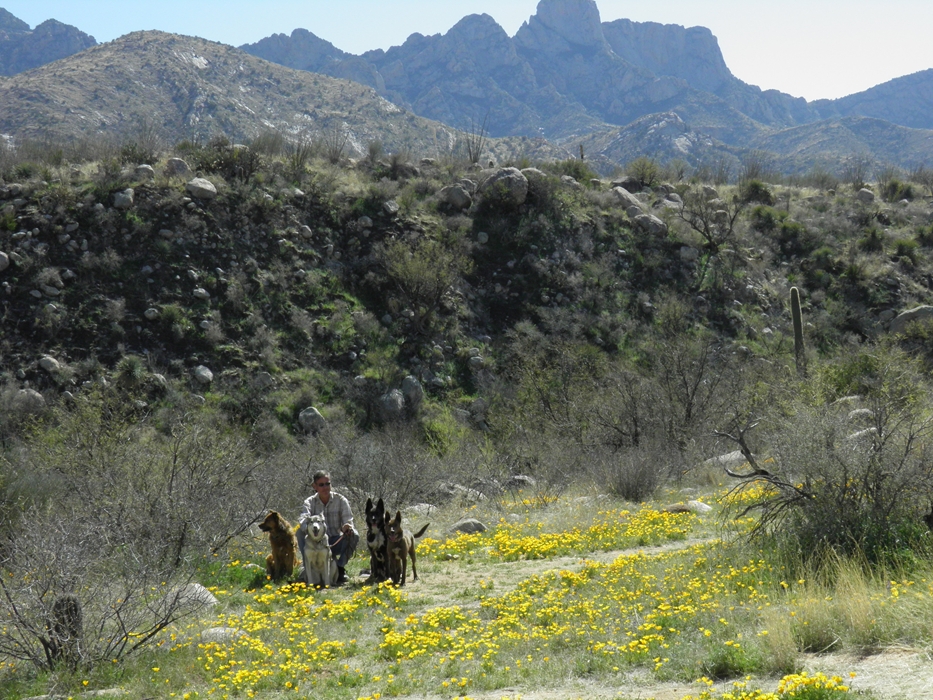
On March1, in Catalina State Park, we took the Southerland Trail to find beautiful golden fields of California Poppies. Randy and our dogs rested under the dramatic backdrop of Push Ridge and posed for every bodies photographs while I got my annual blister beetle shots and also found some nice new insects.
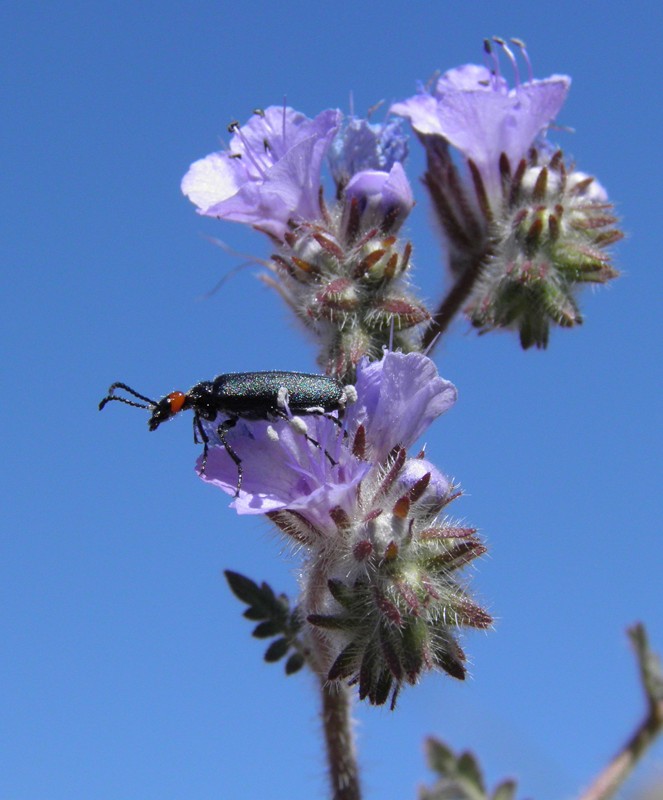
| Lytta auriculata on Scorpionweed |
| Lytta stygica on California Poppy |
| The Giant Yucca Skipper in an aria with many Sotols that are among its host plants |
Cuerna arida, a little Sharpshooter related to cicadas
A pretty little moth that spends his whole life on the Desert Chicory plant: Heliolonche carolus
California Poppies, Eschscholzia californica, and Coulter's Lupine, Lupinus sparsiflorus
| Creamcup Poppies, Platystemon, californicus |
![]() | |||
| Desert Anemone, Anemone tuberosa, and Owl Clover, Castilleja, exserta, formerly, Orthocarpus, purpurascens |
![]() |
| We all had a great day |
Subscribe to:
Posts (Atom)