Showing posts with label Reptile. Show all posts

Tuesday, September 3, 2013

Hiding behind your Worst Enemy

Many species that are pursued by predators pretend to be what they are not to protect themselves. They may mimic toxic, dangerous or noxious tasting models or they may just become invisible sporting cryptic patterns that blend into the background.

Eye spots of moths and butterflies that are revealed with a sudden flick of the wings are widely accepted as a signal to scare or confuse predators. If you have ever seen the up-side down stance of an Eyed Silkmoth that feels threatened you can easily imagine that a hungry bird might be scared away from this fat clumsy morsel that suddenly resembles a cat or an owl. And maybe the scare even works as a defense against the attack of a lizard?

Antheraea oculea (Western Polyphemus Moth)
Most reptiles are predators of insects - the diet of many lizards consists entirely of arthropods and even baby alligators often grow on the proteins of grasshoppers and moths until they are big enough to hunt other prey.

But this isn't where the relationship ends. Evolution has linked insects and reptiles through more than just the food chain.


Papilio rutulus (Western Tiger Swallowtail) caterpillar

Observe the spots on the bloated body of the Western Swallowtail caterpillar: to my eye they not only distract from the real head that remains tucked down and hidden, they also seems to suggest the face of a snake.


Elephant Hawkmoth, Deilephila elpenor by Amy MacDonald
The resemblance to a snake seems even more impressive in the caterpillar of the Elephant Hawkmoth because it is longer, bigger and adds a cobra-like threatening posture to the mere looks of a serpent.
When my friend Alex Pelzer was working on his Ph.D. using these moths as his model, we tried to test whether birds are indeed afraid of the snake mimic. At the time, I had a young tame Jackdaw (small corvid). When offered the big writhing worm the bird seemed confused, but then attacked the caterpillar and tried to eat it.

My trusting friend Jakob the Jackdaw


So instinctive aversion? Not really.
But: the jackdaw was young, hand-raised and inexperienced. Like young wolves, chimpanzees, and humans, the highly social and intelligent corvids are born with very little instinct. Instead, they have a great capacity for learning. In fact, this young bird looked to me for approval of any new food it found, and it would try to eat everything I offered. So he wasn't a good test animal at all, we should have tried something more precocious, like a young chicken. We just all had a lot to learn.


Macacha (Fulgora laternaria) by Leonel Baldoni
In the rainforests of central and South America lives an insect in the family of the Fulgorid Planthoppers that looks even more like a reptile than our caterpillars, at least in photos where you have no size comparison.
My friend Lois O'Brien is an expert of the group Fulgoromorpha. She writes:

"Fulgora, the lantern fly or peanut bug, has a head that looks like a peanut from above. But from the side, the head looks like an alligator head, complete with false eyes and false nostrils ...and a big mouth full of false teeth." 
To humans this planthopper looks so dangerous that there is a widespread legend that its bite kills within 24 h - the only antidote being to have sex before that time runs out. O'Brien speculates whether the 'alligator mimicry' targets birds, reptiles or monkeys, even humans, and wonders about the size difference between model and imitator. As baby alligators are quite small and quite ferocious hunters (and often under the fierce protection of their really terrifying mother), the size difference bothers me less than the difference in habitat between presumed model and mimic. But birds and monkeys get around ... and maybe they are wary enough of alligators to carry the image in their memory wherever they go.
Fulgora laternaria from Cuvier's La Regne Animal
Or maybe the mimicry model isn't an alligator but just another reptile like a lizard. In any event, the similarity seems just too suggestive to be without any function at all.
But if all else fails, Fulgora can still flash two big eye-spots at the attacker as well.


Chrysalis of Dynastor darius stygianus (photo V. Izerskyy)
 Here is another striking tropical example posted by Vladimir Izerskyy on facebook. It's the pupa of Dynastor darius stygianus which seems to be mimicking  the head of a Boa constrictor peruvianus. Dynastor darius stygianus is found in Peru, for example in Coviriali, Satipo, Peru. Clearly, the  pupa needs protection even more than any mobile form of insect, but we are more used to camouflage as the means of survival of pupas.

We found another unexpected reptile imitator closer to home:
After the black-lighting session of the last 'Infestation Party' at Pat Sullivan's house in Ramsey Canyon, Arizona, there were a lot of entomologists as well as left-over moths still hanging around in the early morning hours. The humans were congregating outside with cups of strong coffee and plates of Schwarzwaelder Kirschtorte (great way to wake up!).

Do you see the snake lurking?
At one point I bent down to take a photo of something low in the vegetation at our feet, when I heard Charlie O'Brien's warning 'Careful, there's a snake under those leaves'. And indeed, there was the eye, the shiny nose, the bigger ventral scales and the curved body of a snake - cartoonishly overdrawn but very convincing from the right angle.

But - overemphasized detail aside - I had had my morning coffee already! - so to me it was just a sleepy moth, a beautiful Glover's Silkmoth.

Glover's Silkmoth (Hyalophora columbia gloveri)

Literature: The Wild Wonderful World of Fulgoromorpha, L. O'Brien, Denisia 04, zugleich Kataloge des OOe. Landesmuseums, Neue folge Nr. 176 (2002) pp 83-102


Tuesday, May 7, 2013

Monstrous!


I'm going to be out of the country for a short while without access to my blog, I expect. So this is an opportunity to publish a few short blogs that were planned but not executed before. For example, when I found those big Bot Flies in Sabino Canyon they exited me and a very select few of my entomologist friends to the point, that a much more popular monster was left by the wayside. Literally: just watch him walking along.


Our Gila Monsters were unusually visible this year, at least in Sabino Canyon. For several weeks the Group of the Friends of Sabino Canyon met on or two on each of their Wednesday hikes. No idea whether it was the same individual that took a liking to the group? I think the monsters are rather oblivious of people. Mostly they want food at this time. After all, they spend most of the year under ground, hiding from drought and food shortage between the rainy seasons.
When they are out, they gobble up whole clutches of quail eggs,  whole litters of rat pinkies...I once surprised one that was chewing down a whole rather grown-up pack rat. This venomous lizard  (the only  in the US) has to chew with their formidable jaws to release venom along a grove in their teeth.


On the lower jaw of my friend here you can see the big, bulging glands. Although I didn't get my nose too close to him, after all, Gila Monsters are said to suddenly lunge, bite, and then hold on for good, I noticed a peculiar chemical smell -  ok, all smells are chemical, but his perfume seemed nearly inorganic: a little like chlorine in a pool...   A pheromone? It is mating season.


 The smell of his poisonous droolings? But he wasn't drooling. He was only testing the air with his forked purple tongue. He was certainly not interested in me or my hiking boot standing between him and whatever he had to do before going into hiding once more.

Wednesday, May 19, 2010

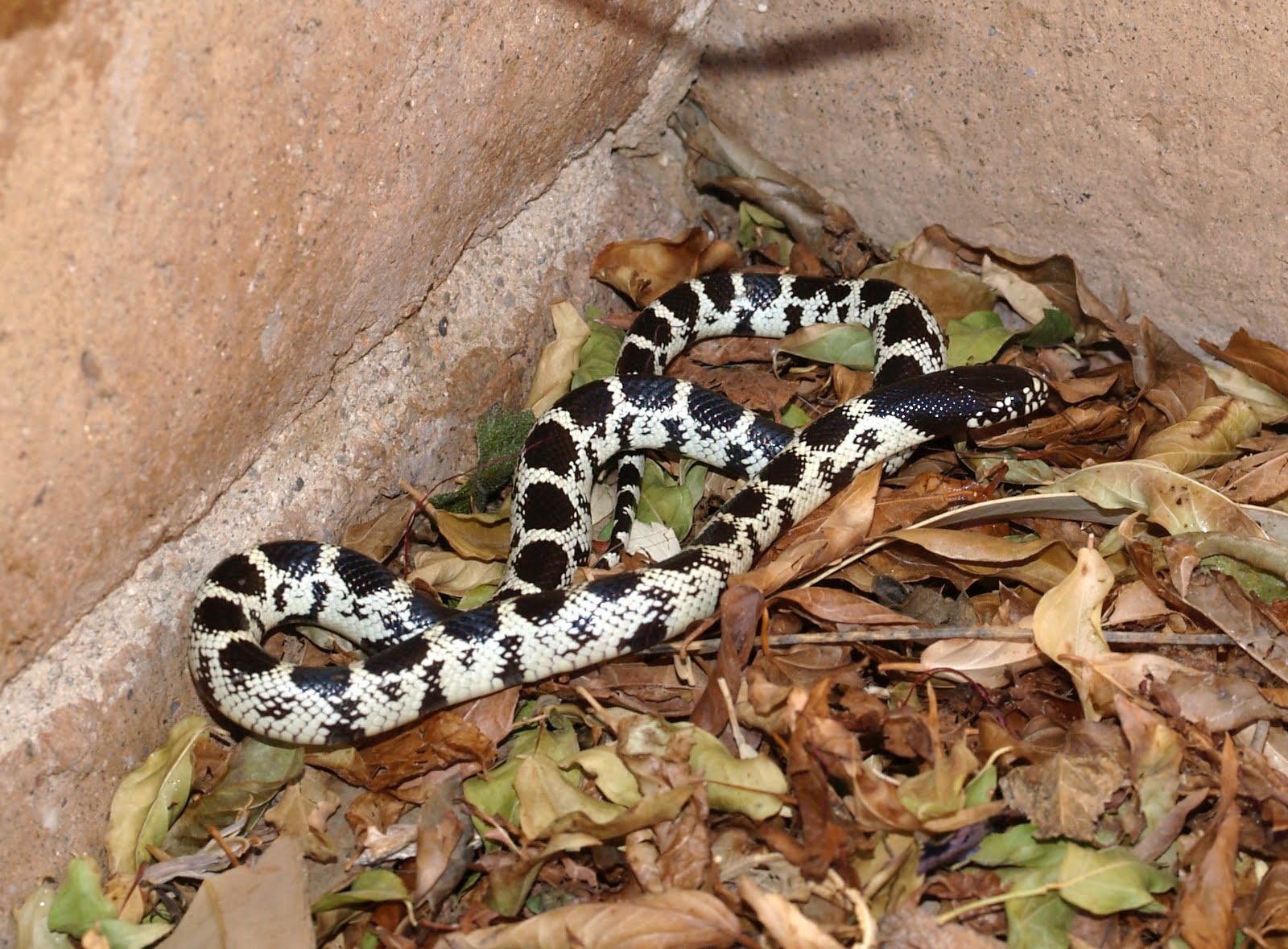
A Young King

My husband Randy inadvertently cornered this beautiful little snake on our terrasse. I think it is a very young Kingsnake, Lampropeltis getula. If so, this one will grow up to become a formidable constrictor, able to take on and devour any rattlesnake. He's immune to rattler venom.
I've found adult Kingsnakes around here, but they are never patient enough to have their picture taken. I remember that they were all of the banded pattern, called California Kingsnake. This one has the dorsal spots of a Desert Kingsnake, but according to the distribution in the literature we seem to be too far north west here (NW Bajada of the Tucson Mountains). I will get expert help to exactly identify the snake from these photos.


The snake made his way straight up the brick wall and disappeared in the foliage of a bush of Barrio Petunias.


Hope to see him again!


P. S.
Here is what the experts said:

Brendan O'Connor: 'Wow that's a unique one for sure. Looks like a desert kingsnake but I can't say I have ever seen one quite like that before. Great find and photo.'

Stephane Poulin: 'There is a lot of variation in kingsnakes but this one is a common kingsnake not a desert one.
Nice photo it is a beautiful specimen'

Pat Sullivan: 'Your kingsnake: is an aberrant color pattern, probably of a California ("desert color phase" = black and white bands). I haven't seen this pattern before. I wonder if it occurred naturally? Are there any snake breeders in your area? It could be an escapee from a breeder (or from breeder's stock).'

Manny Rubio: 'Wow! That is one spectacular kingsnake. I sure wish you'd kept it. It is a yearling and-- as others have said-- very unusually patterned and has exceptionally bright wide wide markings.. If it reappears-- call me!'

So it seems the experts agree that this snake is unusual.