Thursday, August 2, 2018

From San Simon to Paradise


Last Saturday I drove towards the Chiricahua Mountains following the narrow, straight, partly unpaved Road from San Simon on Interstate 10 to Portal at the eastern. edge of the Chiricahuas. The landscape was very flat and nearly uniformly covered in creosote bushes. But in some ares these were in full bloom, telling of recent rains, and at the horizon promising (or threatening)  clouds hung over a beautiful mountain panorama. My friends had indicated that there could be interesting insects in this bleak habitat, but they were delayed by not quite understanding the difference between the Tucson Airport and the Phoenix one - for Easterners they seem to be close to each other - so I struck out on my own with beating sheet and camera. I concentrated on non-creosote areas, mainly along washes that were lined with Mesquites, White Thorn Acacias, ans some herbal plants that began hesitantly to responded to recent rains.


   Shotgun like patterns on Datura leaves indicate the presence of leaf notcher weevil Trichobaris. I found 2 species of the genus.


 The Hawkmoth Manduca sexta (Carolina Sphinx) is not really a tomato specialist, it in fact prefers the local Datura.


Several similar looking Lema species could all be called Datura-phila, Datura-loving. Their larvae protect themselves with fecal shields, this one is just beginning to build one.


 Datura is also the host plant for this tortoise beetle, Plagiometriona clavata

Gratiana pallidula the egg plant tortoise beetle was introduced with agricultural products but is now quite at home on the local Silver-leaf nightshade.


I'm sure that  several leave beetles that like curcubitaceae  were drawn by patches of Coyote Gourd along the road. Paranapiacaba tricincta and Diabrotica undecimpunctata (Spotted Cucumber Beetle)


Very few knee high Acaciella angustissima were in bloom, so all nectar and pollen feeders concentrated on those few bushes. Here a big Sand wasp


Lycus fernandezi, the netwing beetle that can be separated from L. arizonensis by the little nodge in the black end-spot on the elytra. It is smoothly rounded in L. arizonensis


Finally an early Metalmark. There may be thousands when the desert begins to bloom and waves of these butterflies come up from Mexico.


On Mesquite trees I found a form of Cushion Scale. The white fluted part of the insect is an egg sac that can contain up to 1000 eggs. The insect is hermaphroditic, producing sperm that can fertilize its own ova, but in an alternate reproductive strategy it can also make winged males that can fertilize the female part of other individuals.


Two typical mesquite longhorns are Plionoma suturalis and the big black Stenaspis solitaria.


My best find of the afternoon was this little Ripiphorus sp. beetle. With long clear hind-wings and very reduced (orange) elytra, it could easily be mistaken for a wasp or a syrphid and also flies like one.


By the time Cathedral Rock and the entrance to Southfork Canyon came in sight, the wind had picked up enough to turn my beating sheet into kite and I was grateful to be heading straight for Barbara Roth's cozy Bavarian cottage. I never made it to the little town of Paradise, but guess what?

Sunday, July 15, 2018

A Weekend of Rare Cerambycids

This week a visit of my friend and co-author of the Arizona Beetle Book in preparation, Dr. Arthur Evans, and Pat Sullivan's annual Infestation party for entomologists promised a lot of fun field work and the probable discovery of more species to photograph for our book  (is that good or bad by now?) But the first exciting news came actually from a herpetologist and facebook friend in Clinton, Greenlee County, AZ. Terry Johnson informed us that 5 specimens of a striking looking Longhorn Beetle had been found there, and he got photos for us and promised me a specimen. It later turned out that there was only ONE specimen, not 5. But I did get it.

Megaderus bifasciatus, found in Clinton, Greenlee County, AZ
 Robert Velton identified the beetle as Megaderus bifasciatus. There were some few reports of this mainly Mexican and central American species from SE Arizona and from Texas. So I was quite happy, looking forward to adding this striking species to the AZ Beetle Book. But Terry's discovery coincided with the reviewing process of a paper whose authors were doubting that any of those old observations were valid. Luckily our community is small and close-knit so they were informed of the find and right now they are asking good questions about the provenance.. Five living specimens in situ are not easily explained as mislabeled or misidentified,  but were they maybe found right next to a pile of imported logs? That would raise the suspicion that they were recent adventives. I will report the result of this interesting story as soon as I know it. edit: only one pristine, newly hatched looking specimen in a residential development of 5 year old houses. Dan Heffern is now doing detective work to find out how our bug got there. Home Depot wood delivery for fences seems to be under suspicion.


 Meanwhile, we had our potluck feast at Pat's and I was working off some calories in his beautiful garden that slopes up the side of Ramsey Canyon behind his house.  I  picked mainly small leaf beetles from his perennials, all chosen for their attractiveness to insects I am sure. The diversity was delightful, even if they were all old friends.

But then I came across a little grey Cerambycid wit anulated antennae.

Mecas menthae. on  Salvia leucantha
  If it had been on a sunflower leave, I would have disregarded it as  the well-known Dectes texanus. But I have learned to trust the botanical knowledge of bugs implicitly.  I also remembered that lately a friend had compared species in the two Flat-faced Longhorn genera Dectes and Mecas because they resemble each other. Bingo! Genus Mecas! I showed it to Steven Lingafelter and with the help of Pat's house-synoptic collection, we had the species: Mecas menthae. Sure enough, not only did the plant turn out to be Salvia leucantha (Mexican Sage) in the Mint Family (Labiaceae) but we found 5 more specimens on the bush, making it clear that the beetles do consider it their host plant.


After a trip to Copper Canyon where our lights were inundated with scarabs from tiny Diplotaxis to sturdy  Phileurus truncatus and Strategus aloeus and a restful night's sleep in the back of my Subaru
I visited the garden again. This time I found a nice number of leaf beetle species on Sacred Datura and some morning glories whose leaves were just about skeletonized.

Elytroleptus luteus in situ
But then a little streak of orange on a leave of a tall evening primose where I had been watching pinhead sized jumping weevils. Another Cerambycid? Or a very narrow Netwing? From the expert came the e mail shout 'Holy cow, that is a fascinating beetle! ' We both tentatively talked of Elytroleptus sp., but none that we knew.  What Steven Lingafelter then found looked all wrong at first glance: A beetle not red, but yellow and even called E. luteus. But as an experienced collector and taxonomist he knows that dried specimens may change from red to yellow, and that species are sometimes described from dry museum specimens. Maybe the author was never lucky enough to see our bug alive and beautifully contrasted by a green leaf.  The other details, like proportions, leg coloration, and costae on the elytra fit very well. So I guess he got the correct id!

Elytroleptus luteus
 
Check out the distribution for this beetle: it just makes it across the Mexican Border into Arizona, but it's found all through Central America.


Longhorns in the genus Elytroleptus are considered mimics of toxic beetles in the family Lycidae whom they closely resemble.
Close to the Longhorn imitator, I found a Jumpingspider that was trying to take down one of the toxic Lycids. It released the beetle unharmed. I do not know if my camera disturbed it or if it found the beetle unpalatable.


Tuesday, July 3, 2018

Does the Palo Verde Rootborer really kill Palo Verde Trees?


Check your porch lights: It's Palo Verde Rootborer season in Tucson. The huge, up to 4 in long beetles emerge from the ground, mate at night, and lay eggs into or close to dead Palo Verde roots (and probably other trees, too).  
Like every year, friends tell me that 'tree people' claim that the beetles are responsible for the demise of many trees. I don't think these 'tree experts' have done much conclusive research to base this opinion on. What they see is a downed Palo Verde tree with beetle grubs around its roots. 


Palo Verde Root Borer Pupa

 Some larvae are big enough or already pupated to make an identification possible, and they are indeed Palo Verde Rootborers. But did the beetle larvae even really damage the tree roots? Palo Verde Rootborers are prionins. Most (not all) of this subfamily of Longhorns feed on dead wood, mostly even on decaying substrate like old stumps, not on living tissue. 

When water is very scarce, branches die and break off, decreasing the evaporative surface area. Note that for this tree leaves are a luxury, only present right after a very good rain fall. Photosynthesis is performed in the green bark of trunk and branches.
 For Palo verde trees, leaves are a luxury that they only enjoy right after productive rains. Most of the year, they rely for their photosynthesis on the green bark of trunk and branches. That means that the bark also has pores that cause evaporation. During droughts, there are no leaves to drop. So Palo verdes famously react to adverse conditions by dropping whole branches. The branches are dead before they break off, but the main trunk survives with the potential to regrow when the drought finally ends. Maybe under ground, roots that aren't reaching any water source are also cut off  and left to die. Carl A. Olson and several other knowledgeable folks assume that the Palo Verde larvae are primarily feeding on those dead or dying roots.
Consider that desert trees and desert beetles evolved together and the trees survived the onslaught of the beetles just fine for eons. Of course,  climate change could  make the trees more susceptible and tilt that equilibrium. It's possible.


Even the competition of a saguaro that used it as a nurse tree might eventually kill a Palo Verde if there is not enough water for both
Still, most of the trees probably primarily succumb to drought damage, competition for resources, attacks by CA root rot, wrong irrigation, overheated surroundings of asphalt and concrete, or other human induced factors. Besides, Palo Verde Trees do not live as long as Ironwoods, for example, anyway.

Notopleurus lobigenis, a cousin of Derobrachus hovorei, shares its appetites
 But the activity of the ominously big beetles happens under ground, out of sight. So, when a tree finally falls over and we can see pulled-up roots, it's usually a dead or dying tree. Which naturally has plenty of rotting roots, and  Palo Verde Root Borer larvae feeding on those. But what's the hen and what's the egg here? Nobody is any wiser.

Friday, June 8, 2018

A June Day on Mount Lemmon, Catalina Mountains close to Tucson


Wednesday morning: driving across town to join Debbie Bird and her Wednesday Walkers on Mount Lemmon at Turkey Run. Up there it's lush, green and so cool at above 8000 feet elevation while below the city sweltered under 106 degrees Fahrenheit


The drive through town took longer than expected, so we were late and nearly missed the sensation of the morning, a Rose-breasted Grossbeak. We got no photos, but I got a glimpse of this: the red breasted bird among the pink blooming Robinia. Striking!

Kira found everything scary and exciting. Either she had never seen tall trees, or she expected a bear behind every one of them. It made her edgy - she growled and barked at people and dogs. She has to learn that that's not like our dogs behave


It was her first walk away from her new home and she soon took her clues from Mecki.  He took good  care of her. The two got to walk by themselves, leash-law obedient: leashed to each other.


 When I had to lead them, photographing birds became a challenge. I remember that for this yellow-eyed Junko, I was holding the dogs with one hand, the little point-and-shoot camera in the other, fully extended for maximum zoom. I think bird, wind, and dogs must have moved in exact unison for once.


 Bill Kaufman was so kind to send me some of his excellent shots. The Red-faced Warblers were very active - we first thought that they were slipping around on the ground with quivering wings to distract us from a nest, but later I saw several rather small individuals do it and now I believe that some of them might have been very young fledglings.  


 Solitary Thrushes were singing, Stellar's Jays shrieking, and Flickers were loudly claiming the tallest dead trees, while the Hairy Woodpecker whispered only quietly in the understory.


 As usual, red Netwinged Beetles were flying or clinging to the young bracken fern leaves, sharing the undergrowth with the local Fireflies


Sabino Creek is only a small trickle up here, but its moisture is responsible for  all the beauty around Turkey Run. 


Monkey Flowers along the creek were hosting scores of leaf miners Octotoma marginicollis


A beautiful green eyed monster also made use of the water: A tabanid fly in the genus Stonemyia. Beautiful shots by Leslie Brown Eguchi.


Ephemeroptera (Mayflies) are completely dependent on water, because they spend 98% of their live as nymphs and most nymphs develop in streams and rivers that are well-oxygenated and relatively free of pollution; Don't expect mass emergences from the creeks of the Catalinas, but you can always find a few.  


Silver-spotted Skippers claimed territory along the creek, and a Satyr Comma landed a couple of times. 

Seinet photo Heracleum maximum
The creeks also nurture the huge leaves and flowers of Heracleum maximum, Horse Parsnip. The big umbels were in full bloom. There weren't as many insects on them as I would have expected, but still a great variety. 


A huge iridescent blue female Pepsis grossa on Heracleum - do they lick nectar or also feed on pollen? Maybe my video will tell. Many flowers make nectar hard to get, which limits the pollinators to a faithful few that coevolved with the flowers to master deep throats or convoluted access, see the monkey flower for example. Parsnip, and the one blooming white rosaceae, New Mexico Rasberry, Rubus neomexicanus seem to follow a different 'strategy' they offer pollen to beetles and wasps, to flies and butterflies, all of them generalists. How do they ensure that their pollen reaches another flower of the same species? On Mount Lemmon the answer seemed obvious: those two were extremely dominant in certain areas. So nectar seekers were quite likely to return to flowers of the same species and become good pollinators, even though they are typical generalists.

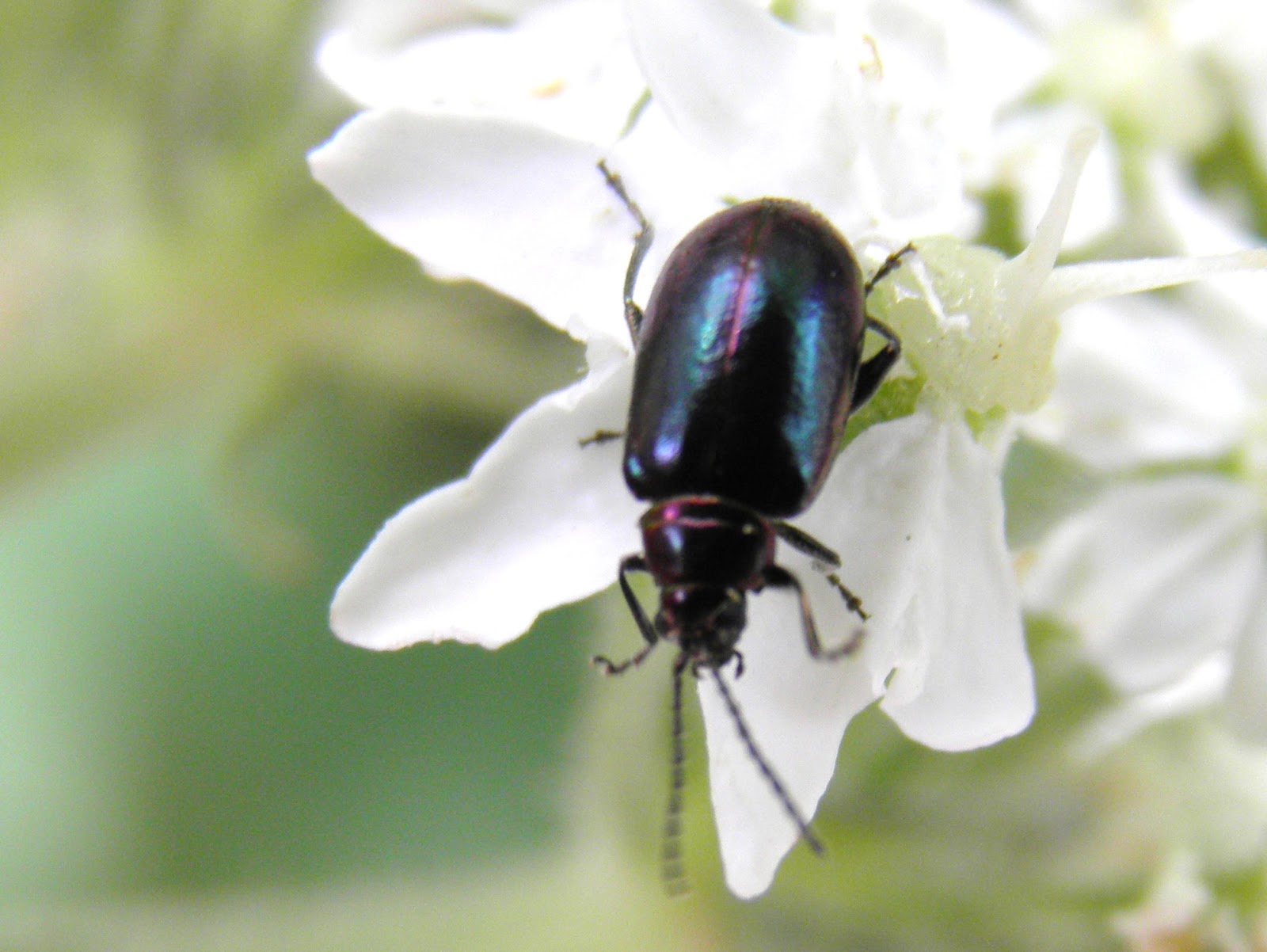
Altica sp. Flea Beetle

Fly, beetles, bee, and something too tiny for my camera on the left on Rubus

Lepturobosca chrysocomaon Heracleum

Lepturobosca chrysocoma on Rubus

Dermestid and Daysitinae (beetles) on Heracleum
Dozens of tiny weevils in Rubus
Grey Hairstreak on Heracleum
 Of course there were a few other flowers, too. little Snow Berry flower bells were attractive to certain flies


And Leslie climbed a slope under the pines to reach beautiful Shooting Stars - I've seen different species of these on high elevations and on poor, acidic soils in Swiss Alps before


So between lovely temperatures, great birds, beautiful flowers, a few bugs and great company, this was another lovely Wednesday Walk!