Friday, March 11, 2016

Marbles in Florida Canyon

One day after my birthday we - Randy, the pack and I - hiked up Florida Canyon Trail towards the saddle. A beautiful, if slightly muggy day.


From the highest point, we had great views all the way over downtown Tucson to the Pinal mines and Green Valley.


On the way up I told some birdwatchers to look for Montezuma Quail and when we met them again higher up, they proudly reported that they actually saw some: 'and suddenly two rocks began to move!'


Heading down I let go of  Mecki because he kept getting in my way on the steep trail with loose rocks. He stayed nicely on the trail until he saw the quail too. He is usually no hunter, but this time he ran. I normally trust our dogs to be smart enough to find us again, but this time we had to wait ominously long. We called and whistled and felt rather bad that he was running free and anxious that he was lost, or worse. There were signs posted along the trail warning of a dead horse that might attract predators. We saw neither carcass nor pumas ...
and Mecki eventually turned up behind us on the path, panting and wet. Very tired, too.


There were only some Blue Dicks and a few Sand Verbenas blooming and we saw few insects with exception of very active Carpenter Bees that constantly droned across our path.We did find some interesting butterflies, though, mating pairs of Desert Marbles, Euchloe lotta.

Looking down from the trail into the Santa Rita Research Station I recognized some familiar figures with beating sheets and nets: Charlie and Lois O'Brien and their Canadian guest Robert Anderson were searching for weevils. So our hike concluded with  a nice visit with them and station manager Mark Heitlinger.

Wednesday, March 9, 2016

Insect photography in canine company


Today I hiked the De Anza Trail. Well, I followed in the footsteps of that Spanish explorer for at least a couple of miles. And I had my own army to organize. Because Randy was working on a paper, I took all 4 dogs, even though I still don't trust Mecki and Frodo to be friends or at least peaceful. So in the car, Mecki sits in the passenger seat and the others in back.


Then, to hike, they get organized in pairs- Mecki and Bilbo and Laika and Frodo share leashes. To add to the confusion, Bilbo was bitten by either neighbor dog or Javelina, licked the wound until its size quadrupled and was turned into an inverse cone-head with the help of an Elizabethan collar. That thing swings from side to side with every step, and since he's decided to just ignore its existence,  he bangs it into legs, car doors and dog noses as if he enjoys it.

 The sandy path along the Santa Cruz in Marana used to produce a multitude of natural and planted spring flowers, but in this deceptive el Nino year they are few and far in between. Even sparser  are  the insects that are usually attracted to the flowers. But I anyway brought my camera and the dogs are getting their training in photography-cooperation.


Some metallic Sweat Bees collect pollen from Desert Marigolds, joined by a Buffalo Treehoppers (Ceresa)  


Some nice Anthophora Bees are visiting Parry's Penstemon but they prove very difficult to photograph.

The blooming Brittlebush has nothing to offer except a big hover fly Copestylum apiciferum which probably grew up in a decomposing cactus in the less cultivated parts of this river park.


A tiny beetle is perched on a petal of a surprisingly white desert Primrose. The beetle turns out to be Lytta auriculata, not even half as big as  these beetles usually are. Most likely it grew up as a brood parasite in the nest of a bee that only stored a minimal amount of provisions.   The plant seems to be The Dune Evening Primrose which is out of place here, but as I said, some flowers were obviously put here by well meaning city gardeners and are not quite native to the Sonoran Desert


My dogs quickly learn not only to sit quietly around the wildflower spots but they even begin to determinedly walk towards them. They know that a reward follows every successful photo session.

Monday, January 18, 2016

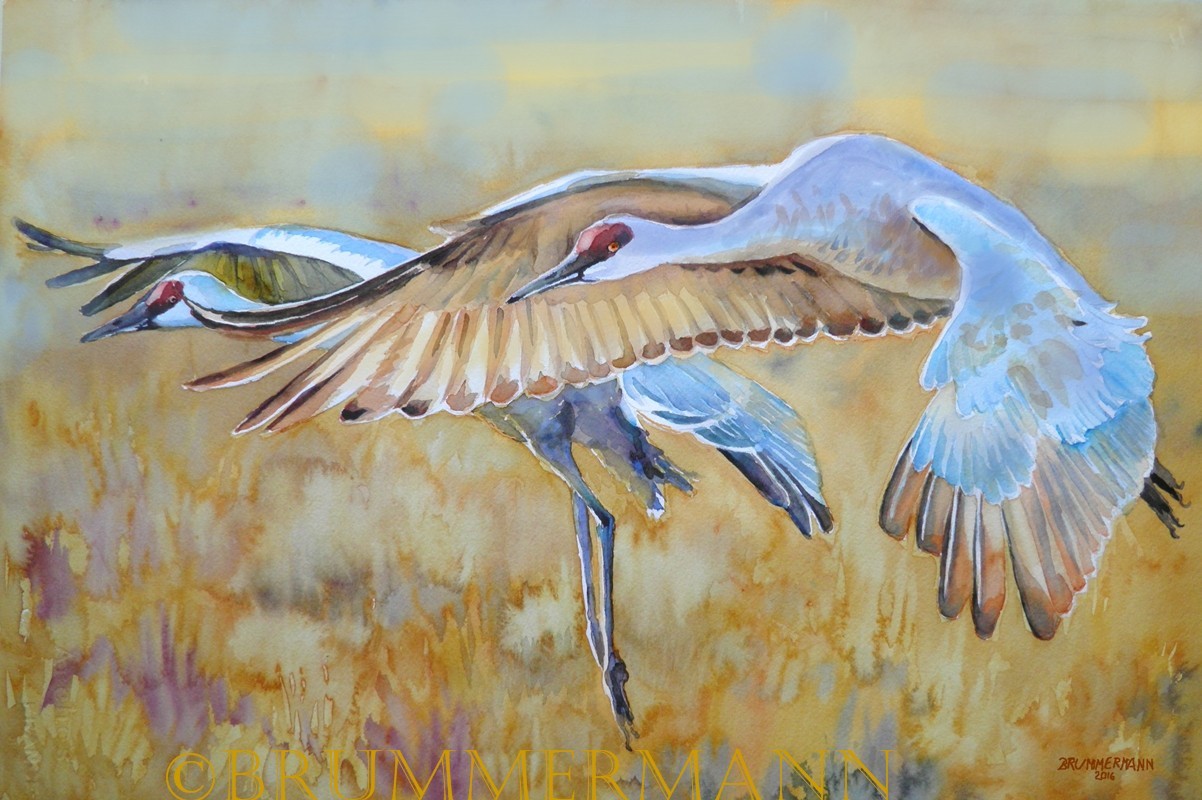
Sandhill Cranes at Whitewater Draw


This year I had a show in early January and no time yet to see the wintering cranes around Willcox Playa and Whitewater Draw close to Tombstone.


So I revived my memories by looking through slides and photos from previous years. The result are my first watercolors of 2016


Cranes taking flight into the morning sun. The spray of drops and the edges of the birds' wings catch the light. Otherwise the birds are blue shadows against the warm colors of the reflections on the shallow water that hardly covers fields of old cornstalks.

In the evening, a pair of Sandhill Cranes against a hillside rich with the jewel tones of sunset and deep blue shadows.

Prints and Originals are available. For prices see my Watercolor blog

Sunday, January 17, 2016

Falcons, Hawks, Owls and Sheep Dogs


Last week Ned Harris and I made a trip into the Santa Cruz Flats around Picacho Peak to look for Caracaras and other raptors.

Ned's photo
 We found several groups of the big birds that are momentarily considered Falcons - they used to be ranked with vultures - in freshly plowed fields, mostly in mixed flocks with Ravens. I heard that the Caracaras feed on pecans, but I cannot confirm that. The oily nuts are appreciated by ravens - some in Patagonia had learned to crack them and spent days harvesting - but I have yet to see a caracara try that. They often fly up into the old pecan trees along the roads, but to feed they seem to concentrate on grubs and worms in freshly turned soil. I have also seen them turn over clods of turf  with their feet. 


Kestrels, Redtail Hawks and one very shy Prairie Falcon were roosting on power lines and posts. As photographers we made our peace with those ugly perches because the birds definitely love them. Without those artificial perches, the birds could make little use of wide open agricultural areas.


Burrowing owls slept in front of burrows and drainage pipes that they probably use for nesting.


A Great Horned Owl posed willingly, if rather sleepily. Did all the owls have a really hard night?


Several Roadrunners crossed our path, Shrikes perched on dead branches, hundreds of Meadow Larks were everywhere.


On a little pond I found a Snipe, but got no good photo. Still, it was nice to at least see it so clearly. Greater Yellow Legs were poking around in a freshly tilled fields.


Repeatedly, huge migration flocks of  sparrows flew up from the grasses. But we both aren't good at identifying sparrows. Raptor man Ned calls them simply prey.  


Surprisingly, we  spent the longest time watching herds of sheep. Lambing happens early here in Arizona, so there were no newborns anymore, but the lambs were still at a cute age. What fascinated us, though, were the two big white dogs that were in control of the large flock.


As we got out of the car with our cameras, the dogs raced up and barked, but they never left the direct vicinity of their charges. And they soon recognized that we were neither mountain lions nor wolfs. The sheep were not alarmed by the barking: they came walking up to their protectors and joined them. These were classic old European flock-guarding dogs, probably a close descendant of the great, white Eastern sheepdogs that slowly spread across Europe over 2,000 years ago: the Karabash and Akbash sheepdogs of Turkey, the Kuvac of Slovakia, the Kuvasz and Komondor of Hungary and the Pyrenean Mountain Dog of France are all of this type. Ours looked particularly similar to Italian Maremma Sheep Dogs.


Dogs like these are raised with the sheep and feel that they are an integral part of the herds. A while ago I heard that international help organizations are giving puppies to herders in developing countries as an aid project, especially in areas close to National Parks in Africa. Of course, they are primarily there to protect the live stock from predators and thus reduce the losses that the human owners may incur. But of course the big dogs also indirectly serve to protect lions and wolfs from the wrath of herdsmen who might hunt or poison any predator that they perceive as  a threat to their herds.


We later found signs that warned hikers and bikers of the presence of the big, unattended dogs and gave advice how to behave around them. I wonder if a person who doesn't already know that those giants are harmless as long as you don't mess with their sheep would learn it from the fine print on those signs.

Saturday, January 2, 2016

Happy New Year - with a True Bug Poster

This is number three of my Arthropods of Arizona Collection - and I have some more ideas based on the photos in my sock drawer. For these posters I use photos that I have taken over the last ten years. All are of living insects - if possible I photographed them on white background, but some are also liberated from very colorful natural backdrops. Some legs and antennae needed to be rearranged or even graphically replaced...

On this poster 28 families (29 if you count Phymatidae) are represented by 73 identified species. A black and white template and the species list organized in taxonomic groupings comes with the poster if you order one. So this one has much more info than the other two - I have more practice now. The poster are 18 in by 24 in and cost $35 plus shipping. It is a fully archival art print. You can order here (send me
a message).

 Here are the first two, I just reordered them from the printer, so I have a few of them in stock, too.
To order, please send me an e mail to mbrummermann@comcast.net

Best regards Margarethe

Monday, December 21, 2015

Winter Solstice 2015


The short, sunny winter day in the desert ends with beautiful warm lights and deep shadows. It's easy for our dogs to make us go for a sunset walk. Above is the view south across our property with Wassem Peak and Saguaro National Park West in the background.

Looking north, through State Trust Land with many Saguaros and even more Chollas into the flat spread of Avra Valley.


On our fence waits a little fly catcher that I haven't seen here before. Maybe a Wood Peewee? Wild guess. Too bad that with two impatient dogs in one hand and the camera in the other, and very little light, the focus is off.

Ants are still active, but dragging their tarsi. Veromessor pergandei, harvesting the seeds of those November-blooming Chinch Weeds I think.

Frodo heard the song of his Coyote relatives and took off to find them. But he eventually returned tired and panting while the choir kept serenading us. Or maybe they were just inspired by some sirens on the freeway.


One of our Great Horned Owls took off from a branch right above my head ans landed not too far from us, not afraid of humans or dogs.  The light was now really getting bad. 


Getting closer and going down on the ground, I could get him against the lighter sky ...


Using the little built-in flash also turned out less than ideal ..  Too bad, because the guy was endlessly patient.


The sky was now getting dramatic - and Saguaro silhouettes do set it off perfectly.


The best colors over Kitt Peak and Ragged Top in the Northwest across Ironwood National Monument. It's nice to live right in the middle of two great parks!.

Happy Winter Solstice to all on the northern half of the world!


Thursday, December 10, 2015

The colors of arthropods

Evolution has produced many outrageously colorful arthopods. The driving factor may have been communication, intraspecific to attract partners or interspecific to warn or deceive predators.
Many patterns and color combinations that appear out-standing when seen out of context may be very cryptic on the right, natural background. Pigments also protect underlying tissues from radiation damage and play a role in thermoregulation.


Colors of arthropods can be based on several different phenomena:

 Transparent epithelia that allow  hemolymph or inner organs be visible and therefore to determine the outer appearance. The abdomen of a mosquito is red shortly after a blood meal, and some spiders adopt the color of their prey if they feed on highly pigmented insects. They 'become what they eat', for a short time.

Crab Spiders of the genus Mecaphesa can adjust their color to their surroundings
Many colors of arthropods are based on organic pigments that are embedded into the exoskeleton or cell layers directly underneath it. These pigmental colors are based on the partial absorption of light. The pigments (carotenoids, ommochroms, flavenoids, quinones, etc) are obtained from food and sequestered or products of the insect's metabolism, often by- or waste-products, and their stability is based on the animal's living, active metabolism. Some arthropods have the ability to change these colors actively (Crab Spiders, Tortoise Beetles). Pigment based colors typically change or fade after death. 

Pair of  Deloyala lecontei which occurs in 2 color morphs
 Structural colors are either based on the selective refraction of reflected light by the exoskeleton or by living cell layers directly under a transparent cuticle. I cannot find definite explanations of the mechanism, but these refracting elements in the latter seem to consist of layers of lipid droplets. 
 
One individual of Jonthonota mexicana undergoing color change due to disturbance
 Many tortoise beetles are able to control these refractors, effectively switching from a bright gold metallic to a dull brown or red appearance.


The permanently metallic appearance of many other insects is created by the unique structural arrangements of many dozens of layers of exo-skeletal chitin. The cuticle, which is just 10 millionths of a meter deep, has some 70 separate layers of chitin—a nitrogen-containing complex sugar that creates the hard outer skeleton. All these layers have different refractive indices.
Calosoms scrutator (Carabidae)
 Incoming white light (sun light) is refracted through—and reflected by—each interface giving, in particular, phase differences in the emerging reflected rays. For several wavelengths in the visible range, there are many reflected rays whose phase differences allow for constructive interference. This leads to the metallic appearance of the the insects. The resulting colors are called 'structural' as opposed to 'pigmentary'. These structural colors outlast the death of the insect. (Loosely quoted from  "Visible light reflection spectra from cuticle layered materials," by Cristian Campos-Fernández, Daniel E. Azofeifa, Marcela Hernández-Jiménez, Adams Ruiz-Ruiz  and William E. Vargas  Optical Materials Express).
Chrysina aurigans
 The cited study was concerned with Costa Rican Scarabs that appear golden all over. 
 Very shiny beetles like those may blend in with the multitude of dew or rain drops sparkling on the foliage around them, especially in the dim light of the tropical rain forest. 

Chrysina gloriosa on juniper
Metallic patterns on  parts of larger bodies may also break up the larger shape and hide it that way. I have noticed this for example in beetles and caterpillars that live in the lacy foliage of mesquite or juniper. Seen from below, against the light, these insects are less visible than their non-reflecting relatives.

Chrysis sp. Chrysididae (Cuckoo Wasps)
 Does the metallic appearance of the exoskeleton  indeed indicate a certain hardness and armament of the wearer? Several parasitic bees that seem to get into scuffles with their host species  appear particularly metallic.

Pipevine Swallowtail - the iridescence will outlast death

 Not to forget: The colors of butterfly wings are also structural, even if they do not usually appear metallic due to the small size of the colorful sub-units, the scales. In some species, however, the arrangement of the scales is such that iridescence is achieved. At the U of A, studies are under way, looking into the importance of these direction dependent flashes of color in the partner choices of our Pipevine Swallowtail.