Friday, April 19, 2013

It always pays to watch the competition


Yesterday, when I arrived for the weekly nature walk of the Friends of Sabino Canyon the temperature was in the fifties. Much too cold for mid-April morning in Tucson and too cold for most insects and lizards that I wanted to see. In addition, a fierce wind was howling down into the canyon from the Catalinas. The other naturalists decided to look mostly at plants, I guess because those can't hide from the elements. Two saguaros, one with an imposing crest, looked indeed positively defiant.

Eastern Collared Lizard, who stayed hidden yesterday (Photo Ned Harris, April 2012)
But I don't get to Sabino often enough, so I was going to give Esperero Trail a try because that's where I had seen the beautiful Eastern Collared Lizards last year. The trail leaves the main canyon and winds up the mountain side with full exposure to the western wind gusts. It seemed like a dumb idea but I am stubborn and in Arizona the sun usually breaks through eventually.

View into Sabino Canyon from Esperero Trail
 Well, it didn't and there seemed to be very few living things willing to share the exposed mountain side with me. Until I came to some part of the trail that rose somewhat over its surroundings resulting in a low but pronounced hill top.

Ash-throated Flycatcher, who was out and about
 There was a big Ash-throated Flycatcher busily swooping from his perch as if catching - flies? Sure enough, even in this abysmal weather some Bee Flies, Tachinids, Robber Flies  and even some butterflies (Tiny Checker Spots, Marine Blues) were hill-topping, a behavior that is typical for many flying day active insects.

Some of the hill-topping flies and butterflies
 Males had staked out little territories, patrolling back and forth, chasing everything that flew by, driving off other males and trying to mate with passing females. I think I understand why the big collared lizards and the flycatcher seem to prefer this exact area. It's the place where they can be sure to find enough prey. Of course the ectotherm lizards had the luxury to take the cold day off while the endotherm bird had to keep working, especially as he was feeding nestlings that I could hear keening in a Saguaro hole. I followed the bird to an especially exposed area with some bare boulders where he seemed to concentrate his efforts.


 At first I payed little attention to a big black fly that landed as if to bask in one of the sparse sunny spots because I mistook it for a Mexican Cactus Fly, a common syrphid. But then I heard a very deep basso buzz when the fly changed to another boulder, only about 5 m from the first. That sound is one of the loudest and deepest flight noises I've ever heard here in Arizona - not easy to forget. Through my new little Papillon binoculars I could also verify that the fly was not all black but had silvery grey flanks - a bot fly in the genus Cuterebra. (Later identified by Jeff Boettner as C. austeni)

Rodent Bot Fly, Cuterebra austeni, Esperero Trail, Sabino Canyon, Pima County Arizona, April 2013 
This is only the third time that I encountered these big, fascinating insects. Some people may feel that the live history of bot flies seems like an episode from the X Files or the movie Aliens. I think, however, that the film makers borrowed their ideas from the biology of these flies whose larvae are mammalian parasites.

Deer Bot Fly, Cephenemyia jellisoni infects the alimentary tract of ungulates like white-tailed deer, mule deer, moose or elk. Photo by Philip Kline Pusch Peak,  Catalina Mountains, Pima County, Arizona, March 2009
 While some bot fly larvae develop in the alimentary tract of mammals, the big black and grey Cuterebra that I was watching yesterday belonged to the group that develops subcutaneously in mammals. Luckily they are quite species specific in their host choices so I knew that I wasn't the target - the host would most likely be a rabbit or a pack rat.

Pack rat with 2 nearly grown Cuterebra larvae Photo Jan Emmings
 The female fly will lay hundreds of eggs in rat runways. Only a few of the larvae will actually find their way into a passing rodent.There it will develop rather quickly feeding on the body fluids of the rat that this irritation draws. Inflammation and pain are controlled by the larva and the wound heals very quickly as soon as the guest drops out of the host to pupate.

Cuterebra sp. larva ready to pupate found crossing Sabino Canyon Rd. on Feb. 22, 2011. Photo by Fred Heath

Rodent Bot Fly, Cuterebra sp., Pima Canyon, Catalina Mts. Pima County, Arizona, September 2009
 The only bot flies likely to infest humans do not occur north of Southern Mexico. As I mentioned, the deep characteristic buzz of the big flies is rather recognizable and would probably warn the victim of an intended egg drop. To give their larva a chance to find their way into the body of a wary primate, female bot flies in the genus  Dermatobia  have an amazing strategy. They capture another insect like a mosquito, horsefly or tick that is drawn to warm blooded mammals for its own reasons and attach a load of their eggs to this carrier. When the released  mosquito later lands on a primate for a blood meal, the bot fly eggs hatch and the young larvae bore into the warm skin of the doubly victimized monkey or human.

 While feeding from the host subcutaneously for several weeks the larvae have to behave reasonably well. They seem to prevent inflammation even though they need to keep a hole in the host's skin open to be able to breath periodically. They probably have anti inflammatory and antibiotic capacities. I have two good friends who both got parasitized in Central America, are now in their eighties, and live and love to tell about it. If not removed prematurely, the larvae will eventually leave the host, drop to the ground and pupate. In time a new generation of mature adults will hatch. These big flies are born without mouth parts. From their time as maggots in the flesh, they are provisioned with enough energy reserves to survive for about 10 days, time enough to start the cycle again.

Catching the redeye to Amhesrt, MA 
Yesterday's bot fly, however, is not going to propagate his genes this way. Instead he is contributing them to conservation biologist Jeff Boettner's research project at UMASS - Amherst. There are many open questions concerning host relationships and phylogeny of the group. As specimens are difficult to obtain, Jeff would be grateful for specimens and info about lek sites. Here is a link to his info pamphlet.
Here is a link to photos of the removal of a human bot fly larva (Peruvian Amazon)
Classification:
Arthropoda (Arthropods) » Insecta (Insects) » Diptera (Flies) » Calyptratae » Oestroidea » Oestridae (Bot Flies) » Cuterebrinae (New World Skin Bot Flies) » Cuterebra (Rodent and Lagomorph Bot Flies)

Tuesday, April 16, 2013

Velvet Mites, Trombidioidea and Chiggers

With this post I am going out on a limb. I got an e mail request to identify a small red bug. I am using bug here as a general term for arthropod, because:

Question:
'Hello Dr. Brummermann,
My co-worker and I were on Mt Lemmon today, in the Marshall Gulch area and we came across thousands of tiny red insects. Our first thought was chiggers, but after looking into it, these insects were too big to be chiggers.
They were bright red, had 6 legs, and large antennae. About 25% of the ones I looked at appeared to be dead (curled in on themselves and dry), but this could have just been the case for the one location that I was seriously investigating them in.
While I don't have any pictures, I can guess they were approximately the size of this "o" (San Serif, 12pt font). They were found in areas with large amounts of dead leaves, and when we dug under the leaves, they appeared to be moving through the soil.
Do you have any ideas as to what we saw?'

Answer:
Without a photo there is not too much to go on. What seemed to be dead ones could be exuviae - in that case I would guess that they were some early instar true bugs or other hemipterans. But since they seemed to be soil related and bright red, how about mites instead of insects? Their front legs could be mistaken for antennae. Here is a photo of a giant velvet mite: http://bugguide.net/node/view/200679
They are usually bigger than your 'o' but.... There are often outbreaks with thousands of them. They are predators as adults.
Let me know what you think and consider carrying a camera for documentation!

Trombidiidae (Velvet Mites) from my backyard. These live in sandy soils, are huge, around 5 mm in length and show up only after rains

Question:
Thank you very much for the speedy reply!
They could have been mites; we didn't have any magnifying lenses on us at the time, so I could have mistaken the front legs for large antennae. Will they bite humans (or other large mammals) or do they only go after other insects? If I'm up in the area again within the next few weeks, I'll take a picture!
Thank you again,

Answer:
At first, I was going to say
Your observation that the bugs were in the leaf litter makes me think that they are really in the family Velvet Mites (Trombidiidae) and not the so called 'Red Spiders", also mites, that live and feed on plants and can become pests.
Velvet Mites (Trombidiidae) may be parasitic on insects as young instars. As adults they will become predators of insects. This is the info in BugGuide, Wikipedia and other web locations.

But I am now looking at John Henry Comstock's 1948 Spider Book, revised in 1965 by W.J. Gertsch. I know that is ancient for a science book, but while a good part of the older taxonomy had to be  revised according to more recent phylogenetic research, the life history of the described organisms has not changed and the old biologists were famously thorough observers.


This last paragraph sounds suspiciously like chiggers, doesn't it?

I moved on to the 1998 Review: Biology and Ecology of trombiid mites (Acari: Trombidioidea) by Zhi-Qiang Zhang, Experimental and Applied Acarology, 22 (1998). The paper first states that the systematics of the group are in flux, and many of the old subfamilies that Comstock still included have since been accorded family status.

Euryopis sp. Spider with a trombidioid larvae (red) and trombidioid adult on the left
 These mites are of economic importance and may be used for biological pest control. But identification even to the genus can be difficult and in many cases either the larval stages and hosts are not known or the larvae are described but not the adults. Trombidiid larvae have been found as parasites on many different arthropds. Some seem very host specific, others can use a variaty of hosts.


If you can read this table that I copied out of the Zhang paper, you'll find that two of the families do use vertebrates as their larval hosts: Leeuvenhokiidae and Trombiculidae They are Chiggers!
So the chiggers that chew into the vertebrate skin (not burrow under the skin) are larvae of Velvet Mites, but not all Velvet Mites are chiggers. Here is a link to the blog of Dragonfly Woman where she explains how the young chiggers actually feed on vertebrate skin.
The mites I was asked about are probably not chiggers, for two reasons: First, It is far too early and cold for chiggers on Mt Lemmon right now. We still had snow a couple of weeks ago.  Second, chiggers (the parasitic larvae) are very tiny, much smaller than the observed mites. But I cannot tell whether these mites could be the adults of what we call chiggers.

 Classification:
Arthropoda (Arthropods) » Arachnida (Arachnids) » Acari (Mites and Ticks) » Acariformes » Trombidiformes » Prostigmata » Anystina » Parasitengona » Trombidiina » Trombidioidea » Trombidiidae (Velvet Mites)

Tuesday, April 9, 2013

A Giant Crab Spider becomes a Gigantic Crabspider

Our friend Frank planted an Olive Tree in his backyard in Picture Rocks, Arizona. Then, being in the plumbing trade, he staked it with copper tubing. A Giant Crab Spider, Olios giganteus, moved into the copper pipe, but kept hiding from my camera.


I kept trying. Then one night, Randy and I found the spider hanging upside down, hog-tied by its own thread. What was going on? I'd never seen this species spinning any silk before. Then I noticed: Its carapax looked funny as if the tegment (dorsal part) had come loose like the lid of a can.


The side view was clearer: the spider was molting. The transparent grey part is the emerging spider in its new skin. Like insects, spiders have stiff  chitinous exoskeletons that cover at least the thorax and the extremities. Muscles attach to the inside, sensory hairs sit on the outside, The cuticula even  gives structure to tracheas and lungs, and it forms sharp claws and scelicera. But it is rigid when fully hardened and needs to be shed periodically for the spider to grow.    


A new pair of new chelicera appeared under the old ones (darker) and also a new row of eyes
Controlled by hormones, a complete new skin is formed under the old one. This includes sensory hairs, claws, even the lenses of the eyes. Molting fluid separates the two layers. The old carapax opens at certain seams, and, like a butterfly escaping the chrysalis, the hanging spider uses gravity's force to pull out of the old skin. It has to happen this way because the new skin is still so soft that the spider's muscles have nothing to work against and are useless.


The abdomen has torn loose from its very thin old skin
 The abdomen of spiders is never covered in a hardened exoskeleton. This part of the body often shrinks or expands depending on the spiders hydration or nourishment status, or when the female is pregnant. But the abdominal skin is also included in the molt, maybe so the spider emerges with a fully renewed set of sensory hairs that cover the entire body. 

The spider in it new pale skin is hanging under the old exuviae, with most of the length of the legs still inside

Suddenly the palps fall forward one by one and their swollen distal parts reveal that this is now a mature a male. He will fill the blueish genital bulbs with seminal fluid from his abdomen. Then he will keep the sperm in his palps until he finds a female that allows him after elaborate courtship to  transfer a spermatophore into her spermatheca. Male palps and female epigyna (cover and opening of the spermatheca) differ greatly from spcies to species and allow sex only among members of the same species.
 If you look closely, you can see the exuvia of the old palps just above the old chelicerae, and there were no genital bulbs. This means that this guy just went through puberty with this molt!


I was watching the progress of the molt now for more than 15 minutes (I carry no watch, but Randy had long left for home because he is not THAT interested in bugs and he can always look at my photos later)....
The spider was now wiggling slightly and rotating on its silk thread because his center of gravity began to shift when his long legs pulled free.


After he had pulled completely free from his exuvia, the spider stayed suspended from his silk line. All extremities were extended. The new skin now needed to harden and dry to become a functional exoskeleton, pigmentation would mature, and I had reached the end of my camera's battery life.

Exuvia and freshly molted spider (hanging still under and attached to the old skin)

I wanted to come back in the morning to claim the exuvia. I was hoping to see how a spider's complex book lungs are represented in the old cuticula. But in the morning there was no trace left of the night's miracle. I did meet Mr. Giant Crab Spider sitting proudly on his copper pipe though.

female Giant Crab Spider Olios giganteus Photo by R. Hardy copyright
Since he was again shy of having his portrait taken, I am showing instead Randy Hardy's spectacular photo of a female Giant Crab Spider. For scale, the scarab beetle (Cyclocephala melanocephala) in her fangs is about 10 mm long (little less than a half inch). Next to her huge black chelicerae her palps are visible,which in females look just like a pair of short extra legs.

Classification:
Arthropods (Arthropoda) » Arachnids (Arachnida) » Spiders (Araneae) » True Spiders (Araneomorphae) » Entelegynes » Giant Crab Spiders (Sparassidae) » Olios » Olios giganteus 


Wednesday, April 3, 2013

Promachella pilosa, a new genus and species for BugGuide and the UAIC

Every morning during breakfast on the patio we sneeze at all the pollen that drift over from blooming Creosote and Brittle Bushes. We both have been in Arizona long enough to develop pollen allergies. While Randy so far just sneezes, I experience the whole spectrum from itchy eyes to sinus problems. But eventually I will jump up with my camera that sits always next to my coffee cup to get even closer to the flowers (I very much appreciate that my point and shoot camera has no view finder. While this seemed to be a serious draw-back at first, it now saves me from getting my face right into the blooming bushes.)
Most of the insects are arriving to either collect pollen and/or nectar, find mates, eat parts of the flowers or leafy parts or deposit their eggs so their off-spring can do so. A few spread their eggs so their off-spring can hitch rides on other flower visitors to  become a parasitic guest in their nurseries.
And of course this aggregation of spring insects also draws some predators.


Promachella pilosa female
 Yesterday I observed a robberfly that was feeding on a small bee. She was busy and easy to approach so I got some good photos. In shape and coloring she reminded of the genus Promachus, but at less than 15 mm she seemed small.


Promachella pilosa male
 Not much later I found a similar, but even smaller male. He was shyer and kept landing among the branches of a Creosote bush, so his portrait didn't turn out quite as well.
On BugGuide Dr. Eric M. Fisher a Diptera specialist with special interest in Asilidae identified
my patio robbers as Promachella pilosa. I am rather proud to say that this added a new Genus and species to Bugguide. Checking the online species data base of the UAIC, I found that there are no (identified) specimens in the collection either.
While it is nice to photograph something new and special (I found no other photos on the web) there is not much information out there either. I have no access right now to Willcox original 1937 paper. So all I know so far is that this is a fly that is only known from Arizona and from neighboring Sonora, Mexico. 
But since the appearance is so similar to that of the widespread genus Promachus, and the female is lacking the dagger-like ovipositor of some genera that stick their eggs into plant material, I guess that the females of the genus Promachella deposit their eggs into the soil. 

Sunday, March 31, 2013

Pollination by Seedbug?

Last night I found a Large Milkweed Bug, (Oncopeltus fasciatus), asleep on the underside of a Brittlebush (Encelia farinosa) flower. Nothing special in itself. There were beetles, spiders, flies, male sand wasps, aphids....all tucked under the umbrellas of those little sunflower cousins.


But I noticed that underside, legs and even antennae of the seedbug were covered in yellow pollen. Did the sticky stuff just get on him because of his choice of bed? True bugs (Heteroptera), with few exceptions, are not considered good pollinators even if they hang out on flowers. They are usually there to hunt if they are predators, or suck juices from the plant tissue.  So the invitation to pollinate, extended by the plant in form of nectar and extra pollen to draw insects to its reproductive organs, is usually lost on true bugs. Or so I thought.


This morning the brightly colored seedbug was still around, this time on the flower surface. A brittlebush flower, like a sunflower, is really an inflorescence that is composed of hundreds of single florets, each with a complete set of stamens, pistil and nectaries surrounded by the fused, tubular corolla. So what looks like a simple, easily accessible disk flower can really only be exploited by insects with adequate elongate mouth parts. Of course, bugs do have a long thin proboscis.


 I watched the Large Milkweed Bug walk from floret to floret, sticking this proboscis into everyone, just like a bee of butterfly would. I even took a video. The bug was clearly going for the nectar deep in the florets and while doing so got powdered all over with pollen. I watched him visit several compound florescences. Does that make him an effective pollinator? Probably about as much as any butterfly, if not quite as good as a hairy, dedicated bee.
It's nice to see something unexpected right in my backyard in the early morning. I love my patch of brittlebush.
 

Saturday, March 30, 2013

Early Cactus bloom in our Backyard

Opuntia Hybrid?
Opuntia macrocentra, Longthorn Prickly Pear, Texas
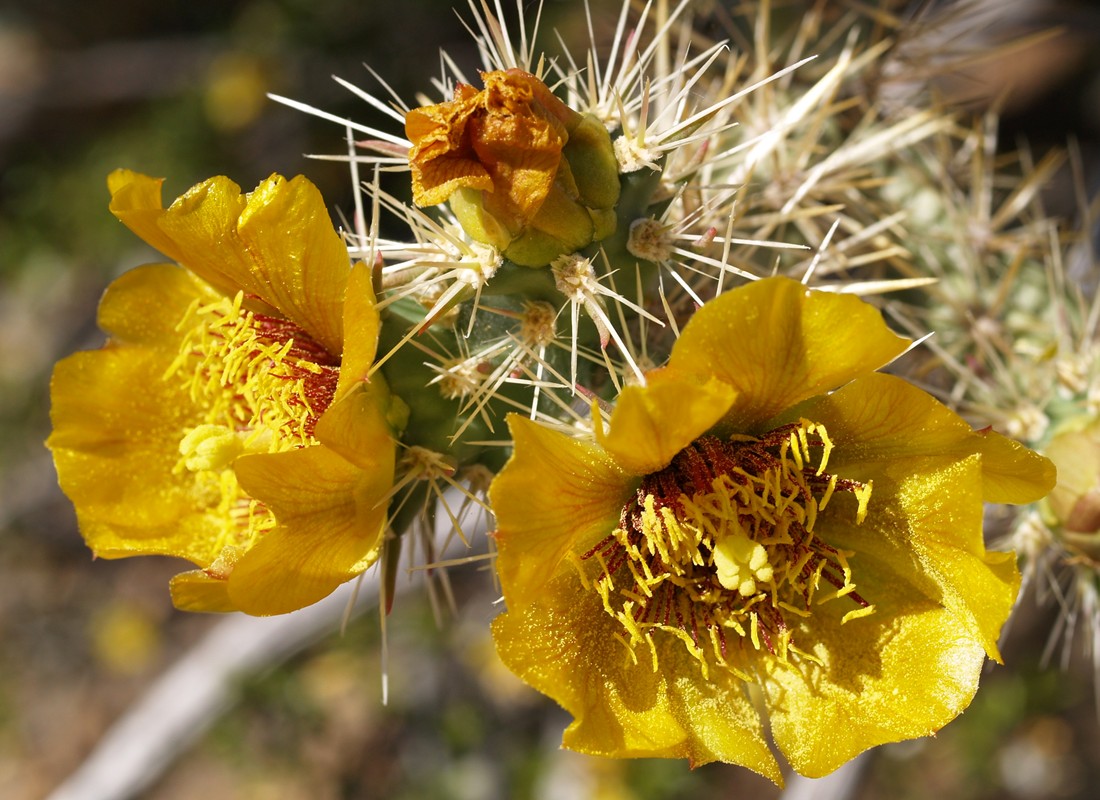
Echinocereus pentalophus, Ladyfinger Cactus
Claret Cup Hedgehog


Trichocereus


Strawberry Hedgehog, Arizona


Cane Cholla, Arizona
Trichocereus

Harisia sp.
Chamacereus silvestrii from Argentinia


Beavertail Opuntia, Arizona

From our cactus garden. Most are part of the Arizona landscape and grow somewhere on the grounds without much more water than nature provides. Some are from Bach's Cactus Nursery and grow better in pots with just a little more care, but all love the Arizona sunshine.

Wednesday, March 27, 2013

Desert Bees

We have a collection of early spring bloomers in our backyard, a mix of imported and native species. Right now, there are several penstemon species, aloes, creosote and brittle bush in full bloom.

Parry's Penstemon is a native species. It can be found in many sandy washes of the Tucson Mountains and beyond. In our garden it is blooming in direct vicinity of several showy Aloe species.


The imported Aloes attract the equally imported Honey Bees, and birds who are not very fussy when it comes to sweet juices.


 Hummingbirds, Gila Woodpeckers and Orioles are frequent visitors. But the native Parry's Penstemon is visited by local specialists.


Habropoda  and Anthophora Bees hover from flower to flower, land, and are gone again. Every flower seems to yield  only a very small amount of nectar. This makes life difficult for macro-photographers, but even more so for the bees.


This becomes obvious when the sun disappears shortly behind a cloud resulting in an immediate drop in temperature. Some bees keep going and going. But others soon drop out of the race for nectar. They clamp their mandibles on a leaf or a stem, tuck their legs and rest motionlessly. I can see that they do not carry any loads of pollen, and when one finally starts moving again I see a flash of white from the face: the bees that take brakes seem to be all males. They may stop flying when the temperature drops and they would have to spend extra energy on heat production to keep their flight muscles operative. For males this expenditure may not be worth it. The resting individuals also looked old and ragged. Maybe they have done their duty.


The pollen loaded females who are provisioning their nests seem to have reasons to invest more energy and keep flying, at least at our only slightly sub-optimal temperatures. 
 Habropoda  and Anthophora are Anthophorine Bees with very long togues (0.4 to 0.8 inches) that enable them to pollinate deep flowers (O’Toole & Raw 1999). Adapted to both temperate and tropical climates Anthophorines are wide-spread, but in the US most abundant in the West and Southwest. They are called mining bees because they are solitary ground nesters whose females dig tunnels in the soil to accommodate a series of brood cells. The cells are lined with an oily substance for protection against moisture and fungal infections.

While watching the bees for hours on several days I saw very few honey bees visit the Penstemon, but quickly return to the aloes. The native Habropoda  and Anthophora Bees completely ignored the aloes and concentrated on just one species of penstemon and the surrounding creosote bushes. Every evening, when it's too cool for most bees, a big female Carpenter Bee also harvests pollen from the creosotes. I will have to use a flash to get her photo.

See also:
The Great Sunflower Project, Anthophora – mining bees (family Apidae)
by Lisa Schonberg and Mace Vaughan (Xerces Society) and Gretchen LeBuhn (SFSU)