Thursday, April 28, 2011

Introducing Wasp mimicry to school kids

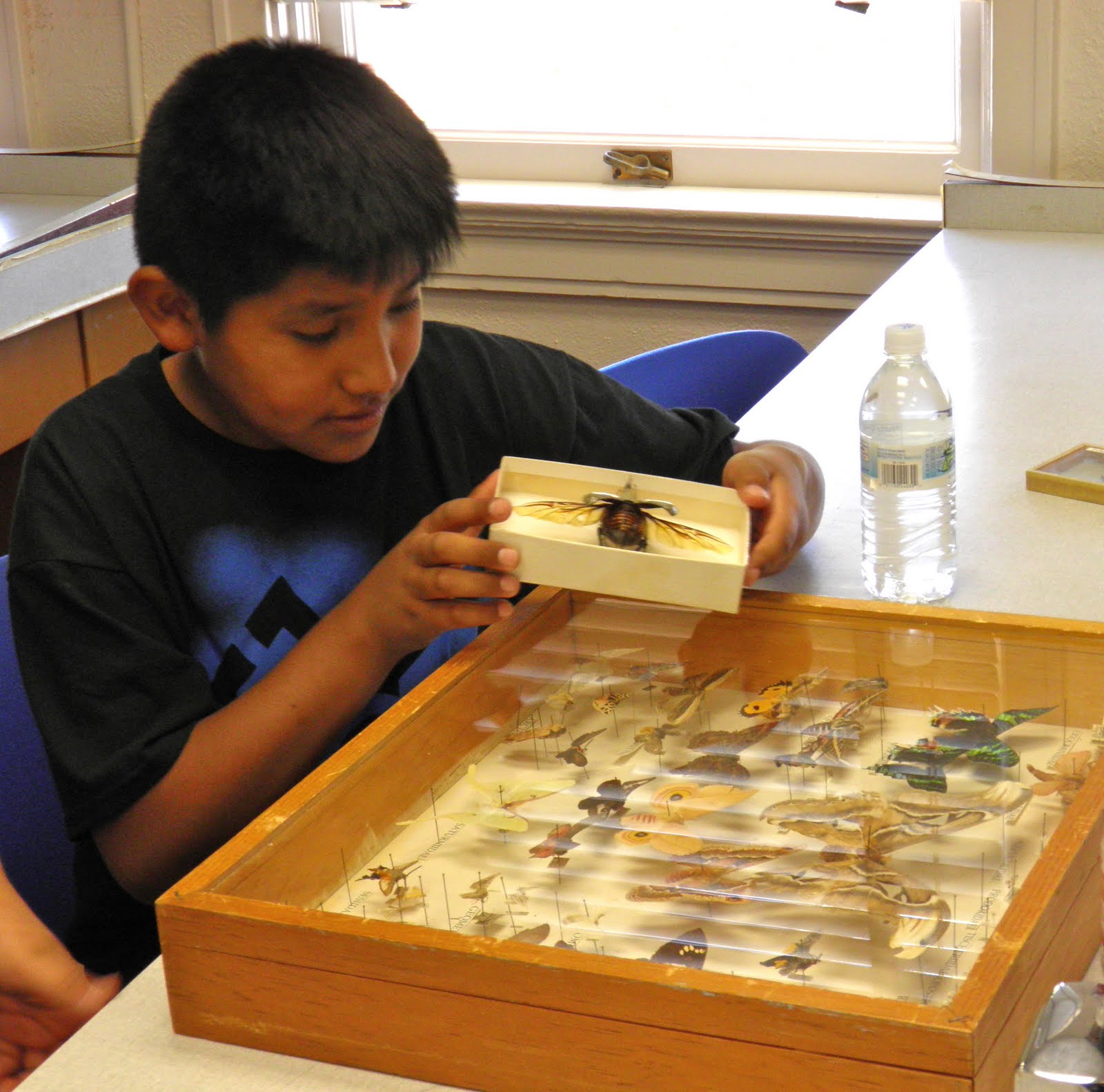
Today a group of 5th graders from Sells, AZ  visited the University of Arizona Insect collection. Our 'Bugman' Carl Olson wasn't here to entertain them, so I had to come up with something interesting, fun, but educational.


The kids and parents were all Tohono O'odham tribal members, and a great group to talk 'Bugs' to. They admired our pinned specimens of especially pretty  insects. Arizona has so many carismatic species...

By borrowing from other flickr members and using my own quite extensive digital insect collection I prepared a slide show of insects from divers orders that mimic stinging wasps and hornets by displaying yellow-dark banding.
I myself was surprised at some of the striking examples that I found.


Ancistrocerus tuberculocephalusAAA Some Insect ordersAAAA Vespula pensylvanica, Western Yellow JacketAidemona azteca nymphb Polistes  comanchusBembix sp
c Acmaeodera amabilisCopestylum sp.d Ripiphorus sp. femalee Aethecerinus latecinctusEumeninaeg Spilomyia crandalli
g Trichodes fasciatusHedriodiscus binotatus, SoldierflyPolistes arizonensisPolistes dorsalisPolybiomyia sp. Flower Fly, CeriiniSoldierfly
Sphecius convallis, Pacific Cicada KillerTrachyderes mandibularis
Add caption
Add caption

Wasp mimicry (Yellow/dark), a set on Flickr. Click on the link to see all.

The kids went cheerfully along with my flickr slide show calling out the  different insect orders that they recognized.

They loved to handle my two life Agave Weevils. Of course, they also enjoyed hunting one of them down when it flew around the class room - after I had introduced it as a flight-less species.


A big Dynastes male with its wings spread open was everyones favorite. I wished the class had visited in summer, so I could have had some life Dynastes and Oxbeetles and maybe some Chrysinas. All of them occur on Reservation land, but I doubt that many of the kids get to see them.


The teacher Kathryn Killmer gave a great introduction to the path to college and university, and kids and parents were obviously fascinated with our subject matter, so one can hope that some of them  will eventually return to the U of A as students.


I hope they had as much fun as I did.


Sunday, April 24, 2011

Birds, Bugs, and Herps in the western Santa Rita Mountains

Eric Eaton and I took a trip to the Santa Rita Mountains (a last one before Eric moves to Colorado or the mountains get eaten up by the planned Rosemont Copper Mine? I hope not).

We went to Madera Canyon Lodge first. Still lots of bird activity, we especially enjoyed the Black-headed Grossbeaks. Caught a glimpse of a Lazuli Bunting, mistook him for a Bluebird, didn't get a photo.

Bombyliid Paravilla sp.
Blooming Velvet-pod Mesquite Trees would have been interesting enough to spend the day. But we were headed for yet another canyon.

Acrobat Ants, Crematogaster, tending to Membracid Vanduzea laeta

At Florida Canyon, a short stop at the creek revealed no water, but Eric spotted and orange flash among the rocks and dry oak leaves: the short distance flight of the incredibly cryptic Oak Leaf Grasshopper.

Oak Leaf Grasshopper,Tomonotus ferruginosus
Butterflies often patrol creeks and roads in the mountains. As it was rather windy, a Spotted Purple found a perch above my head and wouldn't leave, even when I pulled him down to eye level. An imitator of the bad-tasting (so I was told) Pipevine Swallowtail, he had some people fooled.

 Red-Spotted Purple, Limenitis arthemis astyanax
Ironically, we ran into another Pipevine Swallowtail mimic, a Black Swallowtail, and got some good photos while he was clinging to his Arizona Thistle head, but we got no shots of the usually much more common Pipevine Swallowtail itself.

Black Swallowtail, Papilio polyxenes

Those Thistles yielded scores of interesting bees that I'm saving for another blog and some enormous Sand Wasps - for scale, just consider that the Didasia on the right is about the same size as a Honey Bee.


A nice Ambush Bug also showed up on the thistle. This species is always recognizable by the arrow head on its back.

Macrocephalus dorannae
The canyon is full of Sotols, Yuccas and Agaves with their own fauna of bugs and beetles. Since the tiny Mirids defied our photo skills,  here is a photo of the very cute, cooperative agave weevil.

Peltophorus polymitus seminiveus
Prickly Pear Cacti were not blooming yet at this elevation, but the pads were coming to life and oozing juices.
 We found all the True Bugs that we expected and more. Also Soldier flies and many different species of wasps that were drawn to the sugary leaks.

Zarhipis integripennis
When all these insects tumble around among those sharp spines, accidents happen. I often find impaled flies or bees. This time it was a male Glow Worm. According to Eric, the males fight during courtship which could have contributed to his predicament.  We got him off the thorn.

Lycus sanguineus
Several very bright red male Lycus sanguineus were impossible to overlook. Much lighter and equipped with larger wings than the flightless females, they usually allowed only a few shots before taking off.
 One more vertebrate on the way down:  I found this snake after I'd already stepped over him with one foot. For a Sonoran Whipsnake he was quite patient, but once he got going, he disappeared in a flash.

Sonoran Whipsnake Masticophis bilineatus


Saturday, April 23, 2011

Microcosmos Cactus Flower

Engelmann's Prickly Pear, Opuntia engelmanni 
Engelmann's Prickly Pear is the most widespread and common Opuntia around Tucson, and it's just starting to bloom. The flowers are beacons for photographers and pollen and nectar seeking insects. They are flat and easily approachable for bees with short proboscis and even unspecialized beetles.
 Carpophilus  sp.
 In the morning, when fresh flowers open, countless  Nitidulids of the genus  Carpophilus  arrive. They 'drop out of the sky', land and slip between the petals, where they congregate, feed, and find their mates. 


I used to think that they are specialized on cacti, but I this week I found clusters of them in Apache Plume (Rosaceae) and in Arizona Thistle (Asteraceae) in Florida Canyon where the cactus flowers were just budding.

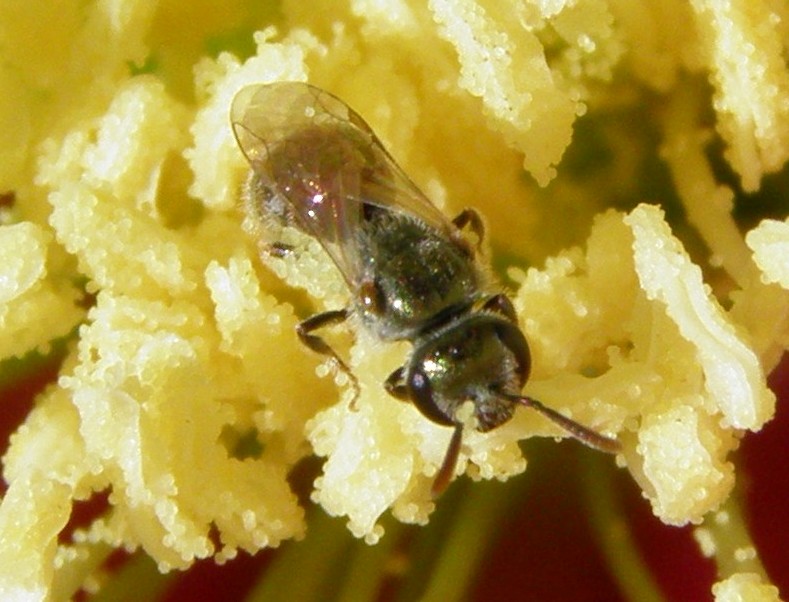
Lasioglossum sp.
 Bees of all sizes are visiting. This small, partly metallic one will hopefully be identified by Monday. 
P. s Thanks to John Asher on Bug Guide: he identified the genus as Lasioglossum.

Cactus Bees,  Diadasia sp.
Cactus Bees, genus Diadasia hectically buzz from flower to flower and dive deeply between the stamina. Males refuel with nectar, females collect pollen for the brood in addition. Often, before they fly off again, they seem to hesitate and wait motionless. That's the moment when males will suddenly pounce on the females.


So this is how the Diadasia couples meet. They share their dating grounds with many other hopefulls. Just check out the depth of the flower behind them, the red and black wing pattern belongs to one of the beetles below

Clerid beetles Trichodes ornatus
Clerid beetles Trichodes ornatus come, like the cactus flowers, in red and yellow. But they don't have to match their back ground - the red ones look deceptively like a blister beetle that flies at the same time, the yellow ones imitate wasps.


The two color morphs occur equally among the larger females and the small males, and there seems to be no mating preference related to color. Still, three is a crowd.


Bruchid Mimosestes amicus
Bean Weevils can be found in cactus flowers but they may just be resting while searching for leguminose flowers where they lay their eggs.

Listrus, a dasytin Melyrid
Dasytinae forage wherever there is a lot of pollen. With their dense hairy coats they make good pollinators.


Where so many insects come together predators will also hang around. Here is one predator stalking another. But the little jumping spider did not attack the tiny Attalus, his aposematic colors  may have warned her off.

Staghorn Cholla Trichopuntia versicolor

Prickly Pear Cacti (Opuntiae) and their close relatives, the Chollas (Cylindropuntia or in older literature still also Opuntia) dominate our Sonoran desert with an abundance of species. Every day seems to bring new color schemes. But the flowers are all very similar in their simple architecture and they are visited and pollinated by the same army of insects.

Friday, April 22, 2011

No tourists were harmed in the making of this video

Add caption
 We, or rather our dogs, are finding several rattlers a day now. Check out the videos on flickr.

http://www.flickr.com/photos/margarethebrummermann/5643727609/in/photostream

http://www.flickr.com/photos/margarethebrummermann/5644161230/in/photostream/

But watch in full screen mode and turn on the sound!

Monday, April 18, 2011

A vey localized population explosion of Eupompha elegans


Around Tucson, we didn't get many Blister Beetles (Meloidae) this spring. They feed on flowers like lupines and desert chicory, but these annuals simply didn't bloom this year. Even the perennial Brittle Bush, Encelia farinosa took the year off in most places. But the bushes on our patio, protected from the worst of the February freeze and slightly irrigated year round, were covered in flowers and all insects put on a great show.


Eupompha elegans usually appears in March and nibbles on the flowers of all available Asteracrae. It's a pretty beetle and I'm always happy to see a few.


This year we experienced one of the very localized population explosions that are so typical for Meloids. There wasn't a single Encelia disc that wasn't occupied by one or two of the beetles in our backyard. While I took picture they landed on my arms, in my hair, in my face - not too pleasant considering they are blister beetles. But I didn't squish any and they didn't give me any blisters. They just munched yellow Encelia leafs, mated and left orange spots behind wherever they landed. At the beginning of April the beetles vanished when the last Encelia flowers wilted.


I didn't find any Eupompha elegans outside our little Brittle Bush patch, not even in Sabino Canyon. My friend Robyn Waayers posted one from California, and hers is of a different subspecies that does not show the red banding that is so typical for our subspecies Eupompha elegans perpulchra (the elegant and especially beautiful Eupomphas)

E. elegans elegans from Borrego Springs (Photo R. Waayers)

Friday, April 15, 2011

It's a Wasp, it's a bee, it's a fly, it's Ripiphorus vierecki!


The campus of the University of Arizona is very poor of native plants. This is difficult to understand given the very interesting and enduring plants that are available for gardening in our desert environment.  The U of A should be a trendsetter in the field of water conservation and xeroscaping, but instead there are beds of petunias....


But a few Desert Marigolds (Baileya multiradiata) escaped the gardeners' scrutiny and keep reseeding themselves in little patches around Old Main. Yesterday on my way to lunch, I was looking there for bees to photograph.


While zooming in on some nectaring Leaf-cutter Bee, I noticed another insect that  resembled the  bees in shape and size, but was hovering and bobbing up and down nearly in the fashion of a bee-fly.

Ripiphorus vierecki female
It didn't seem to be interested in the yellow discs of the blooming daisies. It approached instead everything that looked like a flower bud, including dried up old stalks. Then I caught a glimps of fanned antennae. Greek rhipis (ριπις) 'fan' + phor (φορα) 'bearing':  Eureka, a  Ripiphorus! (since my knowledge of Arizona beetle species is far better than my Greek,  the revelations arrived the other way round. So, scratch the 'Eureka!') But anyway, this does not belong to hymenoptera or diptera, but to coleoptera, this is a real beetle.  Ripiphorus vierecki is the species most commonly observed in the Tucson area.


I caught the beetle and took it back to the department, where the entomologists were dutifully impressed, but everybody else said 'yes, I see those all the time'. Hmm.

I did see a couple more Ripiphorus on my second attempt to get lunch, so I went on a diet for the day, and then I found another three on my way home on a patch of Desert Marigold on the west side of the Tucson Mountains. All were clinging to unopened buds. I looked again the next day, but all the flowers were blooming by then and there were no beetles, just bees.


There is a good reason for this. All the beetles I saw were females, ready to lay their eggs.  I the picture above the ovipositor is visible under the beetle. She is going to plunge it into the unopened Marigold bud and deposit her eggs just in time for the larvae to hatch when the composite flower opens. At this time bees will visit the fresh flowers, and the beetle larvae will hitch a ride to the bee's nest where they will live first as internal, later as external parasites of the bee larvae (Nomia, Diadesia and other spp.)

Male R. vierecki, Photo Greg Corman, Tucson
 Ripiphorus males have bigger antennae than the females, indicating that they find the females by sensing their pheromones. They have a very short lifespan and usually don't show up on flowers but instead frequent the nesting site of the host, waiting for emerging females. I had to borrow this photo from Bug Guide (Creative Commons G. Corman).


Literature: The Rhipiphoridae of California (Coleptera)
By E.G. Linsley & J.W. MacSwain
Bull. Calif. Insect Surv. 1(3): 79-88, 1951
Cite: 360547