Sunday, March 20, 2011

Local Birds, Exotic Plants


When we bought our desert property in August of 2002, there were areas around the house where nothing was growing but a spreading, raggedy little aloes. Our first instinct was to remove them and replace them with native plants. But we had 10 acres to take care of and didn't get around to it until winter. Flower stalks were pushing up by then. Coral red and delicate, but braving night freezes and drought. The hummingbirds loved them...so did we.


Our neighbor Thea brought us a trunk-full of plants from her garden, mostly cactus clippings and agave pups, but also a different species of aloes. These were taller, not spreading, and in March, they produced long lasting yellow flower stands. The Gila Woodpeckers delicately extracted nectar ... and we were getting hooked on aloes.


 At the Boyce Thompson Arboretum and at Tohonochul Park we discovered larger species like Aloe ferox. The friendly owner of Bach's nursery gave me a free six-pack of rather overgrown, root-bound Aloes that would become some kind of tree-aloe if they survived. Two got eaten by bunnies, one was too far gone when I got them, one froze during another cold winter, but two did get so big that Randy started calling them Audrey. Right now, they are about 5.5 feet high, including the flower spike.

Aloe marlothii
The botanical name is Aloe marlothii, or Flat Flowered Aloe. According to an online source  they are hardy to 20 degrees F. This winter severely  tested that, but they both survived several nights of 18 degrees. While most of the fleshy leafs lost their tips to frost burn, the rapidly growing flower spike never even seemed to slow down. 

Bullock's Oriole

The flowers open slowly, starting at the bottom, and for the next two weeks, there will be new ones every day. Traveling Bullock's Orioles can use the refreshment on their trip north.


Hooded Oriole
They have to fight the just returning  Hooded Orioles for it, and these usually win. Here's a link to  our resident male enjoying his treat.

Gila Woodpeckers also like the tree aloes
 Aloes are natives of Africa. They may look similar and are adapted to similar arid, hot, sandy habitats as our local agaves,  but the two genera are only very distantly related. Aloes bloom every year and not just once in a lifetime like their American counterparts which makes them great for a desert garden with little color in early spring. (but we do have great penstemons also)

Since birds and insects don't seem to discriminate against the transplants, we enjoy seeing them blooming in our yard when little else does. But we keep them confined to the 'gardeny' part of our land close to the house. We collected some seeds from each blooming cycle. The seedlings are now 3 (right) and 2 years old and still in pots on the window sill.


On the outlying parts of out property, we preserve and plant strictly native vegetation, even avoiding Mexican and South American succulents and cacti. As a result, we got through the cold spell of the last winter with minimal losses and it is great to see how everything is getting ready to bloom now.
                                           All we need is MORE RAIN!!

Thursday, March 17, 2011

Mating Season for Urban Raptors

Old Main of the University of Arizona
It's spring break. The campus of the University of Arizona is eerily quiet for this week. But every morning when I pass the big old pines framing 'Old Main' I am startled by a crescendo of loud, nasal bird calls.
Today I watched as a small male Cooper's Hawk carried his prey first to the trees at the fountain, listening to his mates impatient  'gna-gna-gna-gna-gna' call, stepping from one foot to the other and waving his bent neck indecisively from left to right.


Then he finally flew across my head to join his mate on a big branch right in front of the windows of the Social Sciences building.  Impressive how much larger the female is! By the time I finally remembered that I was packing (a camera) today, the prey had already changed owners and the little male was about to go hunting again. The female devoured every bite of the gift and had no objections to my filming.

Again, the flickr quality is much better, so please click here to see her feast.


This courtship feeding obviously plays a role in the bonding of the pair. It also allows the female to judge the hunting capabilities of her mate. This will soon be very important when she is tied to the nest for laying and incubating the eggs and also later when she stays with the young nestlings to feed them the prey that the male has to deliver.  Only when the nestlings are quite grown does the female start hunting again - and then she goes for much larger prey than the male.


Now I'm hoping to observe these two nest on campus. They will have to deal with much more traffic when the students are back, but I remember an Osprey pair on the U of Florida campus in Gainesville, that every year raised their young successfully. Of course, their nest was guarded by the  campus pond gator.

Wednesday, March 16, 2011

Under dry Cow patties

Spring is close here in the Sonoran Desert, but this year, there are hardly any flowers or fresh leaves yet. But by now I get desperate for small critters to photograph. So I turn over old, dried-out cow dung. There is very little wood on the ground and rocks are neatly embedded into the loose desert sand. So old cow pies is where everybody is hiding!
Today I found spiders and scorpions, centipedes, termites, some few caterpillars, true bugs, weevils and ground beetles. Once last year I found a really rare Oil beetle.


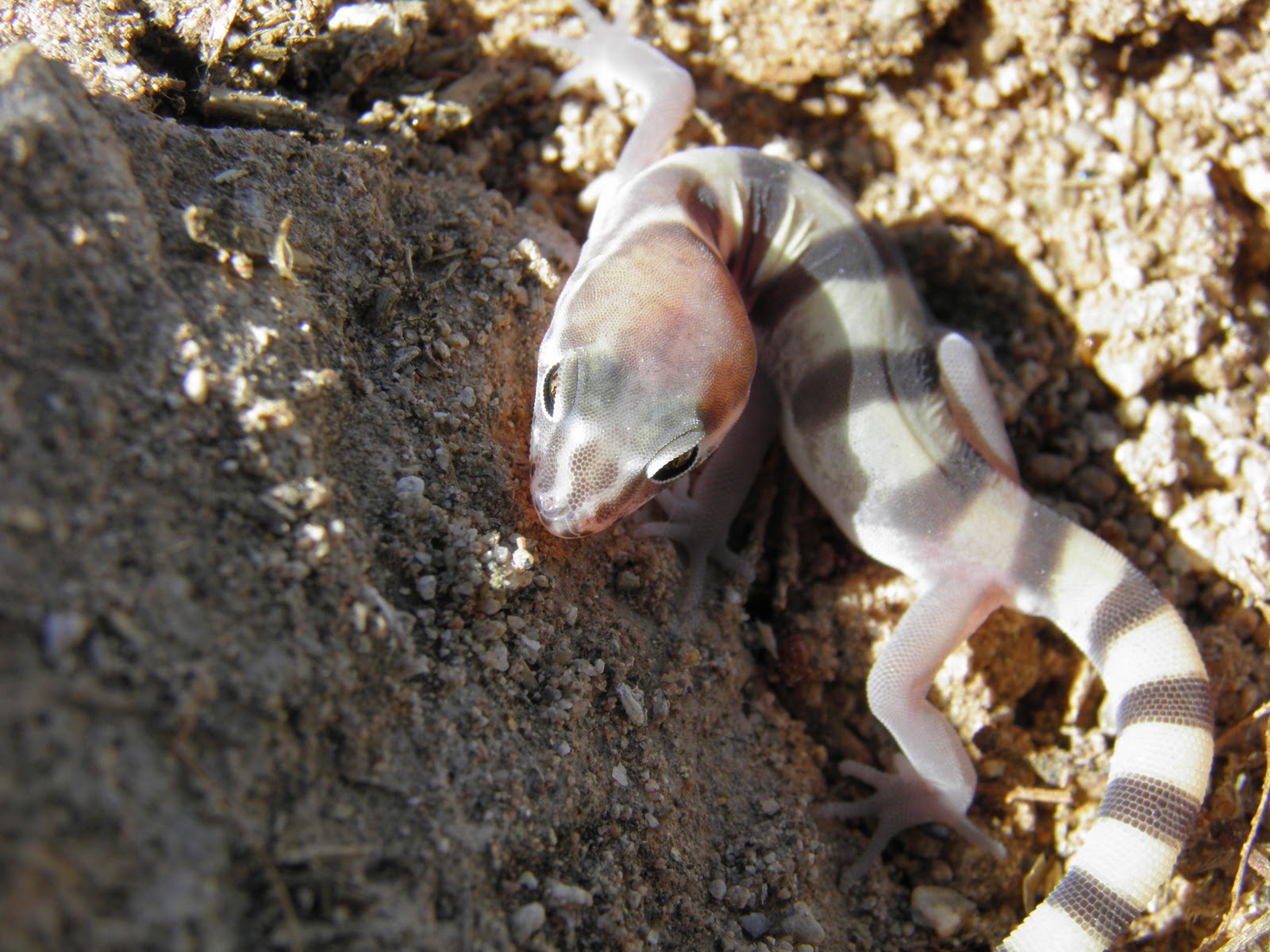
Today's nice surprise was a vertebrate: A Western Banded Gecko. He was very patient with me exposing him to the sun for a few pictures and a video. Usually they just scuttle away into the darkest corner they can find. This one was big enough to be fully grown, but like many of his kind in southeastern Arizona, he had retained the juvenile banded pattern. Western Arizona relatives sport rows of spots rather than bands.


I uploaded the videos to flickr, because I got the impression that the quality is better than if I load it directly to the blog. It's still just one click away, enjoy!

Tuesday, March 15, 2011

I yelped, but I didn't flinch


Edrotes ventricosus, a confirmed vegetarian. Or is he?

Monday, March 14, 2011

Darkling beetles (Tenebrionidae) in the Dunes of Western Arizona

 At the end of February, Charlie O'Brien and I went on an early collecting trip to the dunes of western Arizona, from Yuma and San Luis in the south to Parker and Bouze in the north. After the cold spell in early February,  desert annuals were only sprouting and most bushes and perennials were just coming out of  dormancy.


Dune along the Gila River north of Yuma

Besides Charlie's target group, Curculionidae,  we found mostly Tenebrionidae or Darkling beetles. In American Beetles, Vol 2, Chapter 106, the authors describe the Tenebrionidae as highly evolved and diverse. In fact, they state that because of the many exceptions that exist in most diagnostic characters, these beetles are often difficult to recognize as a family. A tarsal formula of 5/5/4 and a facial ridge covering the base of the antennae is common to most, but not all of the family members. On the other hand, many beetle collectors assume jokingly  that any beetle that doesn't obviously conform with any other family is is most likely a teneb (nick name for Tenebrionidae). The following links represent some examples from Bug Guide, showing tenebs looking deceivingly like June Bugs (Scarabidae), Ground Beetles (Carabidae), Flat Bark Beetles (Silvanidae), and even Lady Bugs (Coccinellidae).

Below is an assortment of 'typical' Tenebs from Arizona.


Some Arizona Tenebs (not to scale)

With 20,000 species, Tenebrionidae populate most parts of the world. They feed on fresh and decaying plant material, which includes grain products in human storage. Easy to raise and feed, adults and larvae (meal worm) have become popular as laboratory animal models and as  food sources for insectivores in captivity.

Tenebs occupy moist forest floors and dark corners under rocks and bark of decaying wood and are freeze resistant or  freeze tolerant even during arctic winters. But undoubtedly, this family found most of its adaptive niches in hot, arid and sandy habitats. Very striking adaptations can be found from the Mediterranean to south African and Asian deserts and of course also in the Sonoran and Mohave Deserts of Arizona.


Eleodes longicollis, Madera Canyon
Surprisingly, many of these desert species are dark and easy to spot on the light sand, especially since most of them become active by early dusk.

Tenebs use several strategies to deter predators. Besides being very good at playing dead, many of them can emit a pungent smell. They announce with a clear behavioral  signal (head stand) when they are going to use this chemical defense. The avoidance reaction of predators must be strong, because there are several non-teneb dark desert beetles that join in on this defense  with Muellerian (Ground Beetle Calosoma peregrinator) and  Batesian (Cactus Longhorn Moneilema) mimicry. To humans of the Southwest, the teneb species are generally known by the popular names Stink Beetle and Pinacate Beetle.


Meal leftovers of a Grasshopper Mouse 


Still, some predators do specialize in hunting the big beetles as a substantial prey. Coyote scat and Sonoran Desert Toad droppings are often full of their exosceletons. Grashopper mice simply stuff the offending hind end of a Stink Beetle into the sand and then chew off its front portion.


Eleodes armatus stored by a Shrike


Most birds do not have a well developed sense of smell. A shrike took this Eleodes armatus and stored it on a pointed branch for a later meal.


Interestingly, the beetle's head-stand that serves as a warning to predators here in Arizona is used by Namibian Tenebrionids to collect fog-moisture. Our local beetles, also suffering from water deprivation, may or may not employ the same mechanism, but dew and fog are  less common here than in the coastal South African desert. Instead, all teneb bodies are superbly built for water conservation. Collectors soon learn how well the carapax of a teneb prevents evaporation even after death. While all other pinned beetles of the same size are long since dry and ready to be stored in insect drawers, the legs of pinned tenebs seem to remain endlessly flexible and the retained moisture sometimes causes the insect pins to rust and break.

Edrotes ventricosus, Mohawk Dunes, Yuma Co.

Shapes approaching  the ideal of a round disk or better yet, a sphere, optimize the surface to mass relation in Eusattus and Edrotes species and thus minimize water-loss.

Eusattus reticulatus, Molino Basin, Catalinas, Pima Co.


Eusattus dubius arizonensis, Kofa, La Paz Co.


Interestingly, the Eusattus species from a moister location at a creek bed in Kofa is not quite as disc-shaped as the Eusattus reticulatus from dry, sandy areas of Molino Basin in Tucson.  


Asbolus verrucosus and Asbolus laevis


Some teneb species have thick wax coatings, but their smooth black relatives seem to be just as heat and aridity tolerant.


In dune habitats, many insect species burrow into the sand during the day to escape from heat and predators. Sifting dry sand through fine sieves is a successful collection method. The best place to start seems to be  the area around Burr Sage and Creosote bushes, especially under hanging branches that touch the soil.


Edrotes arens and Trichiasida hirsuta are covered in soft hair

Many of the insects found by sifting show special adaptations to burrowing in shifting dune sand.  We collected several species of Burrowing Bugs, Weevils and Darkling Beetles that are covered by coats of soft hair. This feature seems to help them to 'swimm' through the loose fine sand while keeping the grains from clogging the tracheal openings (spiracles) needed for respiration.


Cnemodinus testaceus and Notibius puberulus

  The tibiae of these little tenebs found by sifting under Creosote bushes show adaptations to their burrowing lifestyle. The tibiae of Cnemodinus remind of the dentate tibiae of many Scarabs that also burrow underground during the day. Notibius also has widened, shovel-like tibiae.


From left to right: Helops sp., Embaphion depressum, Helops sp., Parasidina hispicula, Metoponium ? sp.
A single Parasidina hispicula under dead wood and several Blaps and Helops-like beetles caught in a pit trap,  plus the  elegant little Ambaphion depressum that was found dead,  brought the number of teneb species for this early spring dune trip to thirteen. Not bad for an area with on-going night-time freezes, still nearly devoid of fresh vegetation.

I like to thank Prof. emerit. Charlie O'Brien who knows all the locations and who did all the driving and sifting, and Kojun Kanda Ph.D. and Aaron Smith Ph. D. for their help with identifications.


Sunday, February 27, 2011

Desert Snow


View from the house towards Wassem's Peak in the Tucson Mountains.

A storm came through last night and we woke up to a cloudy sky and snow cover starting just above out own level of 2400 feet. Our rain gauge showed 4 tenth of an inch, more than we've had so far this year.
A little higher up on Kinney Rd in Saguaro National Park West to wards the ASDM one side of all Saguaros was outlined in white. Already dropping off in big chunks. 

  
View towards the western mountains. This storm blew in from the San Diego direction.


View through Contzen Pass in the Tucson Mountains at the Catalina Mts where the snow cover seems to reach all the way down to Orovalley.
We'll head out into the western and north-western dune areas (AZ and CA) tomorrow to collect insects. This weather system was cold, but it also delivered the moisture that many dune species need to break their diapause, so it may be interesting.

Thursday, February 17, 2011

Marana Stock Auction

Cattleman's Breakfast at the Stockyard Cafe - our neighbors invited us to experience the true Arizona. It smelled a little of cows and mostly of clean hay and straw - this is not one of the feed lots where cattle is fattened before it is slaughtered and stands for weeks in its own muck (I know why I don't eat beef).


Here in Marana the local ranchers buy heifers for breeding, roping calfs, bucking bulls, and cows to turn out on the range to breed more roping calfs, bucking bulls.... Of course, the flat, fertile Avra Valley along the Santa Cruz River is also home to herds of heavy, healthy Black Angus cattle.


 The cattle in the holding pens before the auction could have provided the German Brothers Heck with all the genetic material they needed in their misguided attempt to recreate the extinct 'Auerochs', ancestor of most modern breeds of cattle.


There were cattle descending from French  Spanish, English, German, Indian, and African breeds, even some that seemed to have the brooding profile of the American Bison. They were mostly munching peacefully at long troughs.


 A few cowboys where milling around,  skillfully maneuvering their horses while opening and closing the hundreds of gates to move groups of cattle quietly from corral to corral  into a narrow, rotating  system of wall and gates that led across the scales and  into the auctioning arena.


 Inside rows of seats rising towards the back reminded me of a university auditorium (they didn't look comfortable enough for a movie theater). By the time the auction began, most of the seats were taken, and mostly by ranching people. Not many tourists here.


 The auctioneer kept up a continuous  flow of repetitive syllables, interspersing it with few understandable words. Still, after a while I was absorbing the information about the shown animals as well as the bidding steps without being able to consciously understand anything. It turned out that some of my American-born companions understood even less.


I had told my colleagues at the entomology department that I couldn't come to work today because I was buying a donkey for our planned bug-collecting trips into the Rincon Mountains.  I did actually find two very nice looking donkeys at the auction. But, to Randy's and our neighbors' relief, they turned out to be the resident mascots and not for sale.


So Cody, hop right back into the car. You don't have to make room - this time