Showing posts with label Saguaro. Show all posts

Thursday, June 12, 2014

Fire Ants in Arizona: No Reason to Panic

Solenopsis xyloni (Southern Fire Ant)
Two days ago we woke up to Fire Ants marching across the kitchen counter (after hummingbird food had been prepared there the evening before). A thorough scrubbing of all surfaces will convince them to stay outside, I hope. No new arrivals for a couple of days at least.

Polymorph workers: many different sizes
 On the brighter side, these are our little native Solenopsis xyloni (Southern Fire Ant), not the feared introduced Red Fire Ants, S. invicta, that I met in Florida on my last night of gator watching that left me literally scared for life.  

But our little guys can sting too. When they come to my black light at night to tackle any small scarab that falls and lands on its back, they sometimes also get my toes. They seem to always plan their attacks until several are in position ... just like their bigger relatives in Florida. Their stings burn and itch but are really just a minor irritation. In our kitchen they were so docile that I first doubted my identification. No attempts at stinging at all.

Tackling a Minute Black Scavenger fly
But outdoors they are voracious and attack insects much larger than their size and manage to subdue them. So I assume that the crack in the kitchen wall (?) that they must have found is now free and clean of any other bugs. OK. Just stay off my counter and the floor!

Southern Fire Ants in the compost bin
In the backyard, I have noticed a belligerent colony close to the compost bin. We have lots of space, so this is far from the house.

Southern Fire Ant on a barrel cactus fruit
Solenopsis xyloni are also usually found on barrel cacti. To get the photo for this blog I just pulled a fruit from a barrel in the front yard and immediately had a couple of volunteers. I knew this would be the case because I'd seen the ants on barrels even in winter when I was looking for nymphs of leaf-footed bugs that develop on cacti.


At this time of the year saguaro cacti drop their fruit. Birds have been feasting on the sweet seed pulp before the fruit falls, but there should still be enough left to make some ants happy. Under a free standing saguaro, I found some of those fresh bright-red stars. There were some very small extremely fast-running ants, a Pheidole species I believe, but no Fire Ants. Do they not like saguaro fruit? Or are their colonies simply too far from this cactus?

At nigh at my black light site: Southern Fire Ants taking apart a scarab beetle and gorging on sweet saguaro pulp
 To test my theory I moved a few of the fruits to my black lighting site because I know that Solenopsis xyloni lives around there. I turned on my lights for some hours after sunset (a gorgeous one with virga, rainbow, red clouds and early moonrise).
 When I returned the Fire Ants had performed to expectations: not only did they overpower a small scarab beetle (Acoma sp.) and were just testing the resilience of a much larger Oxygrylius, they were also all over my saguaro offering.   

I know that the time of day and temperatures also play an important role in an ant's activity, but I did find Solenopsis xyloni active in the afternoon on the barrels but not the saguaro. Since they obviously love the saguaro fruit, I am back to my idea that there simply is no colony close to the free-standing saguaro.  Why?
To the human eye areas around the barrels and the columnar giant looks quite similar. So is it the cacti themselves that make the difference? Their yearly cycles are quite different. The saguaro blooms in April/May, and has fruit in June. As far as I can tell, those are the only times when saguaros have anything to offer to ants.

Barrel Cactus, this year's flowers and buds surrounded by last year's fruit
 By contrast, the  thick-walled fruits of the barrel stay on the plant, often for years, so several 'generations' of fruit are constantly present, arranged in rings around the center that keeps producing new flowers once a year, in July/August. Eventually the fruit are chewed open by rodents and the seeds disappear, many carried away by ants that are collecting the sweet sticky pulp.
  Barrel cacti also offer sweet sap from extra-floral nectaries all year round. It could be that the barrel cacti (via coevolution) are 'making sure' that ants have a reason to hang around. The cacti may be employing armies of little fighters for their protection against other bugs and the distribution of their seeds by offering them sweets. I have seen the ants attack cactus-juice-sucking coreid nymphs in several cases.

A jumping spider killing a coreid nymph on a barrel cactus
It is possible that barrel cacti rely overall more on arthropods as allies than saguaros do. Saguaros have many avian house guests that nest in or on the cactus or feed on nectar and fruit pulp. Many of them are insectivore gleaners like cactus wrens that also peck many insects off their host's thick skin.
Barrels are very vulnerable to rodents so they are tightly covered by a mail of interlocking thorns. This formidable defense may keep many birds from spending too much time on a barrel, and at any rate barrels are not tall enough to provide protective spaces for nests. Ants and spiders however have the ideal size and agility to police that space under thorns and between ribs. 

 Both saguaro and barrel cacti eke out a living in spartan surroundings. There is not much more than sand, widely spaced creosote bushes and cholla cacti. Under these borderline conditions the reliable yearlong provider may win out over the once-in-a-year party host when the opportunistic Fire Ants are choosing a neighborhood to live in.

Pheidole sp. left and Messor pergandei right. Colonies close to the saguaro
 I am not saying that the saguaro neighborhood lacks ants: besides the Pheidole colonies, there is a huge permanent Messor pergandei colony. But those ants have a completely different social, foraging and storage system than the Fire Ants. 

With this blog, I would like to stress that not all ants are alike, every species has its own ecological niche, and not even all Fire Ants are alike. The imported, highly invasive Red Fire Ants are established all the way from Florida into Texas in the east and  in California in the west. But they need more moisture than they would find in southern Arizona and they may be too frost sensitive to live on the Colorado Plateau in the north. So they may never overrun Arizona.

Living with ants (and you will, if you live in Arizona) is easier and far more interesting if you learn about the different types, one species at a time. Theirs is a densely populated and highly socially organized world to discover.

Please do not contact me about methods 'to get rid of ants'. I have no experience in that field and - beyond my own kitchen counter - no interest in gaining any.


Wednesday, March 6, 2013

Mating season for backyard raptors


Prairie Falcon photo by Ned Harris
This morning we watched an aerial ballet high in the sky above our backyard. A falcon was soaring, but with his feet hanging down, then banking, spreading his tail feathers, diving a little, catching himself again...I first thought that it was a Kestrel hunting insects. But when Randy brought my binoculars I recognized it as a bigger bird, a Prairie Falcon. He kept circling, diving and banking for more than 5 minutes and was finally joined by his partner. They circled together and then sped up towards Panther Peak.


 We don't seem to have an American Kestrel pair in our saguaro this year, but we sometimes hear  mating calls and see the male fly over. They are probably nesting in the State Land to the north.


Our Dark Female, the Red-tailed Hawk, has flown over a couple of time too, and now she is settling in the Saguaro nest that she used two years ago, she seems to alternate nests regularly. Both sites are along a wash in the state land, only about 300 feet apart.


Great Horned Owls are hooting at night from the Twin Peak on the east side of our land. We found a dead one this winter, but there must be a resident pair again.
 We also found a dead adult Harris Hawk. We have no power lines here that could electrocute them. I hope they aren't dying from an environmental poison. High in the food chain, raptors are always at risk.   


The Cooper's Hawks are also getting territorial. For the first time ever I saw the female go very aggressively after a juvenile Red-tail that likes to hang around.
We also have a ghost, a silver grey male Northern Harrier, but he only visits regularly every winter and then disappears for the breeding season.
With all those raptors getting ready to breed, we are hoping for enough rain to keep the land green and productive. But does the next storm have to hit right during my next art show in Dove Mountain? On my birthday???


Tuesday, January 17, 2012

Of Cactus Flowers and Fruit

The flowers of chollas, prickly pears, saguaros, queen of the night and barrel cacti are strikingly beautiful but delicate and very short lived. If an individual bud opens in the early morning or even at night the flower will begin to wilt by noon with raising temperatures or even as soon as it is pollinated. If it lasts till nightfall it will most likely not open again the next day. There are cacti which go through their whole annual blooming cycle within one night and a short morning like the night blooming cereus, but most species produce enough successive flowers to keep the bloom going for a week or more. It doesn't matter how long it lasts: the bloom of the Sonoran desert cacti is a beautiful spectacle that we celebrate every year. It is also a reliable fiest: the succulent cacti are able to faithfully produce flowers even in drought years when the showy and celebrated annuals of the desert like poppies, lupines and Owl Clovers have to skip the year.

Santa Rita Prickly Pear: Only a few of these pears will ripen.
At least some rain is necessary for the cacti to follow the bloom with the more costly production of fruit. If it doesn't rain enough for too long even the fertilized flowers will just shrivel up and fall off. But in years of at least average rainfall the fruit of our desert cacti are not only at least as beautiful as the flowers but many also last much longer.


Saguaro Cactus
Carnegiea gigantea - Saguaro Cactus
After the bloom in June, Saguaro fruit grow very quickly. They stay plain green on the outside. But as soon as they are ripe in late June they burst open to form a bright red star that advertises the sweet pulp and thousands of tiny seeds to birds and insects.

StellaTucker (Tohono O'odam) harvests Saguaro fruit by pushing them down with a 12 foot pole made from Saguaro ribs
Generations of Tohono O'odam have collected the fruit to brew ceremonial wine. Midsummer dances of this tribe are a plea for good, life spending monsoon rains. By the time the storms arrive, Saguaro fruit are usually gone from the cacti and the seeds distributed by everybody who enjoyed the sweet snacks.


Mammillaria

Mammillaria grahami - Arizona Fishhook Cactus
Pretty much exactly 8 days after each summer rainstorm all our tiny Mammillarias wear crowns of pink flowers. Shortly later they produce small red-pepper-like seedpods. Just the right size to be carried away whole by Trashers, Cactus Wrens, Squirrels and even ambitious Harvester Ants.


Night-blooming Cereus

Peniocereus gregii - Arizona Night-blooming Cereus
The beautiful Queen of the Desert Night chooses a warm night in June or July to open its flowers and fill the desert with its sweet heavy fragrance. Mysteriously, all plants in a certain area appear to be synchronized, while other groups, at only about ten miles distance, follow their own internal signal. Temperature, moon phase or humidity seem of little importance, or their interaction is so complex that I don't understand their impact. Anyway, every year I scout for new plants in the desert around our place during this spectacular night. This cactus is thin-branched and much less succulent than others. Instead, it has a big underground bulb to support it during drought years. Some plants dry up completely and rest for years before they thrive out and bloom again.
Elongate big fruit develop from the pollinated flowers. This year the Pima County gardener asked me for seeds, so I covered a fruit with a paper bag. While the woodpeckers made holes into the other fruits and harvested the seed pulp in mid September,  the protected one kept growing until I lost patience in late October.


Prickly Pear

Opuntia engelmanii - Engelman's Prickly Pear
Desert Tortoise Photo by Doris Evans
Prickly pear Cacti bloom in late March and their fruit grow and ripen up to the end of summer. In good years a big Engleman's Opuntia can produce many pounds of purplish plum-sized 'pears'. They sit in tight decorative rows on the pads until in late September finally Gila Woodpeckers, Fig Beetles, ants and bees dig into the juicy flesh. Fruit that fall off are gobbled up by Desert Tortoises and Havelinas. Our neighbor boils prickly pear juice and jam, mustard and salza in big purple stained pots. With the harvest of the prickly pears, the bounty of summer is mostly gone.


Barrel Cactus

Ferocactus wislizeni - Arizona Barrel Cactus
Cacti that produce their fruit later in the year tend to hold onto them throughout the winter months. A bright yellow crown of fruit on often shoulder-high barrel cacti is a great sight when all other desert colors are rather drab. The fruit are nestled among formidable hooked thorns. Only the most daring squirrels and woodpeckers break some of them loose before their time.

Barrel Cactus seedlings 
The cactus is holding on for a good reason: The seeds, though ripe, will not germinate when it isn't warm enough. We spread seeds last year in December on moist sand in a container on the window sill, and they were just sitting there through the winter to finally produce little cacti at exactly the same time as some other seeds that we put out in March. The March seeds germinated after three weeks in the sand box.


Cholla Cacti

Cylindropuntia spinosior – Cane or Walkingstick Cholla
Cane Cholla fruit also stay on the plant during the winter months. Their bright yellow color stands out against the clear blue sky. Winter visitors often insist that they saw blooming cacti on their hikes in December.

Chain Fruit Cholla - Opuntia fulgida
The Chain-Fruit Cholla drives holding on to its fruit to the extreme. It simply never lets go, so after every blooming season more fruit are added to the ones already hanging on the branches, forming long, dangling chains. I have to cut one open: I doubt that there are seeds inside. Instead, those green fleshy members increase the photosynthesis-surface of the cactus just like leaves would. This cactus is one of the jumping chollas, and spreads its offspring by enlisting animals and people to carry broken-off pieces into new territory (zoochory). This vegetative propagation produces clones of the originals, rather than new plants. 


Christmas Cholla - Cylindropuntia leptocaulis

I like the fruit of the dainty Christmas Cholla best. Unassuming but pretty little star flowers appear in late summer, and the fruit cling to the thin green branches like red holiday decorations just around Christmas. They are juicy and sweet like strawberries. Of course, they don't last too long when they are ripe.

Monday, May 30, 2011

Dark Female


If you have seen the movie 'Pale Male', about the light colored Red-tail that was the first of his kind to breed in New York's Central Park, you have an idea of what I mean if I say that our raptor here is exactly the opposite of that hawk: our Red-tail is very dark, very unused to humans, and lives under extremely harsh conditions. For all I know, she may be female. But she also seems to be a pioneer, just like Pale Male.

Around our house we have a breeding pair of American Kestrels, a group of Harris Hawks, many Cooper's Hawks, a hunting Peregrine Falcon, a visiting Prairie Falcon, and a wintering silver gray Northern Harrier. They share the habitat with formidable and dangerous competition: there's always a pair of Great Horned Owls around. And there is neither water and nor a supply of feral pigeons.
There are Red-tail nests along the Santa Cruz River and in lusher parts of Saguaro National Park, and the hawks come through our part of the desert regularly, but I've never seen the aerial shows of mating pairs here.


The first indication that  Red-tails were moving in was an abandoned nest in a saguaro with no sign that it was ever occupied. We checked ever now and then, but nothing changed: no fresh twigs, no whitewash....


Only once in late January I caught a glimpse of a pair of Red-tails on the power line at the far side of the 400-acre state land.


 Then a dark silhouette appeared a couple of times high above us while we were walking our dogs. When the tail caught the sunlight it flashed in striking, bright orange contrast to the clear blue desert sky. But nothing ever happened at the old nest. The bird seemed protective of the area though, and we mostly stayed away.


On this fresh cool morning (after a spell of near 100 degrees) we were going to give our dogs a special treat - a long walk through the state land. No hawks in the sky yet. The dogs watched Zebra-tail Lizards scramble out from under a thin cover of sand and scurry away, dug feverishly for squirrels, looked longingly for traces of cattle ....We passed the empty old nest, picked up some trash, collected some nice rocks, and inadvertently stepped over a rattler who completely ignored two shoes and eight paws coming within inches of his low-profile coil.


When I looked up, Randy was standing next to a saguaro, and right over his head the shape of two or three small hawks in a big nest were outlined and back-lit by the rising sun. They stood completely still, and so did we. Two of the nearly grown chicks had  light chest feathers. Harris Hawk or Red-tail? We memorized the location and rushed home to get cameras and our friend Frank who wouldn't want to miss this.


 Returning a little later we were discovered by the dark hawk. She circled. Banked right above our heads. Screamed at us. She is definitely not used to people walking her territory, and let us know her displeasure long before we came close to the nest.


Staying at a fair distance, equipped with very long lenses, we walked in a wide circle to get the sun behind us. The nest is on the west side of the Saguaro, nestled in its massive arms. Until noon no possible angle would allow a clear view of the inhabitants without looking into the sun. I wonder why it's so exposed to the afternoon sun, the hottest around here. The wind blew sharply out of the west all day yesterday, as it often does. But the other, unused, nest has the same orientation.


 While we were there, the chicks never moved. They are tall and leggy and already have lost all of their downy  fluffiness. One is as dark as the parent, one has a light chest - did I only imagine a third one earlier?


 While  female hawks stay with the nest and the young while the chicks are small, leaving all the hunting to the male, both parents would be hunting to provide enough for the hungry beaks of chicks this big. I'm worried because there was only a single parent around. The urgent calls should have alerted the other partner. Shortly, the hawk was joined by another big soaring shape, but that one turned out to be a Turkey Vulture. Still no sign of another adult hawk, but time for us to leave them in peace.

Monday, May 16, 2011

Non-insect Pollinators of Saguaro Cactus

Backyard Saguaros
Saguaro Flowers, Watercolor, M. Brummermann 1994


 In May, Saguaro Cacti form crowns of flower buds on the ends of arms and the main stem. The crown is actually a spiral of more mature buds on the outside, and smaller ones closer to the apical growth spot. The flowers open up a few at a time, so the bloom can go on for several weeks. Any individual flower opens during the night and rarely lasts longer than until noon of the next day. By then the waxy flower starts to wilt. It has almost certainly been visited by several pollinators since Saguaro flowers attract scores of very different animals with great amounts of pollen and nectar,

Lesser Long-nosed Bat visiting Saguaro flower at night. Photo:  Merlin D. Tuttle, Bat Conservation International
Famously, Lesser long-nosed bats, migrating through our area just when the Saguaros bloom, are considered a  main Saguaro pollinator. But I've yet to see them in our backyard, and our humming bird feeders are never raided by night, so I'm not sure whether they are indeed visiting our 20 or so mature Saguaros.


White-winged Doves seem to time their return from southern wintering grounds and their breeding to enjoy both the nectar and soon after the juicy fruits of our Saguaros.


Gila Woodpeckers don't just love the nectar and can often be seen with their faces smeared with pollen, they move right in with the Saguaro, hammering out a nest cavity.  The cactus stabilizes it with hard scar tissue, forming a 'saguaro boot'.


The Gilded Flicker, our local form of the Northern Flicker, is another woodpecker that is drawn to blooming saguaros. This photo shows how strong those flowers are, probably a necessary adaptation to bird pollination, especially when other landing options are so very prickly.


Noisy, raucous Cactus Wren families drop in from their nest in a nearby Cholla. Their youngsters often sit begging among the flowers, impatiently demanding to be fed by both parents. This year we have very few nests. I hope they recover soon...


Our breeding pairs of  Northern Cardinals and Pyrrhuloxias are unusual visitors, but love an opportunistic slurp of nectar.

Female Northern Cardinal
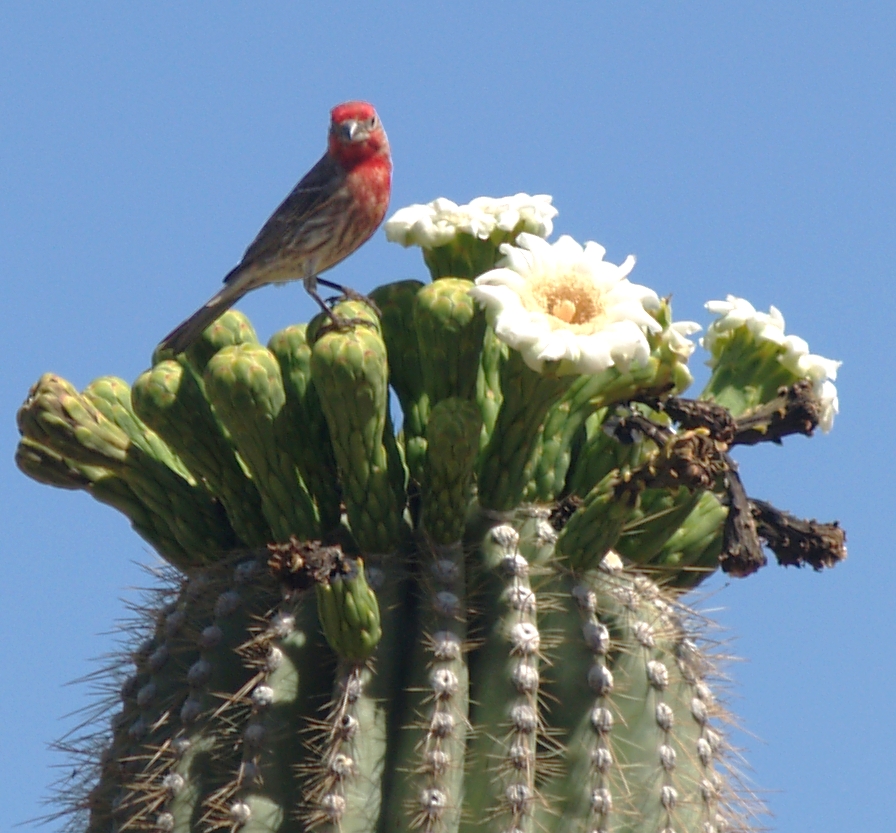
 Male House Finch


House Finches spend a lot of time at the nectar source, but then they are also great hummingbird feeder connoisseurs.


Aggressive Curve-billed Trashers love the sweets and also the dominating height that the saguaro offers, so the males alternate feeding with territorial singing.


But over the last years the Thrashers got powerful competition as our local Ravens learned to appreciate saguaro nectar. The social Ravens can often be heard telling each other when the sweets are served. Under their assaults, even some of the sturdy Saguaro blossom break off and tumble to the ground.

Saguaro fruit, Photo by Ned Harris
 Most flowers, pollinated by so many willing helpers, will develop into fruit within a couple of weeks. When the fruits ripen they stay on the cactus and burst open, forming  bright red stars. This is an announcement to all the sugar-lovers to come back, this time to help spreading thousands of tiny saguaro seeds.