Monday, February 25, 2019

Pollination talk, Part II Bees, Master Pollinators and Pollen Pigs


Carpenter Bee with loaded scopa
Most female bees, solitary as well as social species, collect pollen for their offspring. Great fliers, fury, intend on their task, they zip from flower to flower as fast as possible while filling their pollen collection areas on legs or bellies. 


Leaf-cutter bee, loaded with pollen on her underside
They usually concentrate on just one species of flowers at a time - it makes them most efficient. They gather as much and as fast as they can - to provide for as much offspring as possible. Pollen that actually reaches the next flowers stigma is wasted - from the bee's point of view. 

From the plant's point of view, bees may be the fastest and most reliable transporters of pollen between plants of the same species, but they also carry off most of the pollen for their own purposes.
Again, adaptive evolution on the plant's side: 
-we already talked about narrowed access to many flowers that at least excludes the biggest bullies. 
-Some flowers offer nectar, but their pollen is toxic or unpalatable, so the bees quickly get rid of it. 
-Have you seen cherry trees covered in blossoms, buzzing with bees? There are many 'blank' flowers without pollen or nectar among the ones loaded with both. So busy bees will happen upon those, and after a couple of encounters will be encouraged to move on to another tree - which also keeps cross pollination going.  
-Although pollen is usually sticky or statically charged to cling to an insects 'fur' many pollen granules have spikes that prevent the bees from packing it too tightly into their scopae, so hopefully some pollen will fall off to actually pollinate a target stigma.


Tiny fairy bee Perdita sp and giant Carpenter bee Xylocopa sp (photo Joe Wilson)

Of course, the dance of co-adaptation made bees evolve into  tiny fairy bees (Perdita) and gigantic Carpenter bees, and 4000 north American bee species in between. So bees slither or bite through the narrowest throats, became scent-hounds that can tell 'blanks' from a distance, adjust the density of transport hairs to carry the spikier grains and some even specialize in and digest the undigestable pollen. (after: The Accidental Pollinator by Joseph Wilson)


Poster by Joseph Wilson (available on his website)
Honey Bees, Apis mellifera, the imported competition


As an agricultural tool, Honey bees outrank most other pollinating insects. There are quite a few endemic bee species that have the right behavior and physical attributes to be as efficient, but, being highly social, honey bees are available in masses, active throughout the vegetation period, and, most importantly, transportable,  They are also not specialized, they harvest honey and pollen as opportunists. Honey bees can service most crop plants that are grown in huge mono-culture. We don't try to mass produce orchids in an agricultural setting.  So honey Bees are still the most useful species (group) from the human perspective. Their role in the natural ecosystem, however, might be much less positive and can probably be even detrimental where they are brought in by humans and become invasive, as here in the Southwest US. Honey bees can bully endemic bees and out-compete them. They may harvest pollen so thoroughly that not much is left for endemic species once a big hive of HBs has found a pollen source. Remember that this is mostly desert and flowing plants can be few. 
The fact that hives can be moved in and out of an area also allows for the intensive use of pesticides when the bee keepers have moved on. This heavy use of pesticides indiscriminately kills off local pests and pollinators alike.

New study shows strawberry plants 🍓 pollinated by wild bees result in bigger fruits than those pollinated by honey bees. Andrena (mining bees) are some of the most frequent visitors.

As for the question if HBs actively compete with native bees - to the detriment of the latter - see this video of HBs stealing collected pollen from the 'baskets' of a Sonoran Bumble Bee https://www.facebook.com/philipp.wickey/videos/10157772746482921/

Thursday, January 17, 2019

A tiny wasp with enormous numbers of descendants - Polyembrionic Copidosom sp.

I am still trying to keep my basil plant alive, through short days and some freezing nights. But most of the larger leaves are falling off anyway. So now several dry, rolled up ones became very obvious. Each contained a cocoon - similar to that of the green noctuid moth caterpillars that sometimes compete with me for the basil leaves.
But the cocoons were quite thin, likely unfinished, and inside was a rather repulsive looking, thick sausage with no recognizable organisation. 


Cocoons of noctuid moth caterpillars on basil. The caterpillars were killed by parasites
The casing was stretched thin enough to be transparent, so I could see that it was stuffed full of little grains, like rice, but each only less than 0.5mm long.


Under magnification, little eyes became visible on those white grains. So probably really parasites. Larval (or pupal) wasps rather than flies, because those eyed creatures did not look like headless maggots. 


Copidosoma spp, Pupae
But so many? I had never seen anything like it. So I posted them on BugGuide.net and my Facebook Group SW US Arthropods. 
Charles Melton and Dennis Haines had the answer quickly: 


Copidosoma spp, adult female
A Chalcid wasp in the genus Copidosoma (Pentalitomastix) was behind this amazing find.
The tiny, 1.5mm long wasp female produced just a few eggs, and probably even spread those among the three affected caterpillars that I found.  But she did not actually attack the grown caterpillar, she had laid her eggs early, right when a moth female deposited her eggs on my basil plant.
The wasp eggs multiplied then by cloning into as many as a few thousand (polyembryony). The larvae didn't begin growing until the caterpillar has reached a certain size. So they all uniformly ended up killing their caterpillar just as it was about to spin a cocoon and pupate. 
I collected two of the cocoons to see what will emerge. Dennis Haines remarked that these wasps are obviously interesting for researchers working on biological control, but they are difficult to raise in captivity. 
The sex of the larvae seems to be determined by temperature ... just one more fascinating aspect.


12 days after I discovered the caterpillar full of pupae, tiny wasps are hatching. This one is sitting next to some writing in font size 12, so you see that they are barely 1mm long.


A day later, the container was alive with thousands of little wasps, and some were already mating. So I quickly released them on my lattice plants that often get eaten by noctuid caterpillars. I wish the little wasp females luck in finding any moth eggs in the middle of winter!


Better here: https://flic.kr/p/QKNxHH

PS: there is already another generation pupating in another noctuid cat, again on basil. This is now happening in February, while we actually had a very rare snow fall righr here. Picture Rocks, Pima Co, AZ elev ca 2500 feet. 

Wednesday, January 16, 2019

New Bird Paintings


Elegant Trogons have been breeding in SE Arizona canyons for years. They like the cavities in the creamy white trunks of our Sycamores. The barking call of the males can be heard every spring and summer. But some are now staying during the winter. They feed on Pyracantha Berries (planted) when the endemic Madrones are bare. This year at Madera Canyon the Trogon shares them with a White-throated Thrush, a singular migrant from Mexico. That one, of course, drives the birding community nuts.  They stand forty people deep around the bush armed with their huge lenses on tripods.
I much preferred to peacefully paint the pretty Trogon ...


Several male Pyrrhuloxia or Desert Cardinals used to defend territories in our back and frontyard and feed on the very hot little peppers that I really just keep for them, the Verdins and the Trashers. But this spring I have not seen any Pyrrholoxia. Is it just too early? But they don't migrate and my friends in Green Valley see plenty.  I hope my new painting brings them back to us!

Tuesday, January 1, 2019

Flowers and Snow Herald the Start of 2019

Saguaro National Park West, 1/1/2019
Snow is rare but not really too unusual in the Tucson Mountains. But the beginning of 2019 is also marked by a profusion of blooming Brittle Bush, Desert Marigolds, even some blooming Ocotillos. Along interstate 8, we saw carpets of purple Sand Verbena on our Christmas trip to San Diego. I have not seen so many flowers and snow together in other years, even though the snow often arrives here in late February.
But the insects that are usually visiting those blooming bushes are nowhere to be seen.  So the early flowers may herald a really great wild flower spring for 2019, but the normal rhythms seem quite disturbed.

Happy Holidays 2018


Saturday, October 27, 2018

Florida Canyon in October 2018


October 2018  brought rain to the desert. While destructive hurricanes swept into Baja, Mexico,  we enjoyed the load of precipitation  in their aftermath ,  even if it came in the form of heavy hail in some places like Sonoita and our art show in Patagonia got quite slippery and muddy at times.


While the higher elevations of the sky islands and the Mogollon Rim received a sprinkling of snow and the cool nights are bringing fall colors to aspen and maples, our own low desert is again draped in fresh greens and on the foot hills of the sky islands  all kinds of Asteraceae like Bidens erupted into millions of yellow flowers.   

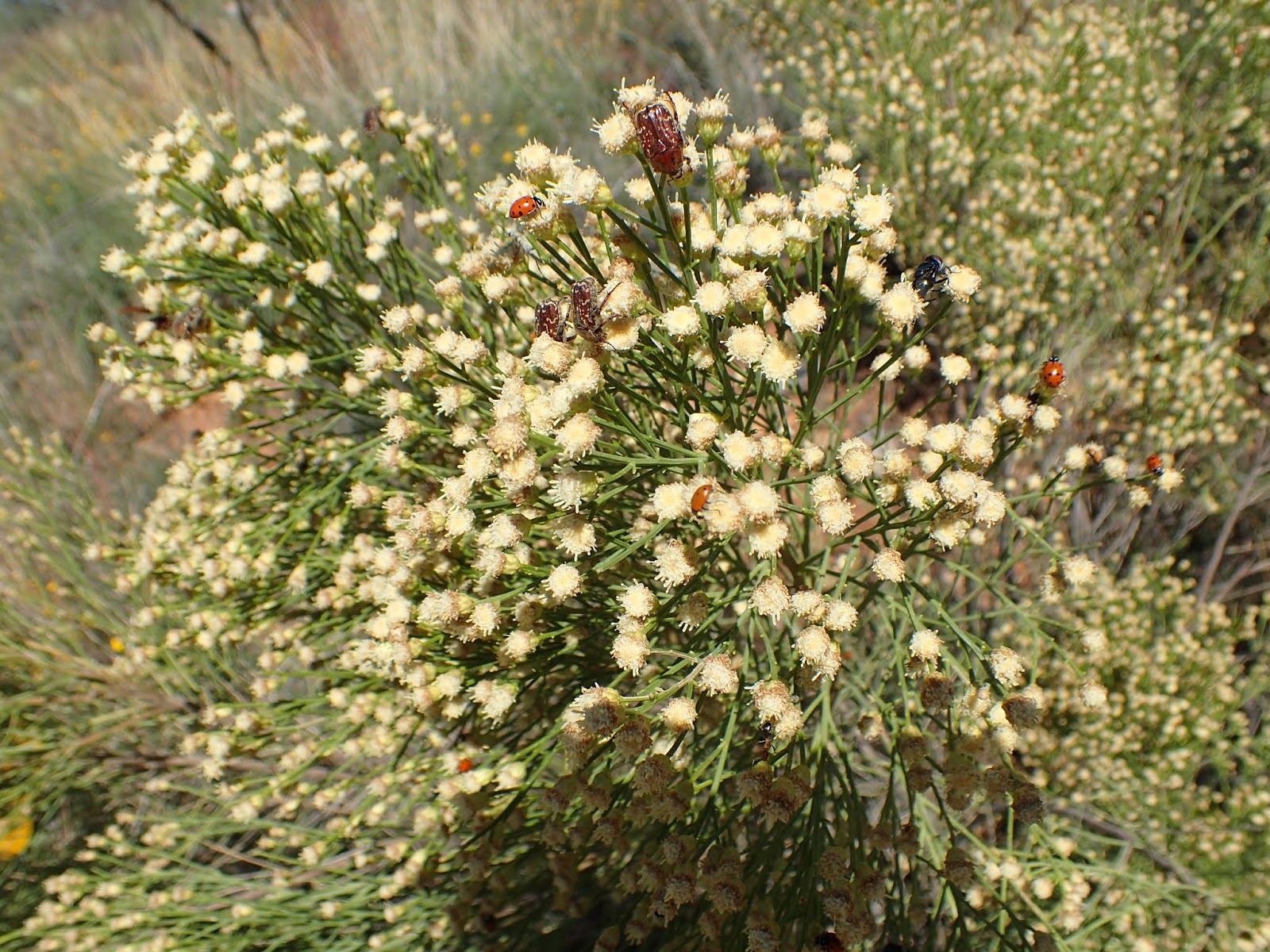
Desert Broom is also blooming. Roads on the west side of the Santa Rita Mountains are lined with nice mature bushes of this often maligned species. It grows in disturbed habitats and insects and entomologists love it as much as gardeners seem to loath it. 


I am still primarily looking for beetles, but I did not find anything new, just the usual mix of Scarabs, Chrysomelids, Cerambycids, Ladybugs and Blister Beetles. I noticed a surprising absence of Cantharids. Maybe those flew early this year, I did see huge numbers in September

Sphaenothecus bilineatus, Disonycha glabrata (Pigweed Flea Beetle), Epicauta sp., Euphoria leucographa, Hippodamia convergens (Convergent Lady Beetle), Brephidium exile (Western Pygmy-Blue
A Great Purple Hairstreak demonstrated how to draw attention away from one's vulnerable head to the expendable pseudo-antennae and false head at the back of one's wings. If I had been a bird I might have fallen for the trick
Atlides halesus (Great Purple Hairstreak

Most Desert Broom bushes were dominated by wasps. Nests of Polistes comanchus, P. flavus and P. major castaneocolor must have been close by. Young queens and males were feeding on nectar (and pollen ?) . They are probably not raising larvae at this time of the year so it was all for their own consumption (not that the males ever contribute to feeding the brood). Many of the big young females were wrestling for dominance. Will their ranking still matter after they have survived the winter to start new colonies from scratch in spring?

Pepsis grossa and Tachypompilus unicolor
 Spider wasps Pepsis and Tachypompilus were also feeding on the broom flowers. Like several of the other visitors, they had eagerly consumed oozing tree sap from the branches of the broom in August and September. Is it possible that the broom actually profits from its earlier losses of sugar water by having pollinators at its beck and call when it finally blooms?  But only a few species are present both in late summer and in late October.


The potter wasp Euodynerus guerrero gave a pretty good imitation of a paper wasp. Euodynerus probably has a sting of her own, but mimicking a powerful social wasps has its advantages.


The Pidgeon Horntail Tremex columba is a wood-boring wasp belonging to the Symphyta. Those wasps have no thin waist and no sting - their ovipositor is still just that. (The one in the picture is a male anyway)  I found a rather big female and several smaller males.


They all were sitting quietly as if asleep. I have never seen these guys more active than this. Are they night active? Or can they be so slow because the trees they place their eggs in don't run away? One male flew very sluggishly after I disturbed him.

Oplomus dichrous
 Nothing sluggish about this male insect: The Predatory Stinkbug   Oplomus dichrous was hunting for insects often larger than himself.

Ptilophorus wrightii
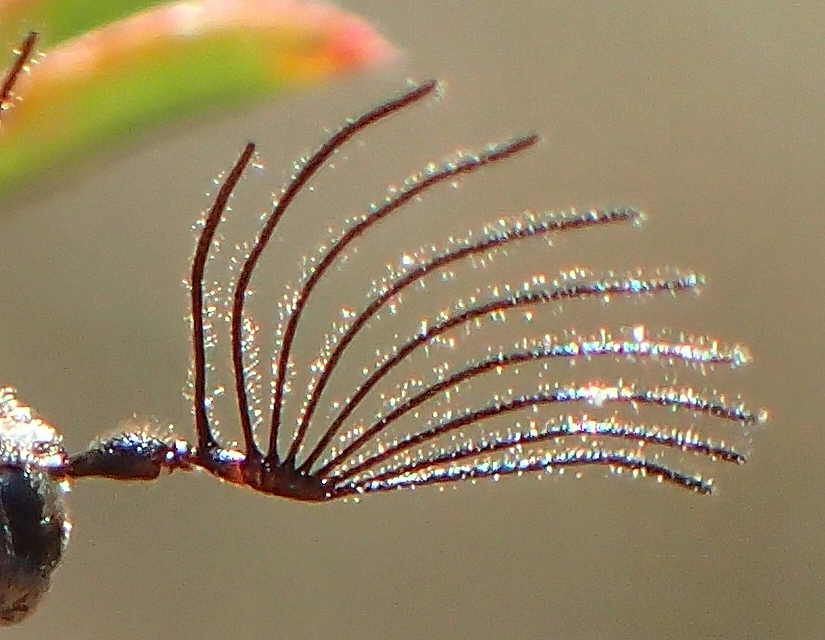
 The male Wedge-shaped Beetle (Ripiphorid) Ptilophorus wrightii was scanning the ether for scents of a female. Just check out the immense enlargement of the surface of his antennae: "the better to smell her with"- those surface areas are loaded with sensory cells.


I concluded the nice day with checking up on my print and card inventory at gift shop of the Santa Rita Lodge in Madera Canyon and enjoyed coffee and ice cream watching Magnificent Hummingbirds.

Tuesday, September 18, 2018

Sky Island Safari, August/September 2018, Portal


During our Sky Island Safari, Joyce, Alice, Aaron and I spent 2 days and nights at Sunny Flats CG in Cave Creek Canyon. When we arrived, there was still no water in the creek, very unusual for the end of August. But clouds soon rolled in, the nights got chilly and rain was pounding the tents. In my car it was quite cozy though. 


I was happy with the performance of my new little Olympus Tough4 under very dim light conditions. The colors are actually especially saturated when the light is so diffuse.


At home, at my larger PC screen I found the draw-back: the camera compensates for low light mainly by increasing the ISO numbers, which leads to granulated low resolution images. 


The little flash is not very potent, but will improve the situation if I remember to control the ISO to no more than 200. 


We found some nice bugs along South Fork Creek and with the help of a local birder even saw 2 juvenile Trogons.  


We visited Southfork Creek in the afternoon and again in the morning, hoping for Rock Rattlers that Alice had seen here previously. 


But we could find neither the snakes, nor their usually very common prey, the Mountain Spiny Lizards. We speculated about the recent fires, floods and land slides but I heard later from other herpers that Sceloporus jervey  is rare this year on all sky islands. 

Leptinotarsa decemlineata (Colorado Potato Beetle) on Silver-leaf Nightshade and Tetraopes discoideus on milkweed
Wet prospective Monarchs
Eggs of a Green Lacewing
The Chrysis cuckoo wasp  was not giving up its sleeping position while it was cold and wet
At theSouthwest Research station a recent heavy downpour had pretty much flattened the milkweed patch and we found fewer bugs than expected.
 
Female Dynastes grantii (Herculaes Beetle)

 Our black lights at night brought little and mine was constantly robbed by a skunk, but Joyce got a big female Dynastes grantii. I've put that beetle up in a terrarium to hopefully lay some eggs. So far she is eating lots of apples. 


While Joyce and Aaron were looking for oak galls in the canyon they were pounded by thunder storm after thunder storm. 


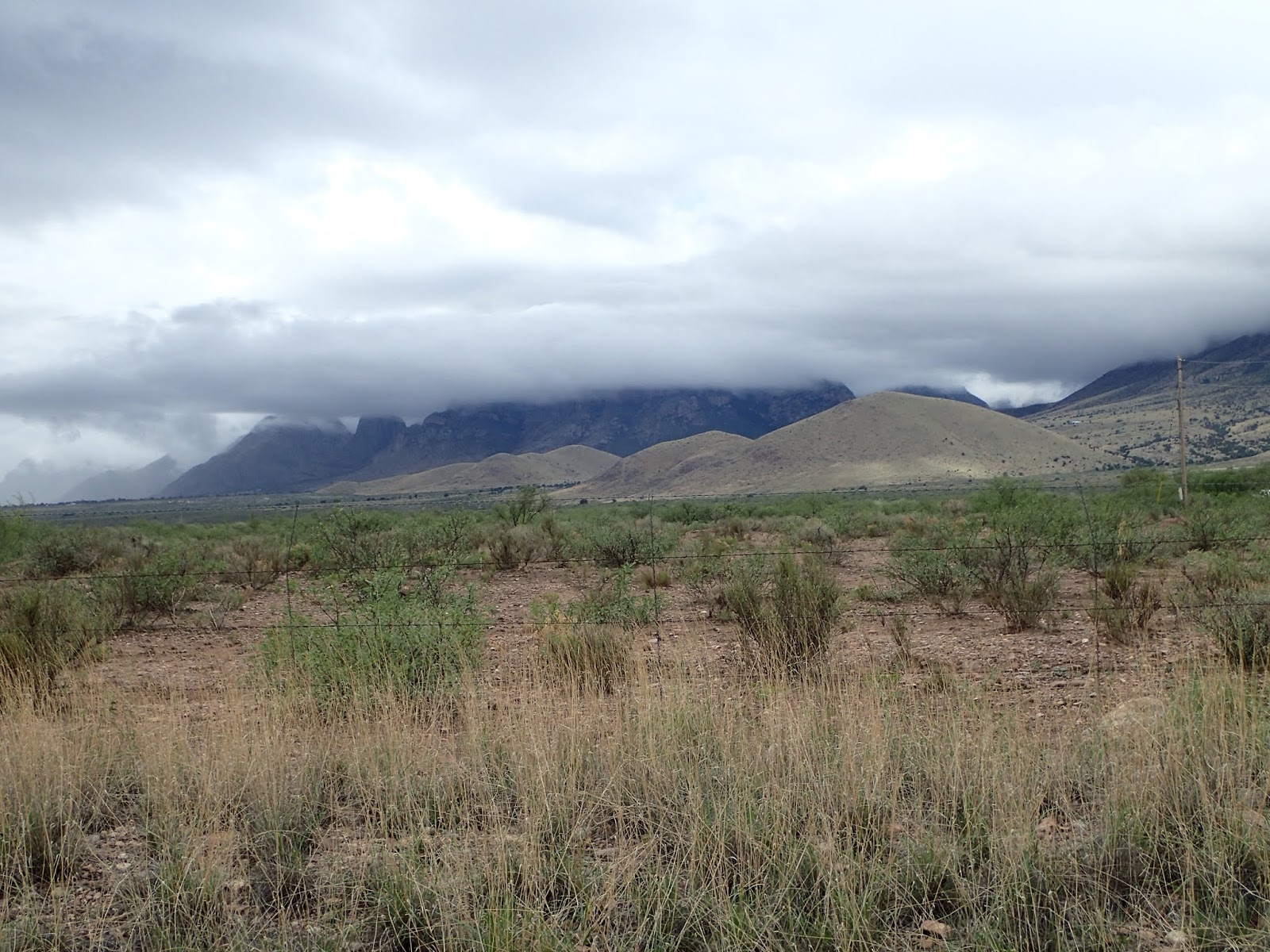
Alice and I tried to stay in ahead of the front following Foothills Road. We were treated to dramatic sights of mountains and canyon being swallowed up by heavy clouds.  

Saxinis sonorensis and trichoderes peninsularis
Buprestids Acmaeodera disjuncta. and flavopicta
Gyascutus caelatus still flirting despite the upcoming storm

Cerambycids Crossidius suturalis, Plionoma suturalis and Stenaspis solitaria
 Many insects were tightly holding on to their perches in expectation of the storm. At least they held still for photos. Since there were many black Stenaspis solitaria in the mesquite trees, we searched for the rarer green/red Stenaspis verticalis. 
 
red form of Stenaspis solitaria

Alice found a big male with lots of red on head and pronotum. First I thought it was S. verticalis, but the antennae were not annulated.  A teneral S. solitaria? I kept it and it never changed color. Now I've learned that this reddish form is not totally uncommon further east in New Mexico and Texas. Foothills Rd in Portal is always good for eastern species and forms. 

Acrolophitus maculipennis (Texas Point-head Grasshopper)
 A slant-face grasshopper that had us guessing. It was now identified as Acrolophitus maculipennis (Texas Point-head Grasshopper). While it seems to occur as far west as Tucson at least, it's more common towards NM and TX. It's found in open desert scrub, Ocotillo, Mesquite, wherever Wooly Crinklemat is common. Soil is generally of limestone origin.
 

 A quiet evening followed the storm, but the washes were now running and more rain came at night.


 In the morning the clouds were still hanging low, so we skipped our planned tour up to Rustler Park and headed for Wilcox Playa instead.