Tuesday, April 17, 2018

Centris Bees and White Ratanay in the Tucson Mountains


Krameria grayi – White Ratany is a grayish inconspicuous desert bush that grows in the lower elevation of the Tucson Mountains  Even when it's blooming, they are not very showy, though the single flowers and later the heart shaped seed pods are very pretty and intricate.


But right now, during their blooming season the bushes draw attention not through their looks but by the noise coming from them. Loud, deep buzzing, very sonorous, very different from the higher sound of Honey Bees.


Big Centris bees are coming and going, sometimes hovering with a strange wiggling motion, sometimes landing in the sand nearby - seemingly just resting.


These New World bees range with 250 species from Kansas to Argentina, and here around the Tucson Mountains I have found at least 3 species. Females of these bees possess adaptations for carrying floral oils rather than (or in addition to) pollen or nectar. According to Wikipedia, they visit mainly plants of the family Malpighiaceae to collect oil, but also Plantaginaceae, Calceolariaceae, Krameriaceae and others. Yesterday, they were definitely concentrating on that one blooming Kramericea, the Ratanay.


Some also visited Janusia, Fam. Malpighiaceae. I did not know the family of this strange vine, but obviously I can rely on the good senses of the bees and in this case Wikipedia (I think I know who is the careful editor of these bee entries).

The Centris bees  completely ignored a desert lavender bush in direct proximity. These flowers were later in the day extremely popular, but with honey bees.


Centris Subgenus Paracentris, Oil-Diggers and Desert-Diggers, Female, could be C. cockerelli or atripes

I have watched Centris pallida  dig tunnels and nesting chambers into loose sand and J. Alcock describes the same for another sympatrically occurring Sonoran Desert Centris, C. rhodopus. So I expect this Centris bee to behave similarly. 
I asked Entomologist and pollination expert Doug Yanega how the oil is used in the nest to rear the larvae. Here is his answer:

'The nest cells are vertical and they have a lining that prevents the oil seeping into the soil, and the bees just scrape off the liquid (which is rather viscous) into the cell.
Once they have a good pool, they float an egg on top and seal it. There are numerous bee genera that do this worldwide, but in the US I think only Macropis and Centris, IIRC.


P.S. Today I found this C. cockerelli  on our neighbor's hybrid (Desert Museum) Palo Verde. There is no sign of C. pallida yet, but most of the foothills paloverdes are not blooming yet around Picture Rocks. I just learned from Doug Yanega that there are no oils in Parkinsonia - just nectar that the bees need to feed themselves. I guessed that already because I often see male Centris on those flowers.

As for the species identification of the Rantanay Centris: One suggestion was C. caesalpinia, but they have red eyes, which mine did not.  Not C. rhodofus because they have red eyes and legs. Mine look like C. cockerelli, except that those should have yellow faces, and mine have a reddish orange clypeus. But:
 John Ascher When all else fails, consult the literature! Turns out that there is a western form in CA and AZ of C. cockerelli with a reddish yellow clypeus and an eastern form form in TX with a white to yellowish clypeus intergrading in NM. I had forgotten about this. So C. cockerelli is likely correct. Sorry for the confusion. At least we learned something (if nothing else, to consult the literature rather then rely on memory!)
 So: western form of Centris cockerelli!

Friday, April 13, 2018

Brown Canyon Hike, Buenos Aires National Wildlife Refuge

For Brown Canyon (you can still join in) on Saturday the 14th of April 2018, we will meet at 7:30 at the intersection of Ajo Way and Hw 286. At 7:40 sharp, we will go south on HW 286 to the turn-off into the preserve (right turn) around mile marker 20, meeting there at 8 am. . The guide will greet us and give a short talk, then take us into the preserve. Bring $5 cash for the guide! There are restrooms at beginning and end of the hike. Bring lots of water and a light lunch!
As the weather cooled down nicely, we are expecting a great, easy hike. Landscape, birds, bats, and bugs will not disappoint.


Brown Canyon is part of the Buenos Aires National Wildlife Refuge and only accessible as a group with a guide.

Tuesday, April 10, 2018

Ancylandrena Mining Bees in our back yard

Updated repost from 2014
 Our house is built on sand. It sits on a little mesa (elevation) consisting of soil that was excavated to put in the basement. Over the years I found out that we share this site with many sand loving, digging insects, tarantulas and scorpions. And please don't think that that is a problem. Some of these guys may even keep out others that we would like less.

The little dark parasitic bee, waiting close to the nest entrance
 Yesterday I was reading at the bedroom window when I noticed a dark little bee zigzagging and descending repeatedly out of sight under the window. Time to investigate.
When I got outside, she was resting on a flat rock. In the soil around it were several small, round holes about 5 mm in diameter. Another bee buzzed closer, circled, landed next to one of the holes and slipped inside.

A mining bee exiting the nest entrance
 This bee was larger, plumper, and lighter than the little observer. It stayed in the hole for a long time. While I was watching, two more bees arrived and crawled in. for over 10 min no bees left as far as I could see. Then the smaller bee flew up, circled shortly and also crawled into the hole. Several other bees of the bigger kind entered 5 other holes, all in an area of less than a square meter.  Eventually bees also exited the hole that I was watching, but too fast to get any good pictures. Peak activity seemed to be around 10 to 11 am.
Today I came better prepared. For example, I found a way to sit instead of crouching over the hole for what turned out to be long waiting times. So I got some video of the larger bees that clearly shows that several bees are using the same entrance and are under ground simultaneously. Incidentally, the little bee was inside during that time as well. This time I trapped her and three exiting larger bees to get a closer look. I had an idea by now that I was dealing with mining bees and a clepto-parasite, but I found that I didn't have these guys in my photo collection yet.

Ancylandrena sp. Doug Yanega det.
 Indoors, I put each bee into a white ceramic bowl and covered it with a clear plastic container. It took a while for them to calm down. If they had been beetles, they would have experienced a short cool-down in the fridge by now, but bees just don't look right when they are cold. So instead, I got the chance to take a few quick photos, some OK, some blurred and some out of focus, of each bee before she took off for the window. No harm done, they were easily coaxed back into the container.
John Ascher commented on BugGuide:
The expected species is A. larreae if creosote bush is blooming nearby (lots of it!)
The yellowish tan thoracic hairs are consistent with that species.
She should have a conspicuous yellow blister at e base of the mandible.

Hexepeolus rhodogyne, Doug Yanega det.
In the close-ups, the parasitic bee looked somewhat beat-up. Maybe her life as an uninvited guest was not quite as easy as it seems. But her visits in the nest, concurrent with those of several 'owners' did not seem to create any disturbance.

Several of my Flickr and facebook connections are bee specialists, so I posted the photos there and on BugGuide.

From Doug Yanega came the response:  "The latter is Hexepeolus rhodogyne, and it is a cleptoparasite in nests of Ancylandrena (the first bee). It wasn't until the 1990's that the host-parasite association of these taxa was confirmed, as I recall. The genus Hexepeolus contains only that one species".

John Ascher added a link to the 1994 paper: Biologies of the bee genera Ancylandrena (Andrenidae, Andreninae) and Hexepeolus (Apidae, Nomadinae) : and phylogenetic relationships of Ancylandrena based on its mature larva (Hymenoptera, Apoidea). American Museum novitates ; no. 3108

It turned out that BugGuide had an image of a mounted specimen of the parasite, but only an empty, prepared, page for the host. So I was able to fill in both with white backgound-life-close-ups and action in situ shots:

BugGuide Info Page

As for the species id, in Discover Life I found a description of a rare Tucson specialty, A. rozeni, but it would be difficult to identify it without comparative material:  A. rozeni - This is a rare species with records restricted to Arizona, specifically known from the Tuscon area - The male appears closest to that of A. larreae though slightly smaller, has a shorter clypeus, has shorter antennae, has smaller light markings in the paraocular area, is less densely pitted anteriorly on the scutum, hairs sparser in the anterior of the scutum, and has a greater proportion of dark hair on the upper areas of the head - The female appears most similar to that of A. timberlakei, although it may be differentiated by the presence of some degree of a tan or yellowish brown mound on the base of the mandible, a greater proportion of dark hairs in the upper areas of the head, the fact that all hairs anterior to the middle of the tegulae are white, and that there is a greater proportion of light-colored hairs on the scopa (2)
 Anyway, I preserved a specimen.

So to summarize, Ancylandrena is a mining bee. In spring males and females emerge from underground cells. They mate, and the females dig nest burrows in sandy soil. Mining bees collect pollen in the long hairs of the tibial scopa of the hind legs. (They do not  have a 'pollen basket' like honey bees and bumble bees). They construct small cells containing a ball of pollen mixed with nectar, upon which an egg is laid, before each cell is sealed. Although not social, several individuals seem to be sharing at least a nest entrance (Solitary, communal ground-nesting). As many insects do, they provide provisions for their offspring, but they are not around to guard the larvae while these are growing up. Clepto-parasites like the one I observed commonly make use of this arrangement to raise their own brood. Many of these clepto-parasites, like this one, are in the subfamily Nomadinae (Cuckoo Bees). They usually lack the hairs that are used by their relatives to collect and transport pollen. There are a number of strategies to get parasitic eggs into a provisioned nest. In this case the cleptoparasitic bee just followed the host bees to get her eggs into the brood chambers before they were closed. In Rozen's study several eggs of Hexepeolus rhodogyne were attached to the inner wall of the brood chambers while the larger egg of the host bee was sitting on the pollen ball. This explains why Hexepeolus was around for several days entering the same nest repeatedly: she had to access the chambers that were just in the right stage of construction.

PS: I was busy at an art show for three days, but when I checked again on Monday, 3/24/2014 there were still Ancylandrenas entering the same nest. I also found another nest about 60 meters south on a berm planted with cacti and creosote bushes.

Update April 2018: In the following years  I did not see these bees nesting again. But my observation and photos made it into a great new bee book 'The Bees in Your Backyard' by J S Wilson and O M Carril Princeton University Press 2016.

 
 In April 2018, on our neighbors' potted Aloe, I found a group of sleeping males most likely of the Ancylandrena species Ancylandrena rozeni. Id by John Ascher from my photos.
These guys lack the brown hair of the ones I photographed in 2014 and are silver-grey all over. No yellow blister under the mandibles.

Saturday, March 31, 2018

Will the Harris Hawks of Sandario Rd in Picture Rocks become homeless?

Watching a pair of Harris hawks at a tree that has hosted their family for years, maybe decades, made me wonder about the symbiosis between an endemic hawk and an imported tree.
Aleppo Pines were brought  to Arizona desert cities from Lebanon and Syria as landscaping trees. Most were planted 30 to 50 years ago. Although they were not really adapted to our typical rain pattern of monsoon showers in summer and soft. but productive rains in winter, they thrived for decades and outgrew in many cases their allotted space. Low slung ranch houses under towering, monstrous pine trees were a strange, but typical look for Tucson neighborhoods when I arrived here in the early nineteen nineties.

But nowadays, those trees are becoming rare. We lost a few on our own property: they became pale, nearly straw colored, produced a couple of panic crops of cones, and died. It made us sad and left us feeling guilty - thinking that we did not care for them properly.
Then there was a diagnosis: Aleppo Pine Blight.
 There was a lot of guessing as to the cause of this disease. Bark Beetles and 'nearly invisible' mites were blamed. I stripped the bark of our tree corpses: no tell-tale sign of bark beetle infestation at all. Anyway, those bugs like mountain air, not desert heat ... but still, bugs usually get the blame.

Bark beetle infestations leave typical tracks under the bark of trees killed by the beetles. They were not present in dying Aleppo pines.
By far not all plant diseases are caused by organisms (bugs). Disease may occur because moisture is not available to tissues; consequently, they malfunction or die as a result. Insect infestation may sometimes be exasperating the problems but they are usually secondary to climactic stresses. No insect infestation was found in most dead pine trees in Tucson. 
Excessive evapotranspiration occurs when soils are dry and sustained winds  blow at extremely low relative humidity. The high water loss from needles cannot be replaced by adequate water uptake from the soil. Climate change has increased these stresses over the last decade, so now even old, established trees are succumbing all over Tucson. Another factor: irrigation over decades might have leached nutrients from the desert soil and caused an increase in salts, while an ever increasing layer of caliche that further inhibits healthy root growth and water uptake. Temperature extremes are also increasing lately - maybe exceeding tolerance thresholds of the Mediterranean Pines.
But even if the huge pines were aesthetically uncool and also, while healthy, a burden on our limited water resources, they had a positive side: Harris Hawks loved them as nesting trees. 
Harris Hawks are superbly adapted to the Sonoran Desert in many ways. I am pretty certain that it was the pressure of this hard environment that made them evolve into the only social species of hawks: the resident, territorial pair allows several younger hawks to live close by. The hawks hunt as a group, share the kill, and the young 'satellites' help the main couple to raise its young. So an obvious advantage for the resident couple. From the viewpoint of the younger hawks, this altruism is a little hard to understand because genetic tests showed that the hawks are not usually related. So no kinship selection here. But, the entire group can take down larger prey than a single hawk could slay. This may be advantageous as so many small prey animals are night active here. Considering that about 50% of fledgling hawks usually die from starvation within their first year, communal living may give more time for the young guys to become strong adults.  Furthermore,  the younger birds are probably in an excellent position to take over territory if something happens to the owners.   
Free Flight Hawk Group of the Arizona Desert Museum
 Harris Hawks,  because they hunt cooperatively, can afford to be smaller than our other successfully free roosting desert birds of prey, Red-tails, Caracaras, and Great Horned Owls. (Kestrels breed in cavities, Gray, Black and Zonetail stay in riparian or mountain forests, Cooper's adapted well to human neighborhoods with trees).

Who knows who built this nest? GHO do not do it themselves
 But Harris Hawks share their habitat directly with their great arch enemy: the Great Horned Owl.  The owls hunt and slay birds up to the size of Harris Hawks, they rob hawk nestlings and they love to take over established nest sites like the classical Harris Hawk nest in the sturdy bowl of sheltering Saguaro arms. 
A different site, also now owned by the GH owls. Both Picture Rocks, west of the Tucson Mountains
 So Harris Hawks around Tucson may have really benefited from the prevalence of huge, dense Aleppo Pines - I knew at least half a dozen nests that successfully produced fledglings year after year.  I also know of successful owl attacks on some of these nests, but at least in one case, the hawks were back a year later. Maybe the dense pine branches give enough of an advantage to the smaller, maneuverable hawk over the large owl. 
Dead Pines along Sandario Road, still hosting an active nest
 Since we lived in Picture Rocks I saw Harris Hawks around, but although I found Red-tail, Screech and GH Owl, Cooper's, and Kestrel nests, I never found a Harris Hawk nest around here. But I always saw them flying, carrying branches or food,  into two huge pine trees at Sandario Rd. There had to be a nest! But it remained completely shrouded by those dark tree crowns. 
Sadly, this spring the needles are falling, the trees are nearly bare. There is a nest though, and the hawks have not quite given up on it. 
 Today I saw the female sitting on the rim of the nest. - freely silhouetted against the sky. Then she flew down, landed on a power line post, the male joined her and they mated. So the hawks are optimistic, life will go on, even in a dead tree. 

Friday, March 30, 2018

Molino Basin in March 2018

The drought is upon us. According to today's newspaper  the affected area stretches from northern NM to SW Arizona. To us, that's no news. So wildflowers were scares and very tiny. Still some bugs had found them.

Acmaeodera sphaeralceae on fleabane
 So every little Fleabane flower seemed occupied, mostly by Acmaeodera Acmaeodera sphaeralceae, one of our earliest spring bupestrids. I think this one is chewing on the ray flowers. Remember your asteraceae anatomy?

  As always (literally), at my first stop up Catalina Highway, I ran into Mary Kinkle and Fred Heath. They must live there! As they are Butterfly people, we watched a Spring Marble flutter by, being camera shy.


Some Comanche Paper Wasps were also flying and another big black bee-like thing that turned out to be a Scarab Beetle, Euphoria verticalis. The beetle achieves the bee-like flight by keeping its black elytra closed and pushing the membraneous wings out from under them through lateral gaps.


I beat some Mesquite and Palo Verde and a nice snakefly ( Raphidiidae » Agulla) landed on my sheet. I do not find these often. According to literature, Snakeflies are confined to arboreal habitats in the broadest sense, including all types of forests, macchias and even biotopes with scattered shrubs.

Pachypsylla celtidisvesicula (Hackberry Blister Gall Psyllid)
Beating bushes also resulted in finding this little guy - not even 3 mm long. I thought it was a Bark louse at first, but the clubby little antennae speak against that. Robert Velten helped id it: Pachypsylla celtidisvesicula (Hackberry Blister Gall Psyllid)


This came from an oak at Molino Basin. The winter-green live oaks are just leaving out, shedding their old leaves. I think it is a nymph of a leafhopper.


At Molino I wanted to look for Osmia, the bee genus that supposedly is the main pollinator of Manzanita. The bushes were blooming beautifully  But I found mostly Honey Bees, some big black Carpenter Bees, some Hover Flies in the genus Copestylum (3 species). The only blueish green bee that I found will probably turn out to be in the genus Andrena. No Osmia at all. But they were there in other years! I did see a couple of Golden-headed Scalloped-wings 


On a Manzanita Leaf, I found this little mound of gello. Because it was only 4 mm long I wasn't sure if it might be a cluster of eggs? But after looking at the enlarged photo, and seeing it moving around the jar I'm keeping it in, I thought that it is a slug caterpillar, just a very young one.


I learned now from Bruce Walsh  that it is rather the caterpillar of Dalcerides ingenita, the only Dalcerid around here. It does not seem to feed on the Mamzanita leaves I collected it with - it's crawling around in search of better food.Bruce thinks it's an oak feeder.

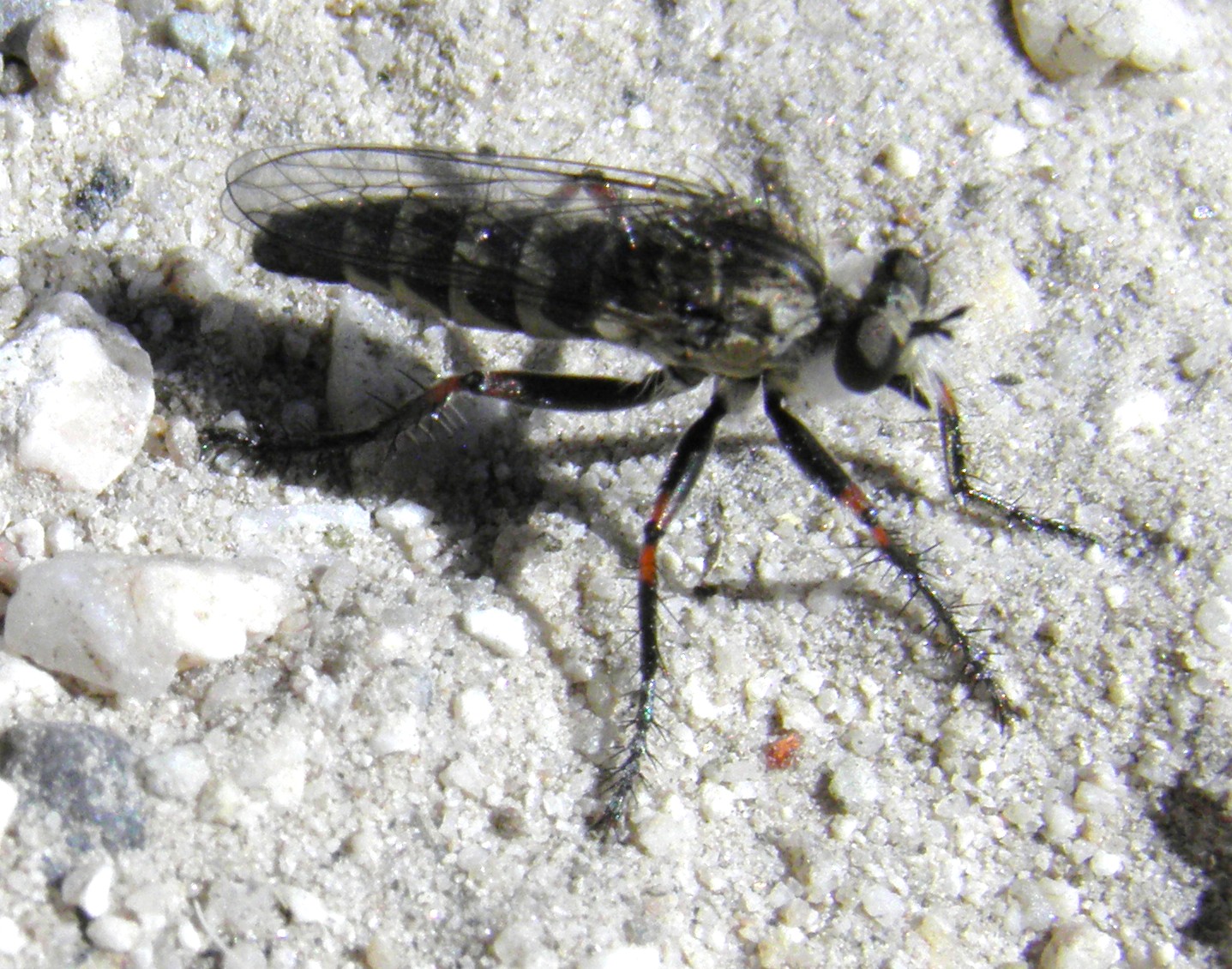
A small Robber Fly was staking out a territory on the path at Molino Creek. Close by I came upon the sad sight of 3 dead rat babies. They might have been clinging to their mother during transport when some kind of catastrophe hit.


 In other climates I would have expected Burrowing Beetles to arrive soon, but here the little corpses attracted only ants.


On blooming Rhus (?) I found some Cryptocephaline Leafbeetles and an Small assassin Bug genus Lophoscutus. Only when I checked out my photos, I found a Green Lynx Spider - do you see it?

Lophoscutus sp.
Chelinidea vittiger (Cactus Coreid)
 Chelinidea sp, a Coreid, flew in, probably from a near-by prickly pear cactus. No flowers on those yet - they seem late this year.


I saw tiny Scudderia sp. nymphs and a big, adult Schistocerca nitens. These bird grasshoppers seem to winter as adults here in Arizona. At nearly 3 inches long, my biggest bug of the day

Coleothorpa axillaris l

Wednesday, March 28, 2018

Who likes the Nectar of Aloe vera and little Petunias?

We try to keep our environment as natural as possible. We let the desert be desert and if we plant we try to stick to endemic plants. But some things were here when we bought the place. We ripped out ice plants and roses, but the Aloes got permanent residency because they are as desert adapted as our Agaves - just to a different desert. Coming to us from down under (South Africa) some also tend to bloom here in winter ...


 Their nectar is appreciated - by Gila Woodpeckers, Hummingbirds and Orioles, Verdins and by honey bees.  Of course, those are foreign imports as well. The woodpecker ingests them gladly in addition to the nectar. In South Africa, many Aloes seem to rely very much on birds for pollination, but honey bees also play an important role. (CT Symes et al. South African J. of Botany, Vol. 75, Issue 4, Oct. 2009)


 Not far from the Aloes, Cacti and Penstemon are blooming. The cacti may not all be endemics of the Sonoran Desert, but at least they came from near-by Baja and Chihuhua. Honey bees pretty much ignore them, but native cactus bees and little green sweat bees find those first cactus flowers within minutes. 


Anthophora bees are hovering among the Penstemons that they love and also nectar on the Creosote bushes that are the character plants of our sand flats.
 

 For the first time we had mini petunias in hanging pots this year and they surprised with an abundance of yellow and deep red flowers all winter long. They also have a weak fragrance. Our Costa's Hummer was mildly interested when his feeder was occupied by honey bees and nothing else was blooming. But he very much prefers the little Desert Honeysuckle and Cape Honeysuckle. I thought the Petunias, like the purple Barrio Petunias, might attract moths, but if so I missed it. An early Whitelined Sphinx instead hovered around our blooming basil plants, soon joined by the Costa's hummer.


But today I got a surprise: the yellow petunias had a yellow visitor: a Two-tailed Swallowtail. While Giant Swallowtails are rather common here thanks to numerous citrus trees in most yards, the Two-tailed is a butterfly of the sky islands where it patrols tirelessly along canyons and creeks. I most often saw it nectaring on thistles. We live in the lower desert of Saguaros, Creosotes and Ironwoods, and I have rarely seen a Two-tailed Swallowtails even  in the Tucson Mountains that are closest to us.


This nice and fresh looking guy payed several extended visits to our yellow petunia.   


The most common desert swallowtail is the Pipevine. In early spring it also appreciates Penstemon flowers while the summer generations have more divers choices.

I combined these examples of flowers and their visitors to point out that there is no great randomness in those pairings.  The flowers all offer nectar, and the visitors all seek those sweet calories but  the selectivity of those visits is caused by visual, chemical and structural characters of the flowers. Flowers with nectar evolved to attract pollinators, but a good pollinator is not a generalist that may squander precious pollen, but a faithful specialist that sticks to just one kind of flower at a time. So flowers evolved to limit access to their nectar to those specialists that evolved with them. This means of course that only flowers and pollinators that evolved together in the same part of the world can be perfectly in tune with each other. So our endemic bees stick with our endemic penstemons and cacti. Generalist honey bees and birds service aloes that are global transplants. Butterflies seem to be beneficiaries of  floral offerings, but due to their long legged anatomy they do not necessarily contribute reliable pollination services. By cross or maybe self pollination, our Aloes bear fruit, the penstemons are reseeding very nicely, the cacti produce well - only the little petunias have yet to show any inclination to make seeds, even though their flowers seem to be complete with all parts necessary. No idea what's going on.


Thursday, March 22, 2018

Cactus flowers, bees and rattlesnakes - spring in Arizona


Spring has sprung. Some Hedgehog cacti are blooming and the related, but non-native ladyfinger cactus on our patio. Cactus bees immediately spotted it, and pose. Little green sweat bees like it too, but are difficult to catch on camera. 


Our big rattler made a first appearance, I guess he was sleeping under the barbecue when Mecki charged into him - some rattling, lots of barking until I banned the dogs into the house. The dogs may need a refresher of their snake avoidance training, they were too close for my comfort, but at least their obedience rapport is firm.


Rattler proceeded to explore the entire patio. Seemed to be tracing something (a partner?) judging from his careful tongue-testing of the path.