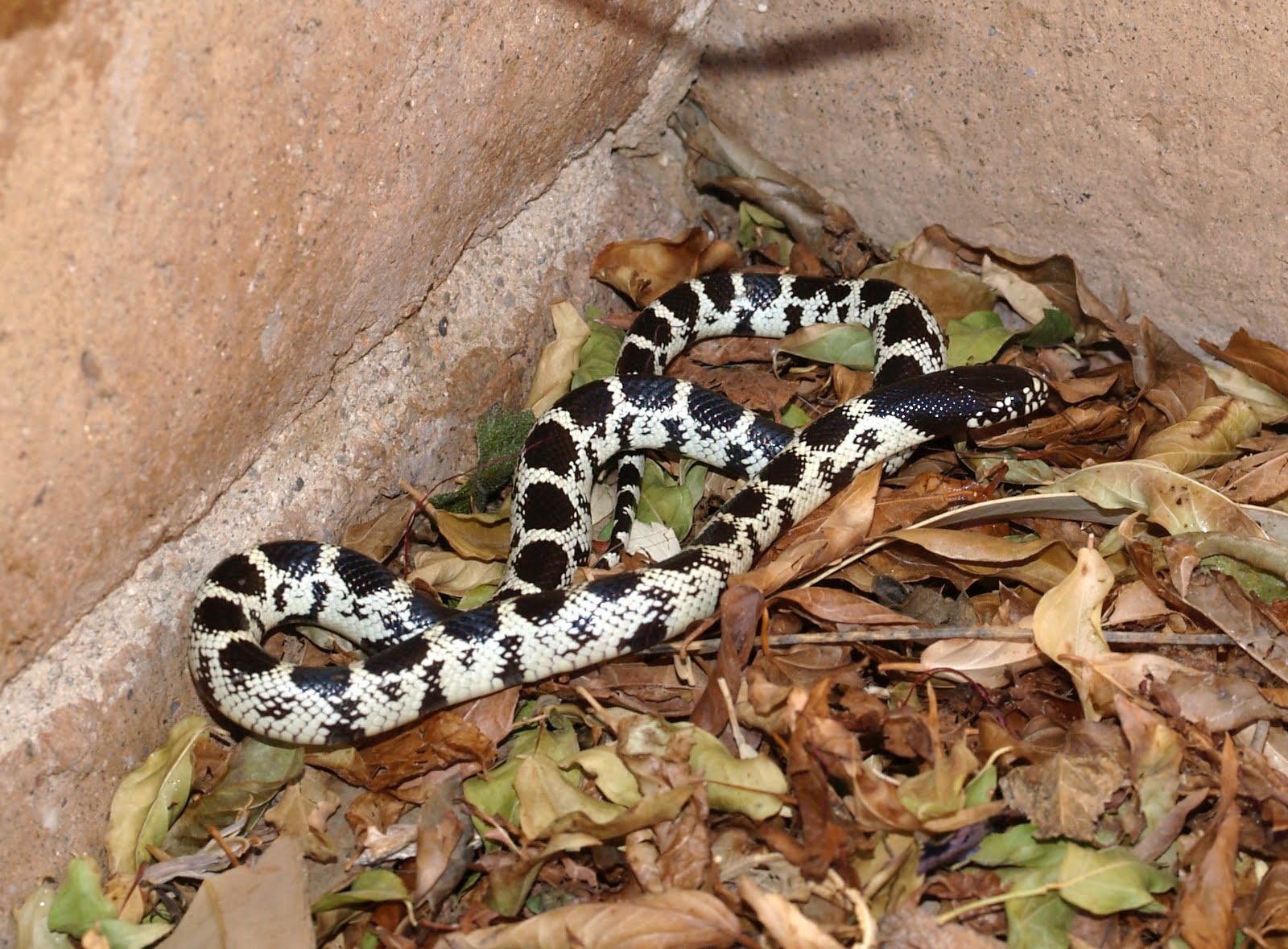
 My husband Randy inadvertently cornered this beautiful little snake on our terrasse. I think it is a very young Kingsnake, Lampropeltis getula. If so, this one will grow up to become a formidable constrictor, able to take on and devour any rattlesnake. He's immune to rattler venom.
 I've found adult Kingsnakes around here, but they are never patient enough to have their picture taken. I remember that they were all of the banded pattern, called California Kingsnake. This one has the dorsal spots of a Desert Kingsnake, but according to the distribution in the literature we seem to be too far north west here (NW Bajada of the Tucson Mountains). I will get expert help to exactly identify the snake from these phot
 os.
os.The snake made his way straight up the brick wall and disappeared in the foliage of a bush of Barrio Petunias.

Hope to see him again!
P. S.
Here is what the experts said:
Brendan O'Connor: 'Wow that's a unique one for sure. Looks like a desert kingsnake but I can't say I have ever seen one quite like that before. Great find and photo.'
Stephane Poulin: 'There is a lot of variation in kingsnakes but this one is a common kingsnake not a desert one.
Nice photo it is a beautiful specimen'
Pat Sullivan: 'Your kingsnake: is an aberrant color pattern, probably of a California ("desert color phase" = black and white bands). I haven't seen this pattern before. I wonder if it occurred naturally? Are there any snake breeders in your area? It could be an escapee from a breeder (or from breeder's stock).'
Manny Rubio: 'Wow! That is one spectacular kingsnake. I sure wish you'd kept it. It is a yearling and-- as others have said-- very unusually patterned and has exceptionally bright wide wide markings.. If it reappears-- call me!'
So it seems the experts agree that this snake is unusual.