Showing posts with label Coleoptera. Show all posts

Friday, May 20, 2011

The Secret of the Moon Flower

Sacred Datura III watercolor by Margrethe Brummermann


 Datura wrightii is blooming again on the sandy banks along the Santa Cruz River and Sabino Creek:  Thornapple, Jimsonweed, Moon Flower, Tolguacha, Sacred Datura - this perennial herb in the Nightshade family is appreciated by many but also abhorred  by a few.


Plagiometriona clavata
Although it's protected by powerful alkaloids (atropine, hyoscyamine and scopolamine), there are several Leaf Beetles that regularly feed on its leaves. The Tortoise Beetle Plagiometriona clavata can be found in July, and two year-round regulars are in the genus  Lema:


Leaf Beetle on Solanaceae - Lema trabeata - male - female
Lema trabeata
Lema daturaphila. The name means 'Datura loving'


Trichobaris compacta
Of the three weevil species that live and breed exclusively on Datura, two Thrichobaris species are 'leaf notchers' that betray their presence through punctures all over the leaves, but the third species utilizes the flowers and I have yet to find it.


The Manduca caterpillar or hornworm loads up on alkaloids wherever he finds nightshade plants. In our area he would have to find somebody's  tomato patch to match the juicy Datura leaves.


  Leafhoppers, Antianthe expansa and their nymphs suck sugar water from the phloem of the Datura stems.


Sacred Datura IV, Watercolor by M. Brummermann


The tightly rolled Datura flowers unfurl before dawn. The huge delicate funnels seem to be illuminated from within. In our climate, they only last til the late morning.


Georgia O'Keefe found eroticism in those deep trumpet shapes. Shamans and  teenagers have been seeking hallucinations from the plant. Witches used it in love potions. Insects find protection from predators with the help of the plant alkaloids that they ingest. Some art show visitors have asked me with astonishment why I would paint such a poisonous weed that also has an unpleasant smell. I was told that it's illegal to grow it in Arizona (luckily, nature doesn't care)
Besides its beauty, I admire the staying power of the Datura. It's a leafy, lush, delicate plant, completely exposed to evaporation and wind damage in our desert environment. Only its fruit, the thorn apples, seem to fit in where almost all vegetation is leathery, succulent, and covered in spines and thorns.
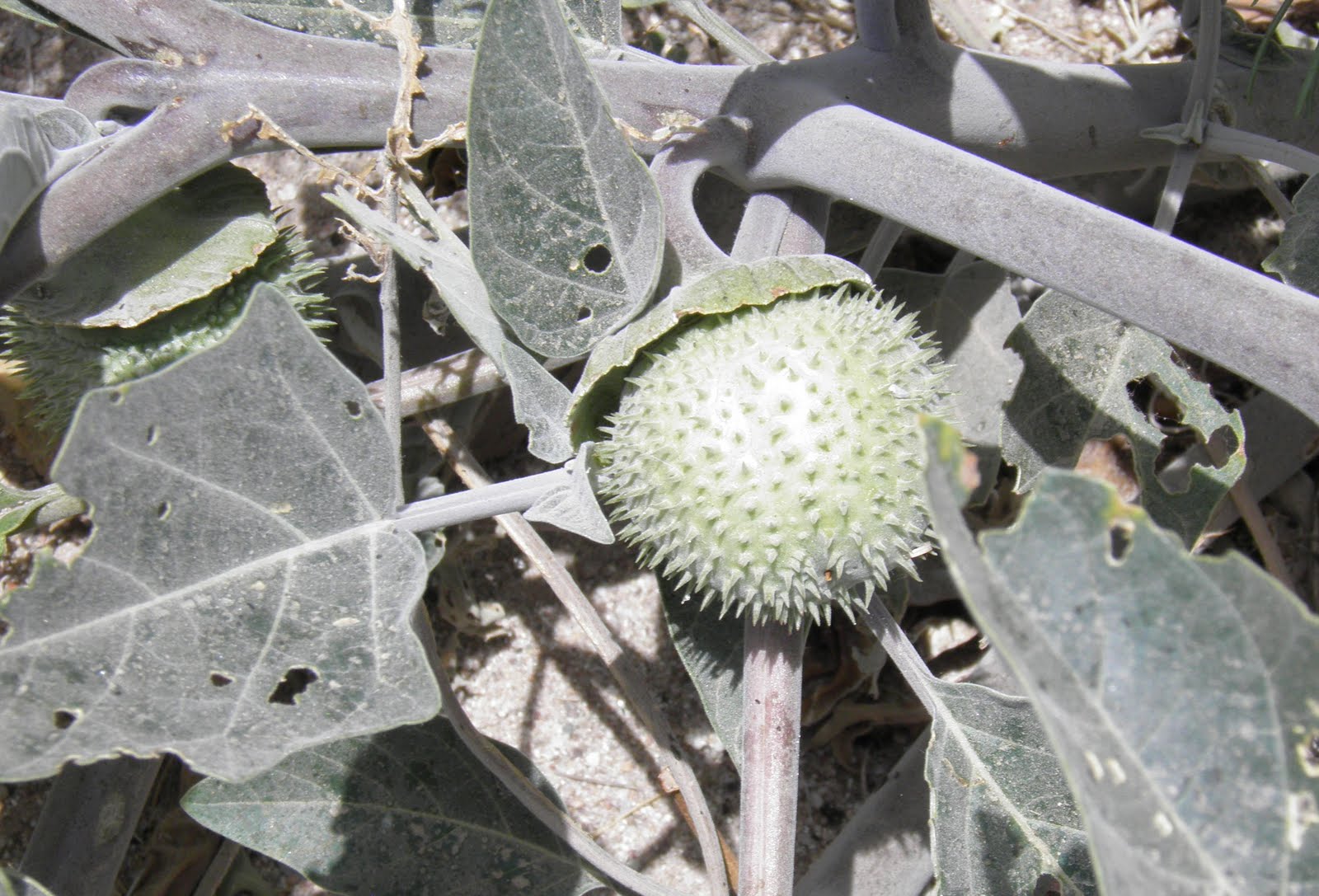

Of course, the Datura prefers to be close to water or else dies back completely during the dry season (9 months out of 12 it seems lately) Only the root stays alive. I once saw an over ten feet long Datura root system exposed in the wall of Antelope Canyon, one of our beautiful, treacherous slot canyons.


For me, the Datura flower holds another mystery. When I point my camera into the flower to shoot tiny White-masked Bees of the genus Hylaeus, I often notice a lump obstructing the depth of the white throat. Checking flower after flower, I find it in nearly all of them, even in the wilted ones that are more than a day old. At closer investigation the lump turns out to be a pretty substantial beetle..


The only way to get to it is to rip the flower lengthwise. I find a sleeping scarab wedged deeply inside. 


Elytra and actually the whole back-end are a dark cream color, the pronotum is a rich brown, and the head, which is the body part stuck most deeply in the flower, is shiny black. That's also in the name of this scarab: Cyclocephala melanocephala (black-headed round -head). 

It's in the Subfamily Dynastinae, which makes her (I only found females) a cousin of Hercules and Rhinoceros Beetles. 


For night active scarabs, these guys are surprisingly alert. When the flower is forced open, the beetles immediately start walking away and even buzzing off in a short, tumbling flight. Did I mention that I stopped by the river on a cool morning on my way to work?
This ectotherm beetle seems more active than it should be, given the outside temperature. 


Once I get to the entomology department (only a little late) I ask Carl Olson directly and Bill Warner by email if they know why the beetles are in the flowers? Carl speculates that the flowers open right when the night-active beetles seek shelter and offer a nice bright landing platform to an insect that is always attracted to lights. He adds: "..and it might be warm in there?"
Bill Warner soon emails back: "Cyclocephala melanocephala is known from Datura flowers; it frequents other types of flowers (I think including ariods) in the tropics.  There are some papers about Cyclocephala and flowers--some species are primary pollinators and some aroids "heat up" their flowers specifically for Cyclocephala." (Aroideae are Jack in the pulpit type flowers).


So is it an example of coevolution between the beetle and the plant?
There seem to be a number of advantages for the beetle.
The majority of night active scarabs flies during humid, warm monsoon nights. But in May, C. melanocephala will often experiences temperatures in the low sixties and even fifties, so a warm hiding place would be an attraction. (Elevated Floral CO2 levels, indicating elevated respiratory activity and thermogenesis were found in Datura Flowers).
The beetle fits snugly into the long throat of the flower and is not only hidden from predators but also engulfed in the peculiar smell of the chemical defenses of its host. The beetles hind-end matches very well the creamy white of an aging Datura blossom, a likely adaptation to this preferred hiding spot. The dark head and pronotum always face into the depth of flower.

I don't yet understand whether there is an equal advantage for the plant that would justify the cost of extra metabolic heat production. Some researchers assume that the elevated CO2 levels serve as a signal to the primary pollinator, Manduca sexta, Our beetle with its smooth surfaces seems indeed an unlikely pollinator. When crawling into its hiding place, the beetle passes the reproductive organs of its host flower, but it wouldn't be useful to transfer pollen between individuals because it seems to stay in just one flower for the day. So what am I missing? I'll have to ask some more experts....If I find out more, I'll add it here. 


Datura II, Watercolor by M. Brummermann


Literature:  
Context- and scale-dependent effects of floral CO2 on nectar foraging by Manduca sexta  Joaquín Goyret, Poppy M. Markwell, Robert A. Raguso PNAS March 25, 2008 vol. 105 no. 12 4565-4570 
The Role of Thermogenesis in the Pollination Biology of the Amazon Waterlily Victoria amazonica
ROGER S. SEYMOUR* and PHILIP G. D. MATTHEWS, Ann Bot. 2006 December; 98(6): 1129–1135.

Tuesday, October 12, 2010

The Euphoria species of Arizona, USA


Overall, in 2010 the numbers of insects in Arizona seemed rather low compared to for example 2007-2008. The extremely dry summer of 2009 and a general increase in temperatures may be the reasons. Small, short-lived and heterotherm, insects are likely to be sensitive to climatic changes. Many species may also reach the limits of their tolerance in hot and arid Arizona. If it gets any hotter and drier here, they may not survive. But so far we are still hoping that this was a temporary decline in numbers and that many species will rebound. Others may be replaced by even more heat adapted species from Mexico.

But even though collection numbers in terms of species as well as individuals were low, I did succeed to complete my virtual collection of the genus Euphoria in the subfamily of  the Flower Chafers, Cetoniinae this year. These are day-active scarabs that fly extremely well with their hard wing covers (first wing pair) closed. A sneak preview of Bill Warner's yet unpublished Checklist of Arizona Scarabaeoidea confirmed that the ten species below are the ones that I can hope to find.

Euphoria Species of Arizona
 
Since I prepared this table, there has been a revision of the genus Euphoria and some names have been changed: E. fulgida holochloris is now E. monticola .  E. fascifera trapezium is now simply E. fascifera, E. kernii was always spelled like this, E. histrionica is now  E. sonorae

Usually I try to photograph living beetles, but I was also delighted to have access to the beautiful and rather complete collection of Patrick Sullivan in Sierra Vista. The specimens of Euphoria devulsa and E. canescens were photographed in this collection. Even Pat's representative for E. canescens came from Mexico, but Barney Streit told me that E. canescens can be found on Sunflowers along  Duquesne Road,Cochise County, Arizona.


E. kernii, which is so common on Opuntia and Prickly Pear flowers further east (Texas), is found in Arizona in a light and a nearly black morph and seems fairly rare.


E. quadricollis (E. arizonica) female and male

E. quadricollis, synonym E. arizonica, 'is sexually dimorphic, with the females tending to be shiny, broader and much darker than the more gracile, tomentose males. The amount of dark spotting on both sexes is variable, but usually much less in males' (Bill Warner via email). Females seem to be less represented in collections which led to some questions about the identification of the female that I found on a tree stump at Copper Canyon, Cochise Co.The image of the male is of a specimen curated at the collection of the University of Arizona.

Euphoria verticalis
E. verticalis, which used to be in the genus Stephanucha when I collected my first specimen in 2007, apparently flies after both rainy seasons: Eric Eaton caught the first one this year in early April when it was buzzing knee-high along stands of wild flowers in Sabino Canyon. In late September I usually find dozens around Annual Sunflowers at the Santa Cruz River and on Desert  Broom bushes in Molino Basin.


  Euphoria leucographa (sepulcralis rufina)


Every year in late summer,  Desert Broom is also the best place to find Euphoria leucographa, our most common Euphoria. With many other insects, the beetles enjoy the sweet juices oozing from the bark of this bush after generous monsoon rains. In October they also frequent the Desert broom flowers.


Euphoria sonorae (histrionica)

 I collected the similarly patterned, smaller E. sonorae in the Huachucas, from lower Carr Canyon to the very top of Miller Canyon. These beetles bury deeply into the flower disc of Sunflowers. This is so typical for them that they can be recognized immediately by their protruding hind ends.


Euphoria inda


I have encountered E. inda only once, at the research Station in Portal buried in flowers of milk weed and then flying off to the mesquite where I photographed it. B. Streit found it west of Portal in thistle flowers.
About this species, Art Evans has an interesting story to tell in his blog - how a specimen made it all the way to Africa to be described there as a newly discovered genus, until Art found it in the South African Museum in Cape town  and dismantled its cover.


 E. monticola (fulgida holochloris) is a great imitator of Carpenter Bees. Like the bees, it spends a lot of time on the wing without landing. when the beetle is buzzing by at high speed the closed shiny fore-wings give a perfect impression of the bee's heavy, dark body.
 Euphoria monticola (photos D. Danforth)


In July and August, I've seen them in the Chiricahuas and the Canelos in similar forested areas under oaks where the ground was covered in moist leaf litter. The male beetles seem to patrol certain paths and clearings, never flying more than a few feet high, probably in search of females on or in the ground. Females are hardly ever collected

Euphoria fascifera trapezium 

 E. fascifera trapezium, which I knew from California, is reported occasionally from our lower desert areas, supposedly associated with pack rat nests. This year it was observed in Tucson in early summer. It seemed to be feeding on fresh Mesquite pods that were bleeding after Mesquite Bug infestation. I finally got hold of one in October when Bruce Mitton collected it for me on blooming Rabbit Bush in his yard in North West Tucson where they regularly breed under his raised planters with lots of composted manure.

The life cycle of this genus is not well described. There seem to be one to two generations per year. The phytophagous larvae have been found in the ground under cow dung and in ant hills. Some adults are reportedly associated with gopher and pack rat nests. Adults feed on pollen, tree-sap, sweet fruit. They have been known to invade bee hives. Rarely, they become pests, damaging young corn or the flowers of roses or mango.


Friday, September 24, 2010

Color-changing Leaf Beetles

The coloration of leaf beetles or Chrysomelidae is fascinating. Their colors do not only range from highly aposematic to extremely cryptic and from opaque to transparent or metallic-reflective, some leaf beetles can even change colors. 

While some species go through reversible changes repeatedly and quickly probably in a reaction to exogenous factors like light, temperature or humidity, others experience one irreversible color change that coincides with their ‘attainment of sexual maturity’ as Knab described it in 1909. He referred to the resulting mature color as ‘nuptial color’.
This color change is distinctly different from the chitinization and pigmentation process  right after eclosion (hatching from the pupa) and usually happens weeks or months later.
Most Chrysomelidae are single brooded and become sexually mature only after they have aestivated or hibernated. The same physiological changes that lead to sexual maturity seem to induce the color change. The resulting new look is so different that the two stages have sometimes been described as different species.
This blog chapter will concentrate  on  two Arizona leaf beetle species from two different sub-families, one cassidine and one chrysomelinae.


The Canyon Ragweed Tortoise Beetle, Physonota arizonae Schaeffer, 1925
For several years, towards the end of the monsoon season in late August, I found the freshly hatched adults among many last instar larvae and pupae on the leaves of Canyon Ragweed. At this time the perennial plant produces several feet-high stems with rich leaves. 

The newly enclosed, and presumably sexually immature beetles have a striking pattern of cream and brown spots. Surprisingly, they blend in well with the scar tissue of ragweed leaves that were damaged by larval feeding. 


On the 3rd of July 2009, before the non-mosoon of that year began, I finally found a single 'mature' individual. I only recognized it by its size and the three spots on the pronotum. It helped that I was actively looking for this type. At this stage, the beetles are metallic brown-green and somewhat camouflaged on undamaged leaves. I assume that this was a mature beetle that had over-wintered because we hadn't been able to find any larvae til then and also none of their very obvious frass pattern.


 Two color forms of  P.arizonae Photo by Rick Williams

Later that year a  friend sent me a picture of the two forms together, taken on September 8th . So the change seems to happen not too long after eclosion, before the winter pause.


Calligrapha serpentine (Rogers, 1854)
Is a very attractive leaf beetle living on Narrow-leaf Mallow (Sphaeralcea angustifolia) Desert Globe Mallow  (Sphaeralcea ambigua), and probably some related Malvaceae species in Mexico and in the US from Texas to Arizona. 


I have found mating adults in the grass land of Cochise County, AZ in early to mid July and in Grant County New Mexico in early August. Their elytra showed a distinct black linear pattern on a vividly iridescent green base color.


On September 4 September 2010 I went back to a patch of Mallows 2 miles north of Lochiel, Cochise Co. where I had seen the beetles last year in late July. I was quite surprised to find bright red leaf beetles with exactly the same black pattern on one plant and only hairy red and black leaf beetle larvae on other Mallows.

 A post by Sheri L. Williamson from Oct. 2009 on Bugguide.net confirmed that the green and the red beetles were indeed the same species. She also connected me to the delightful True Confessions of a Citizen Scientist by S. A. Russel who had followed C. serpentina from the egg to larva, pupa and early red imago and to mature green nuptial beetledom. 


Since this change from red to its total complementary opposite, green, seems particularly interesting, I decided to observe its progress in the five beetles that I had collected.

   September 10. All  5 beetles are still red
The problem was to provide appropriate food because Globemallows are spring flowers in Tucson and have just about no leaves in summer. My beetles had to spend the first three days without food in the fridge and then lived for a couple of weeks on an unusually diverse diet of several Mallow and Hibiscus species that I brought home from field trips to the Tucson Mountains, Mount Lemmon and Kitt Peak.

 September 15. All beetles are showing patches of green

After 5 days one beetle was still mainly tomato-red. The others showed patches of green, mostly on the lateral portions of the elytra. The biggest, roundest beetle (probably one of  the  females) appeared more green than red.
September 16. The big female is nearly all green, one male is still mostly red. 

September 18. All beetles have green elytra but the four smaller ones are still a little paler than the big female. 


September 19. All beetles are bright green
 
The color change had taken about 8 days. It didn't happen gradually, but patches switched from red to green rather abruptly, first in the lateral areas of the elytra and then moving towards the center seam.

I'm still curious about the physiological changes and how the colorshift is correlated with the process of reaching sexual maturity. I did not observe any mating attempts.  Little is known in which form these beetles overwinter. The post-monsoon season is dry and a lot of herbaceous plants are already starting to shrivel up. So my guess is that the adult beetles will enter a resting phase now, and new larvae will grow up during the vegetation seasons of he next year.

Due to the lack of food I had to end my own observations here. 


Tuesday, July 20, 2010

Beetle Parties

Every year Fred and Carol Skillman host their famous annual 'Beetle Bash' at Cochise Stronghold when the monsoon hits (or should hit) Cochise County. The party was delicious, interesting, inspiring, educational, and lots of fun. Thank you so much, Fred and Carol!


The following day, July 11, Eric Eaton and I headed for the Chiricahua Mountains. There was some indication that it had been raining there but the ground was rather dry.
Still, at at a lush creek crossing among ash and oak trees beautiful metallic green-blue Euphoria fulgida holochloris were buzzing around, looking very much like low-flying Carpenter bees.


We set up black lights at Onion Saddle, elevation 7600 ft, in an area with tall Alligator Junipers, Silverleaf Oaks and some Ponderosa Pines. Bill Warner and Aaron Smith stopped by and made us very envious with a beautiful specimen of the rare Carabus forreri. Collectors from as far away as Europe come searching for this beetle endemic to the Chiricahuas and the Huachucas of Arizona.


The sun had set but it was still too bright for the black light to attract anything when the humming and buzzing began. Big dark Scarabs that I later identified as the Dynastinae Coscinocephalus cribrifrons were zooming in on our location. They weren't headed for the black light. They ignored it and landed on a tree near by. More and more beetles appeared as it got darker. I soon found two more trees within a fifty meter radius where more of them were congregating. There must have been close to a hundred beetles per tree, running up and down the trunk, their elytra partly open, ready to take flight again and buzz around some more. The noise of all those feet on the bark sounded first like raindrops and then like a little waterfall.


Clumps of seven or eight beetles clinging together kept falling to the ground still madly scrambling after each other. It became clear that this was similar to a lekking situation where many females and even more pursuing males were coming together to mate. I have no clue how the first arrivals pick a particular tree to be their dancing ground - to me the three chosen trees had nothing to distinguish them from their neighbors. Two of them were junipers, the third one some kind of spruce. At the height of the party the trees were probably surrounded by a thick cloud of pheromones, attracting more and more beetles.


Interestingly, there were also numerous sarcophagid flies attending the dance. Nearly every beetle had a following that approached as soon as the beetle was busy with other beetles or momentarily incapacitated. Even though the flies weren't Tachnidae who are well-known Scarab brood-parasites, I think they were specifically targeting this pheromone-loaded situation, probably to attach eggs to the female beetles that would be transferred to the beetle brood as parasites. My theory is supported by the observation that the flies were all of just one species, their incredible persistence in following the beetles around, and that there were so many of them on the mating trees but none at the black light that had also attracted scarabs (of different species) by then.

The whole mad spectacle ended about an hour after sunset. Sinking temperatures may have curtailed the high activity level at that time.


Our patience at the black light was rewarded by a few more interesting beetle species and a three beautiful huge Oculea Silk Moths.
This chapter of my blog also appeared in  "Scarabs Newsletter # 57"  

Tuesday, May 18, 2010

Bugs and Beetles from Aravaipa Canyon

Last Sunday we had visitors from Texas and Germany who were mostly interested in mantids and ants. May is by no means the best time to find either. Mantis nymphs are still tiny and ants are not swarming, so their queens are deeply entrenched under their mounds and layers of rock and caliche. Turns out the two guys couldn't visit later in the season because of the impending Soccer World Cup.


We decided to go to Aravaipa Canyon in Pinal County, AZ. We had no time to get permits for the actual Wildlife Preserve and instead stayed in the more open, less dramatic western part of the canyon. This area only hints at the dramatic beauty of the deeper chasm of the preserve, but is still very attractive with it's year-round running creek.

Following is just a pictorial list of insects that I was glad to find, even if most of them weren't first sightings.


Beetles, Coleoptera

Griburius montezuma, Glyptoscelis pubescens, Disonycha alternata, Plagiodera arizonae, all Chrysomelidae
Necrobia rufipes Cleridae, Ulus crassus Tenebrionidae, Lixus semivittatus CurculionidaeCanthon sp., Aphodius haemorrhoidalis, Aphodius vittatus, all Scarabaeidae
Olla-v nigrum Coccinellidae, Chrysobothris sp. Buprestidae, Cymindis sp. Carabidae, Laemosaccus sp. Curculionidae


True Bugs, Heteroptera
unidentified Mirid, Ochrimnus sp., Lygaeidae, Gelastocoris oculatus, Gelastocoridae


Crophius sp., Oxycarenidae, Leptoglossus clypealis, Coreidae, Rhopalus tigrinus, Rhophalidae, Neurocolpus arizonae, Miridae


More little Toad Bugs to come!


Collecting Methods

We found all these critters by whacking bushes over a beating- sheet, fishing around in muddy algae, turning over the leathery corps of a long dead cow, going through dung of very much alive cows...the usual.

One of our group, though, showed his true dedication by trapping an over four-feet-long snake in the leg of his trousers. Luckily only one and a half feet went up, and luckily it was only a Gopher Snake.