Showing posts with label Cactus bee. Show all posts

Wednesday, March 28, 2018

Who likes the Nectar of Aloe vera and little Petunias?

We try to keep our environment as natural as possible. We let the desert be desert and if we plant we try to stick to endemic plants. But some things were here when we bought the place. We ripped out ice plants and roses, but the Aloes got permanent residency because they are as desert adapted as our Agaves - just to a different desert. Coming to us from down under (South Africa) some also tend to bloom here in winter ...


 Their nectar is appreciated - by Gila Woodpeckers, Hummingbirds and Orioles, Verdins and by honey bees.  Of course, those are foreign imports as well. The woodpecker ingests them gladly in addition to the nectar. In South Africa, many Aloes seem to rely very much on birds for pollination, but honey bees also play an important role. (CT Symes et al. South African J. of Botany, Vol. 75, Issue 4, Oct. 2009)


 Not far from the Aloes, Cacti and Penstemon are blooming. The cacti may not all be endemics of the Sonoran Desert, but at least they came from near-by Baja and Chihuhua. Honey bees pretty much ignore them, but native cactus bees and little green sweat bees find those first cactus flowers within minutes. 


Anthophora bees are hovering among the Penstemons that they love and also nectar on the Creosote bushes that are the character plants of our sand flats.
 

 For the first time we had mini petunias in hanging pots this year and they surprised with an abundance of yellow and deep red flowers all winter long. They also have a weak fragrance. Our Costa's Hummer was mildly interested when his feeder was occupied by honey bees and nothing else was blooming. But he very much prefers the little Desert Honeysuckle and Cape Honeysuckle. I thought the Petunias, like the purple Barrio Petunias, might attract moths, but if so I missed it. An early Whitelined Sphinx instead hovered around our blooming basil plants, soon joined by the Costa's hummer.


But today I got a surprise: the yellow petunias had a yellow visitor: a Two-tailed Swallowtail. While Giant Swallowtails are rather common here thanks to numerous citrus trees in most yards, the Two-tailed is a butterfly of the sky islands where it patrols tirelessly along canyons and creeks. I most often saw it nectaring on thistles. We live in the lower desert of Saguaros, Creosotes and Ironwoods, and I have rarely seen a Two-tailed Swallowtails even  in the Tucson Mountains that are closest to us.


This nice and fresh looking guy payed several extended visits to our yellow petunia.   


The most common desert swallowtail is the Pipevine. In early spring it also appreciates Penstemon flowers while the summer generations have more divers choices.

I combined these examples of flowers and their visitors to point out that there is no great randomness in those pairings.  The flowers all offer nectar, and the visitors all seek those sweet calories but  the selectivity of those visits is caused by visual, chemical and structural characters of the flowers. Flowers with nectar evolved to attract pollinators, but a good pollinator is not a generalist that may squander precious pollen, but a faithful specialist that sticks to just one kind of flower at a time. So flowers evolved to limit access to their nectar to those specialists that evolved with them. This means of course that only flowers and pollinators that evolved together in the same part of the world can be perfectly in tune with each other. So our endemic bees stick with our endemic penstemons and cacti. Generalist honey bees and birds service aloes that are global transplants. Butterflies seem to be beneficiaries of  floral offerings, but due to their long legged anatomy they do not necessarily contribute reliable pollination services. By cross or maybe self pollination, our Aloes bear fruit, the penstemons are reseeding very nicely, the cacti produce well - only the little petunias have yet to show any inclination to make seeds, even though their flowers seem to be complete with all parts necessary. No idea what's going on.


Saturday, April 23, 2011

Microcosmos Cactus Flower

Engelmann's Prickly Pear, Opuntia engelmanni 
Engelmann's Prickly Pear is the most widespread and common Opuntia around Tucson, and it's just starting to bloom. The flowers are beacons for photographers and pollen and nectar seeking insects. They are flat and easily approachable for bees with short proboscis and even unspecialized beetles.
 Carpophilus  sp.
 In the morning, when fresh flowers open, countless  Nitidulids of the genus  Carpophilus  arrive. They 'drop out of the sky', land and slip between the petals, where they congregate, feed, and find their mates. 


I used to think that they are specialized on cacti, but I this week I found clusters of them in Apache Plume (Rosaceae) and in Arizona Thistle (Asteraceae) in Florida Canyon where the cactus flowers were just budding.

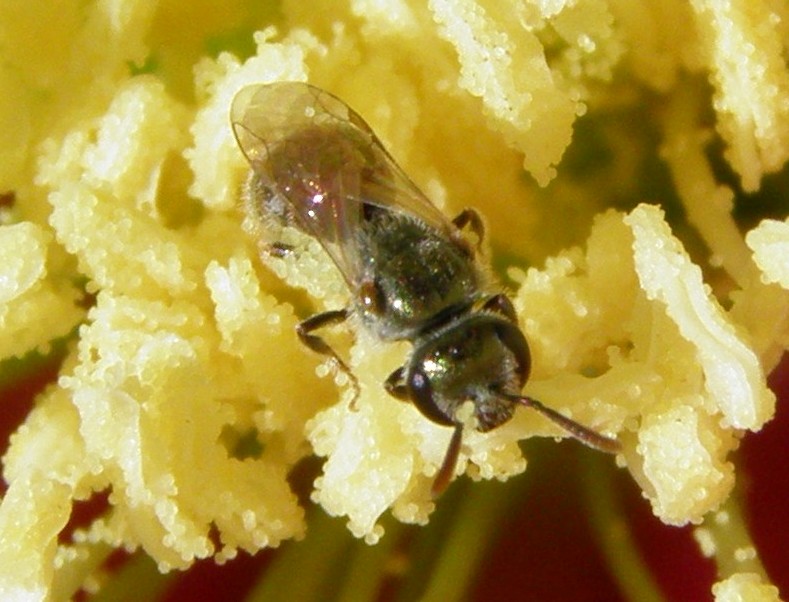
Lasioglossum sp.
 Bees of all sizes are visiting. This small, partly metallic one will hopefully be identified by Monday. 
P. s Thanks to John Asher on Bug Guide: he identified the genus as Lasioglossum.

Cactus Bees,  Diadasia sp.
Cactus Bees, genus Diadasia hectically buzz from flower to flower and dive deeply between the stamina. Males refuel with nectar, females collect pollen for the brood in addition. Often, before they fly off again, they seem to hesitate and wait motionless. That's the moment when males will suddenly pounce on the females.


So this is how the Diadasia couples meet. They share their dating grounds with many other hopefulls. Just check out the depth of the flower behind them, the red and black wing pattern belongs to one of the beetles below

Clerid beetles Trichodes ornatus
Clerid beetles Trichodes ornatus come, like the cactus flowers, in red and yellow. But they don't have to match their back ground - the red ones look deceptively like a blister beetle that flies at the same time, the yellow ones imitate wasps.


The two color morphs occur equally among the larger females and the small males, and there seems to be no mating preference related to color. Still, three is a crowd.


Bruchid Mimosestes amicus
Bean Weevils can be found in cactus flowers but they may just be resting while searching for leguminose flowers where they lay their eggs.

Listrus, a dasytin Melyrid
Dasytinae forage wherever there is a lot of pollen. With their dense hairy coats they make good pollinators.


Where so many insects come together predators will also hang around. Here is one predator stalking another. But the little jumping spider did not attack the tiny Attalus, his aposematic colors  may have warned her off.

Staghorn Cholla Trichopuntia versicolor

Prickly Pear Cacti (Opuntiae) and their close relatives, the Chollas (Cylindropuntia or in older literature still also Opuntia) dominate our Sonoran desert with an abundance of species. Every day seems to bring new color schemes. But the flowers are all very similar in their simple architecture and they are visited and pollinated by the same army of insects.